

Why Upgrading Speakers for a Harley-Davidson Makes a Real Difference
Choosing the right speakers for a Harley-Davidson is one of the most impactful upgrades you can make to your ride. Factory audio systems are built to a budget — and at highway speeds, with wind and engine noise competing for your attention, they simply can't keep up.
Quick answer — the best speakers for a Harley-Davidson depend on:
- Your model and year (Street Glide, Road Glide, Ultra Classic, etc.)
- Mounting location (fairing, saddlebag lids, Tour-Pak)
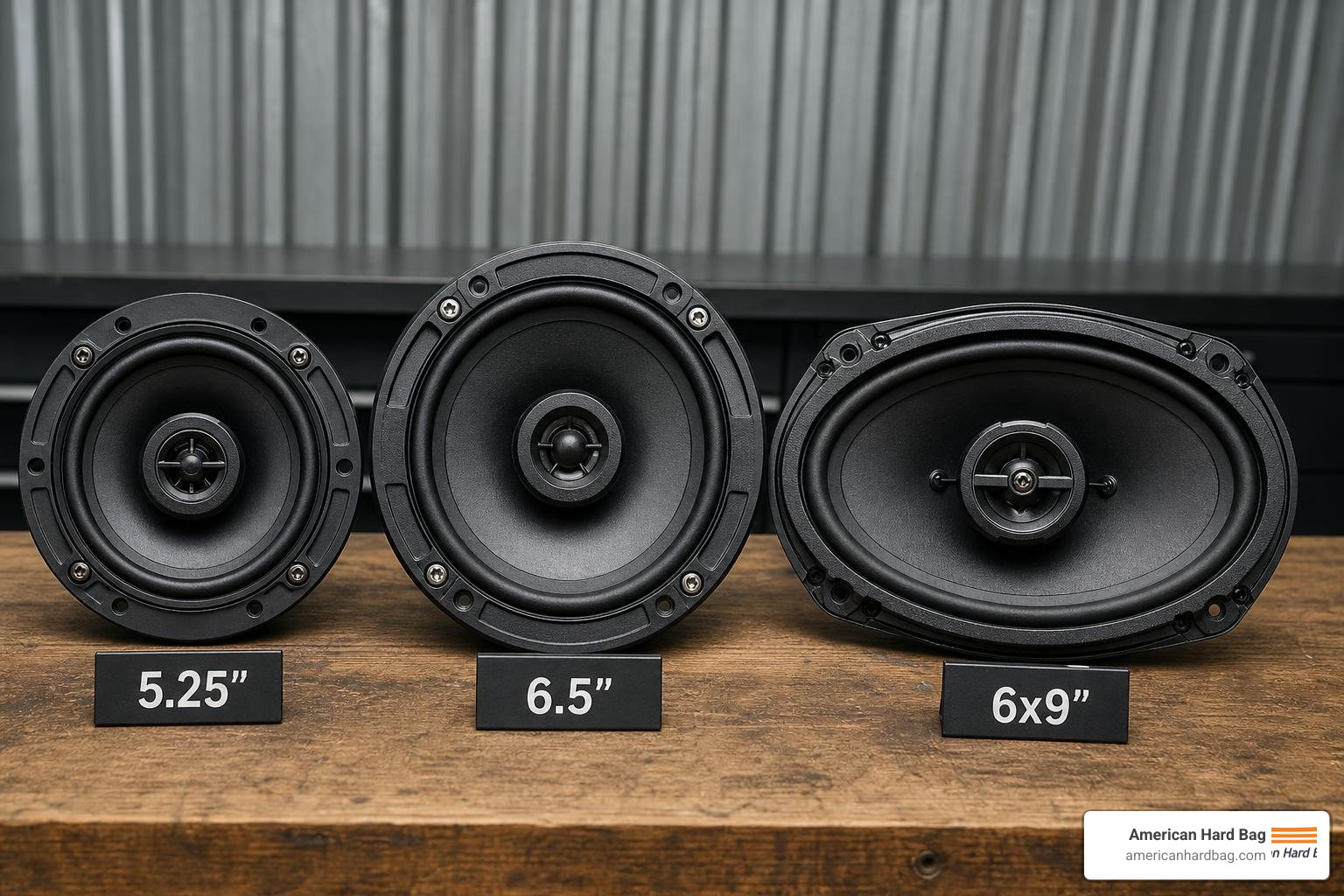
- Speaker size (5.25", 6.5", or 6x9" are most common)
- Impedance (2-ohm for maximum volume; 4-ohm for balanced, efficient sound)
- Budget (entry-level kits start around $900; premium 4-speaker systems can reach $4,000+)
- Installation preference (plug-and-play kits vs. custom wiring)
Most Harley riders find that factory speakers distort at higher volumes, struggle to cut through wind noise above 60 mph, and lack the bass response that makes music enjoyable on the open road. The good news: the aftermarket has caught up in a big way, with marine-grade, weather-resistant options built specifically for motorcycle use.
At American Hard Bag, we're a US-based manufacturer of premium motorcycle accessories with deep expertise in Harley-Davidson audio setups — including how speakers for a Harley-Davidson interact with your bags, fairings, and overall build. In the sections below, we'll walk you through everything you need to make a confident, compatible upgrade.
Key Factors When Choosing Speakers for a Harley-Davidson
When looking for the best speakers for a Harley-Davidson, you cannot simply buy standard car speakers and expect them to survive or sound good. Motorcycles present a brutal environment for audio equipment. To get a setup that lasts and performs, you need to understand the unique demands of the open road.
First and foremost is road and wind noise. When you are cruising down the interstate at 70 mph, the ambient noise level can easily exceed 90 to 100 decibels. Standard speakers will distort long before they reach the volume necessary to overcome this barrier.
Second is weather resistance. Your bike will inevitably face rain, intense UV rays, dust, and temperature extremes. High-quality motorcycle speakers utilize specialized materials like polypropylene cones, titanium or ceramic tweeters, and waterproof surrounds to ensure they do not degrade over time.
Finally, you must consider how your motorcycle's electrical and physical layout differs from a car. To dive deeper into how motorcycle audio systems operate as a cohesive unit, check out our guide on Understanding Harley Davidson Audio from Factory Systems to Custom Setups.
Selecting the Right Speakers for a Harley-Davidson by Model and Year
Harley-Davidson has evolved its motorcycle designs significantly over the decades. What fits a 2005 Electra Glide will not fit a 2024 Road Glide.
- 1998–2013 Models: These older Touring models typically came with smaller 5.25-inch speakers in the fairing. Upgrading these often requires adapter rings to step up to a more robust 6.5-inch speaker, which provides a massive jump in sound quality and volume.
- 2014–2023 Models (Project Rushmore): These models feature redesigned Batwing (Street Glide) and Sharknose (Road Glide) fairings. They natively accommodate 6.5-inch speakers, but mounting depth remains a critical restriction. You must ensure the magnet of your aftermarket speaker does not interfere with the inner fairing brackets or the glove boxes on Road Glides.
- 2024+ Models: The latest generation of Harley-Davidson Touring models features completely redesigned fairings and electrical architectures. Upgrading these requires next-generation "Element Ready" or model-specific plug-and-play kits engineered for the updated physical space and factory digital systems.
Before making any purchases, we highly recommend consulting our comprehensive Harley-Davidson Speaker Fitment Guide by Model and Year to ensure a perfect physical and electrical match.
Speaker Sizes and Mounting Locations
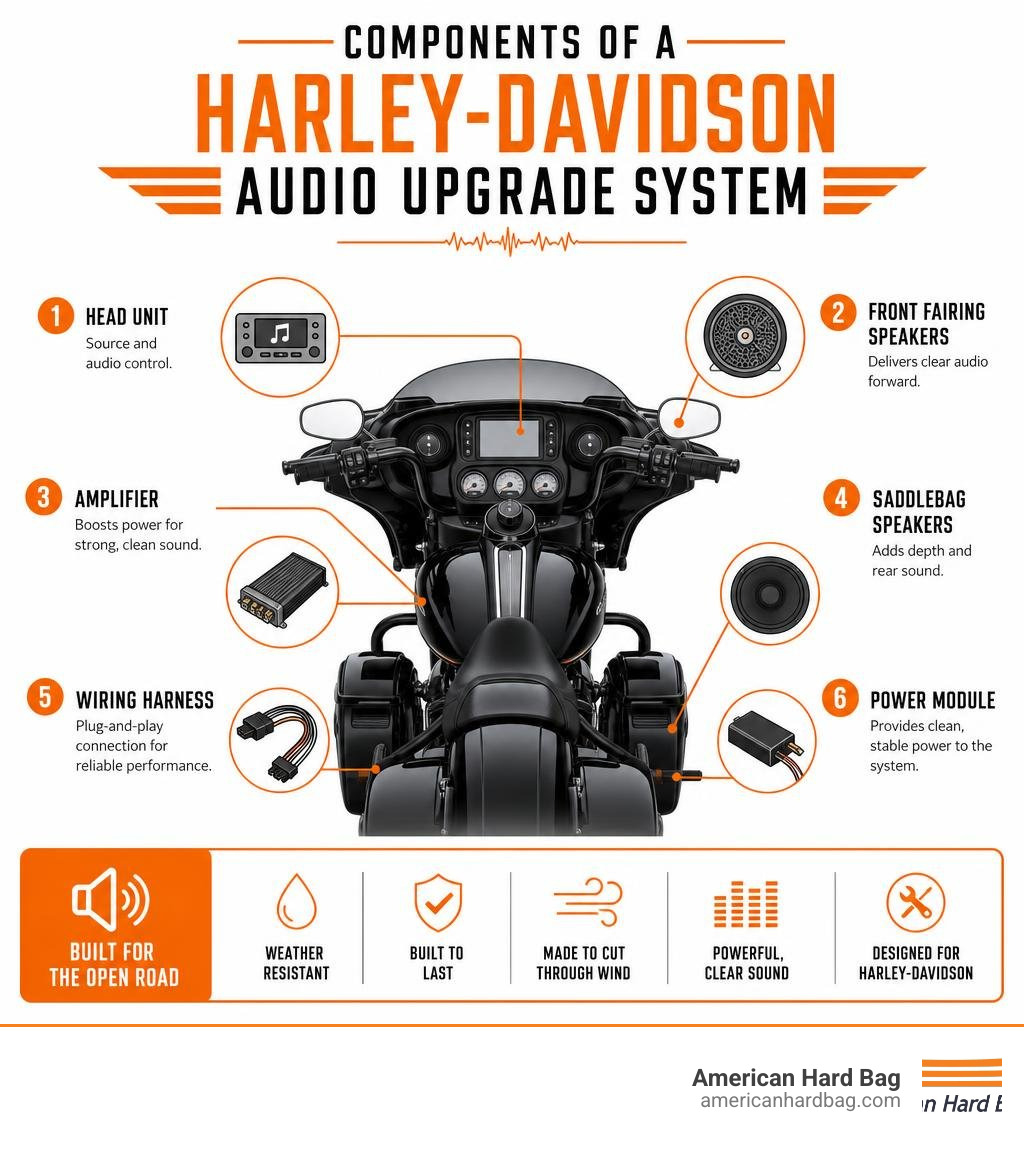
To build a truly immersive soundstage on your bike, you can leverage several key speaker mounting locations:
- Front Fairings (5.25-inch to 6.5-inch): This is the most critical location because the sound is projected directly at you. Upgrading from the factory size to a premium 6.5-inch speaker is the single best first step you can take.
- Saddlebag Lids (6x9-inch): Pointing upward and slightly forward, 6x9-inch speakers in your saddlebag lids provide the necessary mid-bass and volume to fill out the soundstage at speed.
- Lower Fairings (6.5-inch): If your bike has lowers (vented fairings), adding 6.5-inch speakers here brings the sound closer to your legs and midsection, creating a much fuller wall of sound.
- Tour-Pak (5.25-inch to 6.5-inch): For those who tour with a passenger, upgrading the rear Tour-Pak speakers ensures your copilot enjoys crystal-clear audio without you having to blast the front fairing speakers to comfortable limits.
To help prioritize your upgrade path, explore The Top 3 Audio Upgrades Every Harley Owner Should Consider.
Technical Specifications: Impedance, Power, and Speaker Technology
To get the most out of your upgrade, you need to understand the relationship between your speakers and your amplifier. Let's look at a quick comparison of how impedance ratings affect real-world performance:
| Feature | 2-Ohm Speakers | 4-Ohm Speakers |
|---|---|---|
| Electrical Resistance | Lower (allows more current flow) | Higher (more controlled current flow) |
| Volume Potential | Extremely Loud (ideal for high-speed wind) | Moderate to Loud (more balanced) |
| Power Efficiency | Draws more power from the amplifier | More efficient, runs cooler |
| Sound Clarity | Good, but prone to distortion at absolute max | Exceptional, highly detailed mids and highs |
| System Compatibility | Great for factory head units & high-output amps | Highly compatible with standard aftermarket amps |
In the motorcycle audio industry, power handling is measured in RMS (continuous power) rather than peak power. High-quality 6.5-inch and 5.25-inch motorcycle speakers handle anywhere from 75W to 300W RMS, while larger 6x9-inch saddlebag speakers can handle up to 400W RMS. To achieve these high numbers without adding massive weight to your bike, premium manufacturers use lightweight, ultra-strong neodymium magnets instead of heavy, bulky ferrite magnets.
Understanding 2-Ohm vs. 4-Ohm Speakers for a Harley-Davidson
Impedance (measured in ohms) represents the electrical resistance a speaker presents to an amplifier.
2-Ohm speakers allow more current to flow from the amplifier. This means they can produce incredible volume levels at lower amplifier settings, making them highly effective at overcoming wind and engine noise. In fact, many factory Harley-Davidson head units are designed to run on 2-ohm stable architectures.
4-Ohm speakers offer higher resistance, which typically results in a cleaner, more balanced audio signal with tighter control over the speaker cone. They are highly efficient and are the industry standard for custom, multi-amplifier aftermarket builds.
Matching your speaker impedance to your amplifier's output is critical. Mismatching can overheat your amplifier or damage your speakers. For a detailed breakdown of how to maximize your system's output safely, read our guide on how to Increase Power Handling of Your Harley Fairing Speakers.
Speaker Technologies: Coaxial vs. Horn-Loaded Designs
The technology inside the speaker determines how well it projects sound over your handlebars and into your helmet at 75 mph.
- Coaxial Speakers: These are standard two-way or three-way speakers where the tweeter is mounted on a bridge directly over the center of the woofer cone. They offer a highly balanced, warm sound across all music genres. Learn why our custom-engineered options stand out in our article on 5 Reasons Why American Hard Bag Speakers Outperform the Competition.
- Horn-Loaded Speakers: Instead of a standard dome tweeter, these speakers use a compression driver coupled with a physical horn flare (waveguide). This design acts like a megaphone, projecting high frequencies with extreme efficiency over long distances. If your primary goal is maximum volume and clarity at highway speeds, horn-loaded designs are unmatched.
Amplifiers, Weatherproofing, and Installation Options
Even the best aftermarket speakers for a Harley-Davidson will sound underwhelming if they are underpowered. Factory radio head units rarely output more than 20 to 30 watts per channel, which is why adding a dedicated, compact amplifier is essential.

When selecting an amplifier, look for powersports-specific models featuring conformal-coated circuit boards to protect against moisture, and cast-aluminum chassis for heat dissipation. For example, high-end motorcycle amplifiers can deliver 300 watts of clean power while fitting neatly inside your fairing on factory bolt locations.
To make sure you choose the right power source for your speakers, check out our guide on How to Choose the Right Amplifier for Your Harley's Sound System.
Plug-and-Play Kits vs. Custom Wiring
When it comes to installing your new audio system, you have two primary routes:
- Plug-and-Play Kits: These kits are designed specifically for your Harley's year and model. They include pre-terminated wiring harnesses that plug directly into your factory radio and speaker pods without any cutting or splicing. They also include custom-molded mounting brackets and speaker grilles.
- Custom Wiring: If you are building a highly customized, competition-grade system, you may need to run custom wiring. This requires a deeper understanding of electrical systems, soldering, and customized mounting fabrication.
To weigh your options and decide which route is best for your skill level, read our breakdown of DIY vs Professional Installation: What You Need to Know About Upgrading Your Harley's Audio.
Frequently Asked Questions about Harley-Davidson Audio
Are aftermarket motorcycle speakers waterproof?
High-quality aftermarket motorcycle speakers are designed to be highly water-resistant or waterproof, often carrying an IP66 rating. This means they can handle heavy rain, road spray, and washdowns. They achieve this durability by using impermeable materials like polypropylene or carbon-fiber cones, rubber surrounds, and sealed magnet assemblies. However, they should never be submerged or sprayed directly with a high-pressure power washer.
Do I need to flash my Harley's factory radio when upgrading speakers?
Yes, if you have a 2014 or newer Harley-Davidson with the Boom! Box infotainment system, you must flash the radio. From the factory, Harley programs a highly aggressive equalization (EQ) curve into the radio to make their cheap factory speakers sound passable at low speeds. When you hook up high-quality aftermarket speakers and an amplifier to an unflashed radio, this factory EQ curve will send distorted, clipped signals to your new equipment, which can ruin your sound quality or even destroy your new speakers. Flashing the radio flattens this EQ curve, providing a clean, balanced signal.
How much does a high-quality Harley speaker upgrade cost?
The cost of upgrading your Harley's audio system varies widely depending on your goals:
- Budget Upgrades ($300 - $600): Simple front fairing speaker replacements running off factory power.
- Mid-Tier Systems ($900 - $1,800): A high-quality 2-speaker or 4-speaker plug-and-play kit including a compact amplifier, mounting brackets, and custom wiring harnesses.
- Premium Systems ($2,500 - $4,000+): Complete multi-speaker setups (fairings, lowers, and saddlebag lids) powered by multiple high-output amplifiers, complete with digital sound processors (DSPs) for flawless tuning.
For a complete breakdown of what to expect financially, read our detailed article on The Real Cost of Upgrading Your Harley-Davidson Audio System.
Conclusion
Upgrading the speakers for a Harley-Davidson is more than just a cosmetic or volume upgrade — it fundamentally changes your riding experience. Being able to hear your favorite soundtrack with absolute clarity over the roar of your exhaust and the rush of the wind makes every mile on the open road that much more memorable.
Historically, Harley-Davidson has fostered an incredible culture of personalization and premium quality. From executive turnarounds in the mid-1980s led by pioneers like Ken Schmidt and Tim Hoelter, to the massive expansion of licensed accessories under Clyde Fessler, customizing your ride has always been a core part of the Harley lifestyle. Today, that legacy of customization continues to thrive across the globe, as seen in Harley-Davidson's ongoing innovations presented at major events like the Baird 2026 Global Consumer, Technology & Services Conference, and their creative organizational strategies highlighted at the Organization Design Forum.
At American Hard Bag, we are committed to helping you find the perfect audio balance for your motorcycle. We design and deliver premium, American-engineered, plug-and-play audio upgrades that provide high-power sound tailored specifically to Harley riders, ensuring you get the best performance on every ride.
Ready to design the ultimate sound system for your bike? Head over to The Ultimate Guide to Upgrading Your Harley Davidson's Audio System to start planning your perfect build today!