

Why a 12V 24Ah Lithium Battery Is a Smart Compact Power Upgrade
A 12V 24Ah lithium battery is a compact deep-cycle power source that stores about 307.2Wh of energy. For motorcycle audio, lights, and other 12V accessories, a LiFePO4 model can deliver steady voltage while weighing roughly 5.5 to 6.6 pounds - far less than a comparable lead-acid battery.
Before buying, check three things:
- Voltage: Choose a 12.8V LiFePO4 battery for a 12V accessory system.
- Discharge rating: Make sure its continuous and peak amp ratings can handle your amplifier's demand.
- Fit and charging: Confirm the case dimensions, terminal style, and use a LiFePO4-compatible charger.
Compared with AGM lead-acid batteries, LiFePO4 packs can cut weight by 60-70%, support much deeper discharge, and may last 3,000 to 5,000 cycles when used correctly. A built-in battery management system (BMS) is essential because it helps protect against overcharging, short circuits, excessive current, and damaging temperatures.
American Hard Bag builds durable motorcycle hard bags and accessories for riders who need dependable gear on the road. Our experience with motorcycle storage and audio-focused setups helps us explain how a 12V 24Ah lithium battery can fit into a practical, lighter accessory-power upgrade.

Core Specifications of a 12V 24Ah Lithium Battery
When we examine the technical footprint of a modern 12V 24Ah lithium iron phosphate (LiFePO4) battery, the nominal voltage sits right at 12.8V. By multiplying this nominal voltage by the 24 amp-hour capacity rating, you get a rated total energy storage capacity of exactly 307.2 watt-hours (Wh).
Unlike legacy technologies, these cells deliver a flat discharge curve, maintaining steady operating voltage right up until depletion. Continuous discharge rates typically support 20A to 25A continuous draws, with peak burst current capabilities reaching 40A to 50A for several seconds—vital when high-demand electronics like audio amplifiers hit sudden transient dynamic peaks. Standard terminals, usually M5 or M6 internal threaded brass bolts, ensure low electrical resistance and solid mechanical contact under heavy vibration.
Energy Capacity, Dimensions, and Weight Profile
A typical 12V 24Ah LiFePO4 battery weighs roughly 6.61 lbs (3.0 kg), though some ultralight ABS-housed variants register as low as 5.5 lbs (2.5 kg).
Dimensions across major manufacturers are standardized for compact battery boxes, typically measuring:
- Length: 7.12 inches (181 mm)
- Width: 3.00 inches (76 mm)
- Height: 6.69 inches (170 mm)
This form factor packs 307.2Wh into a shell smaller than many traditional powersports batteries, maximizing usable space inside tight enclosures, saddlebags, and utility compartments.
Smart BMS Protection and Safety Certifications
Every dependable LiFePO4 pack relies on an integrated Battery Management System (BMS). The BMS acts as an electronic guardian, monitoring internal cell balance, short-circuit hazards, excessive current draw, over-voltage during charging, and under-voltage during deep discharge.
Top-tier units incorporate safety standards such as UL1642 cell testing, IEC62619 industrial certification, UN38.3 transport compliance, and an IP65 or IP67 ingress rating to block dust and water. Modern units also feature integrated Bluetooth, allowing users to track real-time voltage, remaining amp-hours, internal cell temperatures, and health metrics directly on a smartphone.
12V 24Ah LiFePO4 vs. Traditional Lead-Acid Batteries
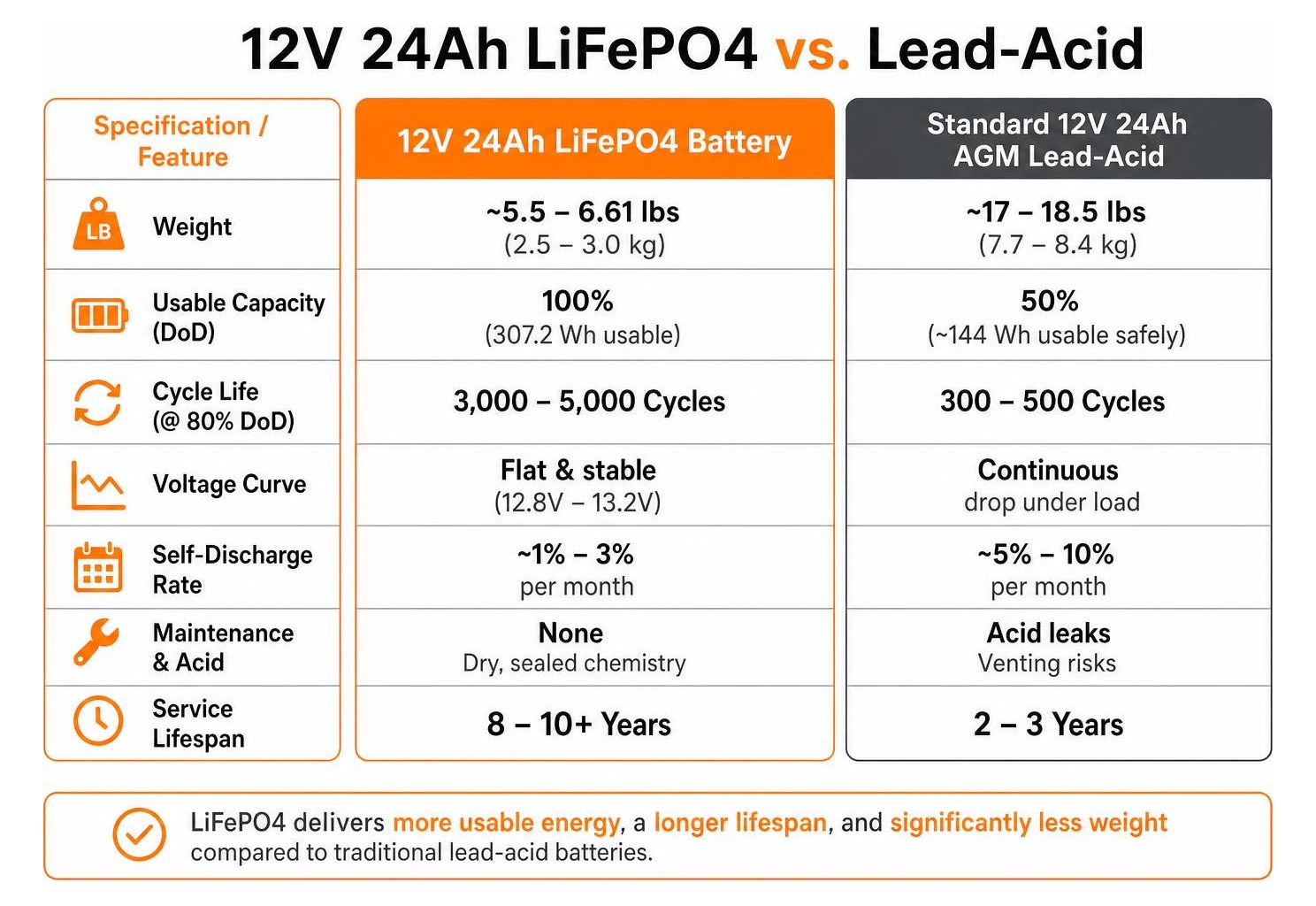
Comparing lithium iron phosphate against traditional sealed lead-acid or AGM battery options highlights huge differences in energy density, usable capacity, and overall longevity:
| Specification / Feature | 12V 24Ah LiFePO4 Battery | Standard 12V 24Ah AGM Lead-Acid |
|---|---|---|
| Weight | ~5.5 – 6.61 lbs (2.5 – 3.0 kg) | ~17 – 18.5 lbs (7.7 – 8.4 kg) |
| Usable Capacity (DoD) | 100% (307.2 Wh usable) | 50% (~144 Wh usable safely) |
| Cycle Life (@ 80% DoD) | 3,000 – 5,000 Cycles | 300 – 500 Cycles |
| Voltage Curve | Flat & stable (12.8V – 13.2V) | Continuous drop under load |
| Self-Discharge Rate | ~1% – 3% per month | ~5% – 10% per month |
| Maintenance & Acid | None / Dry, sealed chemistry | Acid leaks / Venting risks |
| Service Lifespan | 8 – 10+ Years | 2 – 3 Years |
Weight Reduction and Usable Energy Density
LiFePO4 architecture provides a 60% to 70% weight reduction over lead-acid equivalents. Dropping more than 11 pounds while doubling usable run-time changes everything for mobile setups. Furthermore, lead-acid options suffer severe voltage sag when current demands climb; LiFePO4 delivers consistent, clean voltage across its entire cycle without caustic acids or hazardous venting.
Cycle Life and 100% Depth of Discharge
While conventional batteries degrade quickly if drained past 50% Depth of Discharge (DoD), a quality LiFePO4 battery safely supports up to 100% DoD. With an average life rating of 3,000 to 5,000 cycles, these cells outlast traditional AGM units up to ten times over. Paired with a minimal self-discharge rate of approximately 3% per month, they can sit through winter storage and wake up ready to perform.
Top Real-World Applications for 12V 24Ah Power Packs
The 12V 24Ah form factor strikes the ultimate sweet spot between compact portability and robust energy capacity across varied mobile and stationary environments.
Why a 12V 24Ah Lithium Battery Excels in Outdoor Audio
For mobile sound machines and high-output touring setups, power delivery must remain clean and immediate. High-wattage digital amplifiers demand high burst currents to produce sharp, distortion-free audio. The ultra-low internal resistance of battery lithium designs prevents voltage drops during heavy bass hits. Their rugged solid-state build also resists vibration and mechanical shock along rough highways.
Marine Kayak Electronics, Fish Finders, and Trolling Gear
In small-craft marine setups, every pound counts. Anglers use 12V 24Ah packs to run high-resolution sonar, GPS chartplotters, and small kayak motors throughout 12-hour fishing days. Built inside water-resistant IP67 cases, these sealed batteries handle splashing, damp environments, and salt spray without corrosion or leakage.
Off-Grid Solar Storage, UPS Systems, and Field Equipment
Beyond marine and audio, these packs are workhorses for:
- Small solar installations and remote security camera rigs
- Medical utility carts and mobile workstations
- Uninterruptible Power Supply (UPS) backup systems
- Electric golf caddies and portable lawn maintenance tools
Charging Protocols, Temperature Limits, and Maintenance
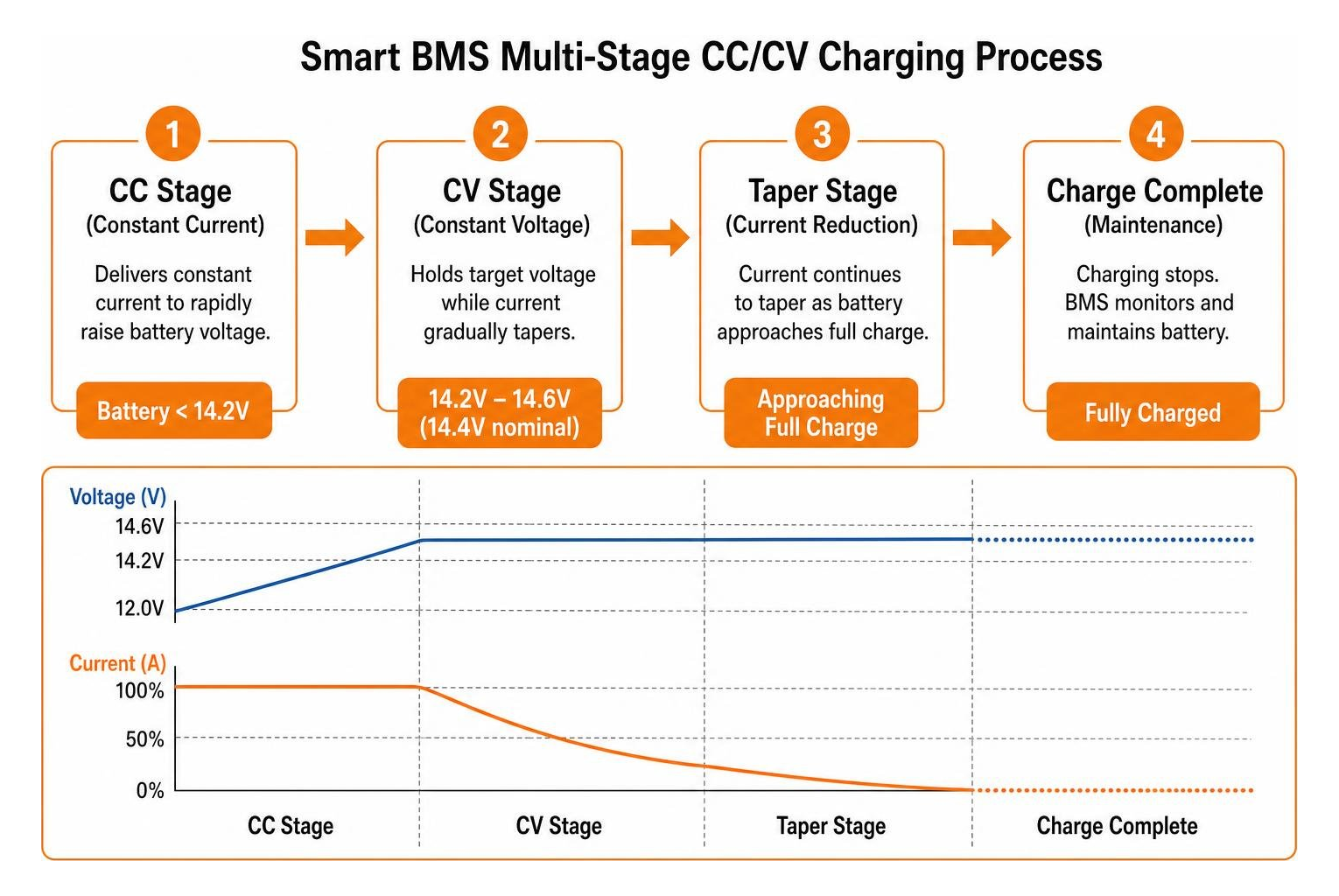
Charging lithium safely requires adhering to modern multi-stage Constant Current / Constant Voltage (CC/CV) profiles. Selecting a dedicated battery charger designed for lithium chemistries prevents undercharging and cell imbalance.
Optimal Voltage and Current Profiles for Safe Charging
To get the most life out of your battery, follow these parameters:
- Target Charge Voltage: 14.2V to 14.6V (14.4V nominal)
- Float Voltage: 13.6V to 13.8V
- Recommended Current: 2A to 10A (0.1C to 0.5C rate for extended lifespan)
- Maximum Charge Current: Up to 20A for fast top-offs
Using a tailored lithium battery charger ensures precise cell termination without triggering BMS over-voltage cutouts.
Operating a 12V 24Ah Lithium Battery in Extreme Temperatures
LiFePO4 chemistry functions across wide operating windows, but requires attention during charging:
- Discharge Range: -4°F to 140°F (-20°C to 60°C)
- Charge Range: 32°F to 113°F (0°C to 45°C)
- Storage Range: 14°F to 113°F (-10°C to 45°C)
Critical Safety Rule: Never force-charge a standard lithium battery below 32°F (0°C). Attempting to charge frozen cells causes permanent lithium metal plating and short-circuits. Ensure your battery includes low-temperature charge cutoff protection or integrated self-heating elements if operating in freezing climates.
Wiring Configurations, Pricing, and Buying Considerations
Whether setting up a single pack or building a larger bank from our curated batteries & chargers inventory, understanding system limitations is critical for safety.
Series and Parallel Connection Guidelines
When scaling power, you have two configuration options:
- Parallel Connections (Capacity Scaling): Connecting batteries in parallel (positive-to-positive, negative-to-negative) keeps the voltage at 12.8V while doubling the capacity to 48Ah. Most manufacturers permit up to 4 identical units in parallel.
- Series Connections (Voltage Scaling): Connecting positive-to-negative increases system voltage (e.g., two units for 24V or four for 48V). Always verify your battery’s BMS supports series wiring, and fully balance-charge each unit individually before linking them together.
Cost Factors, Lifespan ROI, and Warranty Coverage
A premium 12V 24Ah LiFePO4 battery typically ranges from $199 to $220. While this carries a higher initial investment than a $70 AGM battery, the total cost of ownership is far lower. With over 3,000 cycles and an 8-to-10-year service life, one lithium pack replaces four to five lead-acid replacements, easily delivering a positive return on investment. Look for brands offering minimum 3-to-5-year full replacement warranties and responsive domestic customer support.
Frequently Asked Questions About 12V 24Ah Lithium Power
Can I charge a 12V 24Ah LiFePO4 battery with a standard lead-acid charger?
We do not recommend it. Standard lead-acid chargers use de-sulfation pulsing stages and incorrect float voltages that can trigger BMS safety shutoffs or fail to fully saturate lithium cells to 100%. Always choose a dedicated lithium CC/CV charger.
How long will a 12V 24Ah lithium battery run a 50W device?
At 307.2Wh capacity and assuming a 90% inverter/circuit efficiency rate, a 50W device will run continuously for roughly 5.5 hours ($$307.2 \times 0.90 / 50 \approx 5.53\text{ hours}$$).
Can I connect 12V 24Ah lithium batteries in series to make 24V or 48V?
Yes, provided the manufacturer specifies that the internal BMS is rated for the combined voltage of series strings. Never connect different battery brands, ages, or capacities in series.
Conclusion
The 12V 24Ah lithium battery stands as one of the most practical, energy-dense power upgrades available today. Delivering 307.2Wh of stable power at a fraction of the weight of lead-acid alternatives, it provides unmatched runtime, long cycle durability, and total maintenance freedom.
If you are upgrading your touring setup with high-demand audio gear or dependable electronics, pair your installation with a proven, ultra-durable Lithium Battery by XS Power PWR-S5-30Q to get the clean, continuous performance you deserve on every mile.