

Why Getting Harley Speaker Wiring Right Makes or Breaks Your Audio Upgrade
Harley speaker wiring is the foundation of any successful motorcycle audio upgrade — and getting it wrong can mean blown speakers, dead channels, or worse, electrical damage to your bike.
Quick Answer: How Harley Speaker Wiring Works
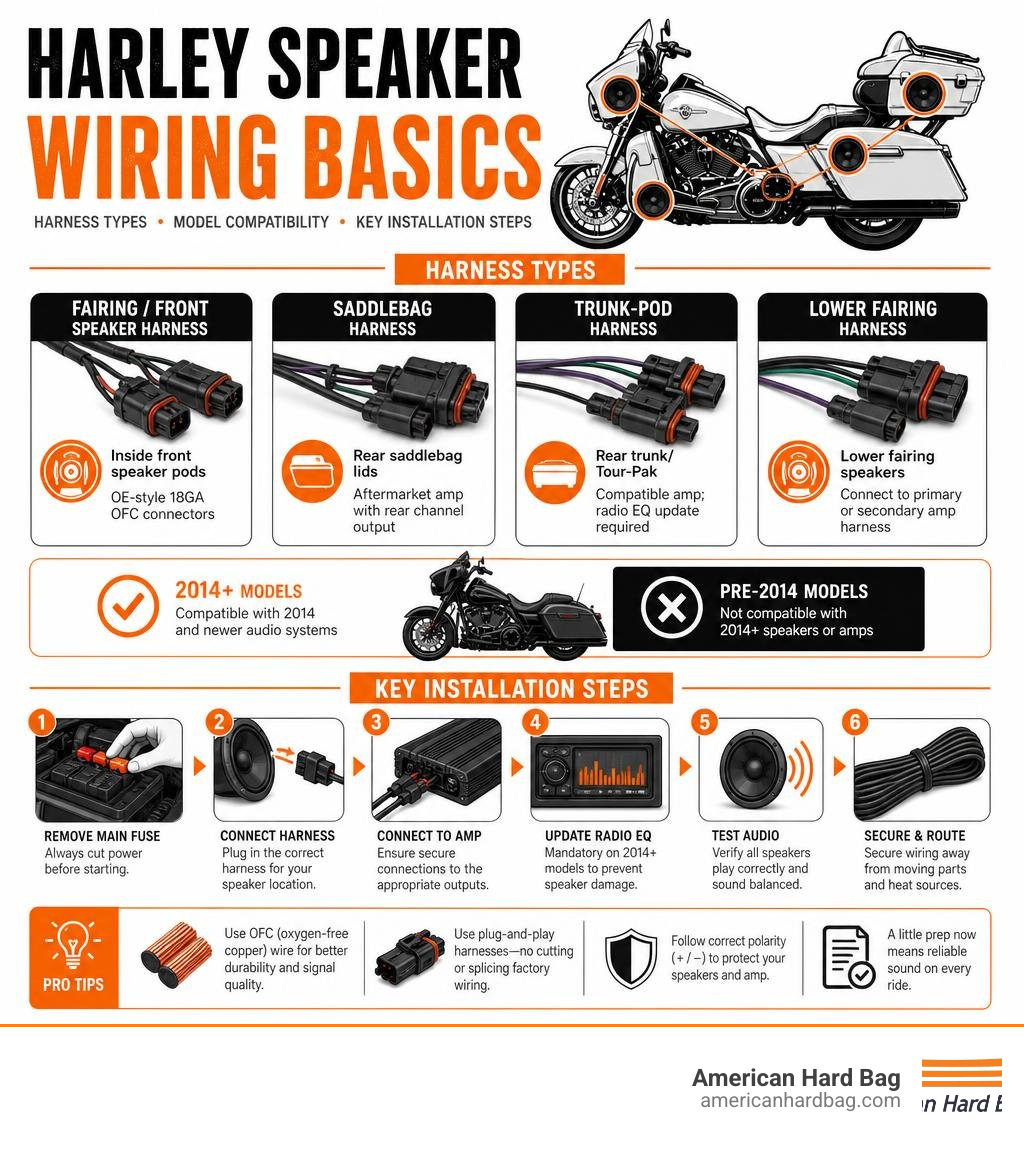
| Wiring Type | Location | Key Requirement |
|---|---|---|
| Fairing / front speaker harness | Inside front speaker pods | OE-style 18GA OFC connectors |
| Saddlebag harness | Rear saddlebag lids | Aftermarket amp with rear channel output |
| Trunk-pod harness | Rear trunk/Tour-Pak | Compatible amp; radio EQ update required |
| Lower fairing harness | Lower fairing speakers | Connect to primary or secondary amp harness |
The most important things to know before you start:
- Always remove the main fuse before touching any wiring
- 2014+ Harley audio systems are not compatible with pre-2014 speakers or amps
- A radio EQ update is mandatory after installing new speakers on 2014+ models — skipping this step will immediately damage your speakers
- Plug-and-play harnesses let you avoid cutting or splicing factory wiring
- Wire material matters: OFC (oxygen-free copper) outperforms CCA (copper-clad aluminum) for durability and signal quality
Getting all of this right takes more than just plugging things in. The harness type, model year, amplifier compatibility, and even speaker orientation all affect whether your system sounds great — or fails on the first ride.
At American Hard Bag, we're a US-based manufacturer specializing in premium hard bags and motorcycle accessories, including plug-and-play harley speaker wiring harnesses built for real-world performance. Our products are designed to take the guesswork out of audio upgrades, so you can spend less time troubleshooting and more time riding.
Essential Guide to Harley Speaker Wiring
When you decide to upgrade your Harley-Davidson’s audio system, the sheer variety of wiring paths can feel overwhelming. Depending on where you want to add sound, you will encounter several distinct harness configurations:
- Trunk-Pod Harness: Designed specifically to run power and audio signals to the rear Tour-Pak speaker pods. High-quality trunk-pod harnesses typically retail for around $119.99 and integrate directly with your factory-style routing.
- Saddlebag Harness: Essential for adding speakers to your saddlebag lids. These run from the front fairing amplifier, through the bike's backbone, and into the bags.
- Fairing Lower Speakers: These harnesses allow you to add speakers to your lower fairings (twin-cooled or non-twin-cooled models), routing sound down from the main fairing.
Choosing the right harness structure depends entirely on whether you want a seamless, reliable installation or a complex DIY headache.
Plug-and-Play vs. Custom Kits
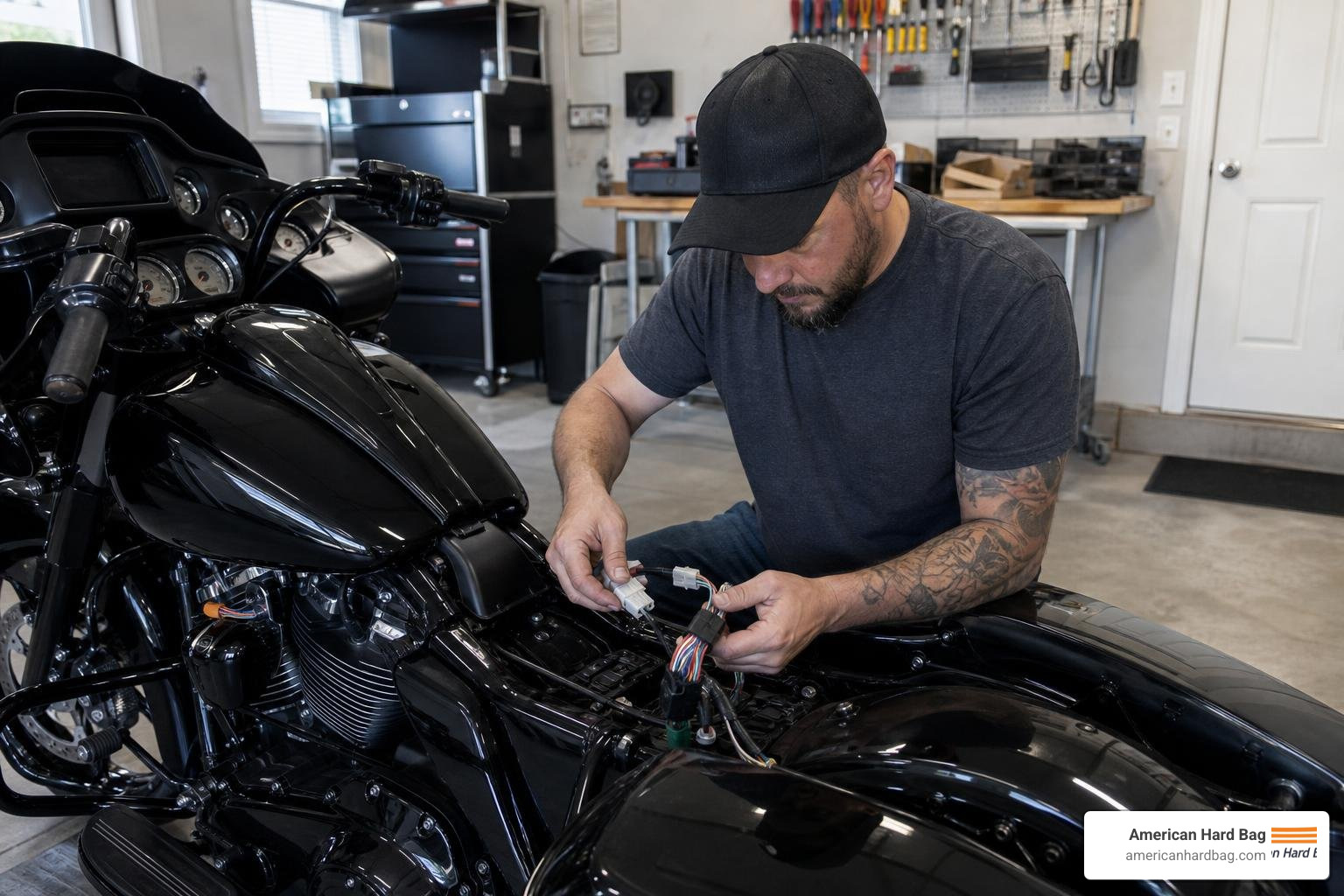
The debate between plug-and-play harnesses and universal custom kits comes down to reliability, ease of installation, and protecting your motorcycle's factory warranty.
Universal kits often require you to cut, strip, and solder wires directly into your bike’s factory electrical system. This not only introduces multiple potential failure points but can also void your electrical warranty. On the other hand, premium plug-and-play harnesses use OEM-style connectors that snap directly into your factory plugs, ensuring a clean, moisture-resistant connection without modifying the bike's original wiring.
| Feature | Plug-and-Play Harnesses | Universal / Custom Wire Kits |
|---|---|---|
| Installation Time | Fast (usually under 1 hour) | Slow (requires routing, cutting, soldering) |
| Warranty Safe | Yes (no modification to factory wires) | No (requires splicing into factory harness) |
| Water Resistance | High (molded, weather-tight plugs) | Variable (dependent on electrical tape/heat shrink) |
| Serviceability | Easy (quick-disconnects for bag removal) | Difficult (requires cutting or untaping wires) |
| Average Cost | $119.99 (Deluxe Backbone) | $20.00 – $60.00 |
Fairing and Lower Speaker Harnesses
The front stage is where your audio journey begins. When upgrading the front fairing speakers on 2014 through 2023 models, you will mount your speakers inside the front speaker pods. To do this without cutting the factory wiring, you need a speaker jumper wire harness. These jumper harnesses (typically sold as a pair for around $22.00 to $24.00) utilize OE-style 18GA OFC (Oxygen-Free Copper) connectors wrapped in protective cloth tape for a factory-grade finish.
If you are expanding your front stage to include lower fairing speakers, you will need a dedicated lower speaker harness. This harness routes from your amplifier down through the wire trough along the main frame backbone toward the steering head.
When upgrading to high-performance setups, such as the boom! audio stage ii fairing speaker kit (flht/flhx) - Harley-Davidson , precise physical orientation is required. For example, during installation, the left speaker must be rotated so that the letter "B" is at the bottom, while the right speaker must be rotated so the letter "A" is at the bottom to ensure correct tweeter alignment and water drainage.
Rear Tour-Pak and Saddlebag Harley Speaker Wiring
Adding rear lid speakers or Tour-Pak pods completely changes the riding experience, enveloping you in sound at highway speeds. However, the rear section of a motorcycle is highly exposed to the elements and undergoes regular maintenance, meaning your harley speaker wiring must be both weather-resistant and serviceable.
This is where specialized harnesses shine. For instance, our Deluxe Rear Speaker Split Backbone Wire Harness (priced on sale at $119.99, down from $159.99) is designed to run from the front fairing all the way to the rear bags. It features a compact, blacked-out jacket with stainless steel chrome-plated wire inlets.
The most critical feature of a rear saddlebag harness is the integration of waterproof quick-disconnects. These allow you to remove your saddlebags for routine maintenance or cleaning without having to pull apart your entire audio system. Individual service disconnects per saddlebag lid also allow you to perform phase and signal voltage testing with ease.
For real-world wiring discussions and routing tips from fellow riders, you can check out the Road Glide Rear Speaker Wiring Discussion.
Technical Requirements and Compatibility by Model Year
Harley-Davidson audio architecture has evolved significantly over the years, meaning a wiring harness that fits a 2018 Road Glide will not work on a newer model.
- 2014–2023 Models: These models rely on the classic Rushmore-era wiring backbone. Upgrading these bikes is highly standardized, with a massive ecosystem of plug-and-play T-harnesses and amplifier mounting brackets available.
- 2024–2026 Models: The newest generation of Harley-Davidson Touring models features a completely redesigned electrical architecture. Adding rear saddlebag speakers to 2024 and newer models requires specialized harnesses (such as the 24-SWH-XL series, which runs around £38.00 GBP) that must be paired with an upper saddlebag speaker harness (USSH) to plug directly into the new OE backbone.
Regardless of the year, adding rear speakers requires an aftermarket amplifier or a factory-upgraded amplifier that actively powers the rear channels. Standard factory head units do not have the internal power to drive four high-performance speakers.
For motorcycle applications, we always recommend Class D amplifiers. Class D amplifiers are highly efficient, run much cooler, and draw significantly less current from your bike's charging system than traditional Class A/B amplifiers, making them perfect for the limited space and power constraints of a motorcycle fairing.
Wire Materials: OFC vs. CCA
When shopping for harley speaker wiring, you will run into two primary wire types: Oxygen-Free Copper (OFC) and Copper-Clad Aluminum (CCA).
- Oxygen-Free Copper (OFC): This is 100% pure copper. It offers the lowest possible electrical resistance, maximum signal transfer, and incredible durability. Most importantly for motorcycles, OFC is highly resistant to corrosion.
- Copper-Clad Aluminum (CCA): This wire consists of an aluminum core coated in a thin layer of copper. While cheaper (often found in budget kits priced around EUR 60.15), aluminum has higher resistance, meaning it can drop signal voltage over long runs. More importantly, CCA is highly susceptible to corrosion when exposed to moisture and salt on the open road, leading to brittle wires that can snap under the intense vibrations of a V-twin engine.
At American Hard Bag, we only use 100% OFC wire in our deluxe harnesses to ensure your audio system performs flawlessly for years to0 come.
Harley Speaker Wiring Color Codes and Connectors
To keep your installation clean and prevent phase cancellation (where speakers push and pull against each other, destroying your bass response), you must follow factory color codes.
Harley-Davidson standardizes speaker wire colors to help installers maintain consistency:
- Right Side Speakers: Light Blue (+) and Light Blue/Black (-)
- Left Side Speakers: Light Blue/Orange (+) and Light Blue/Gray (-)
Additionally, factory and premium aftermarket harnesses utilize twisted-pair wiring. Twisting the positive and negative wires together minimizes electromagnetic interference (EMI) from the motorcycle’s ignition system, spark plug wires, and engine sensors.
Always ensure your connections are secured using weatherproof, over-molded rubber grommets and sealed connectors to prevent water intrusion during rain rides or bike washes.
Step-by-Step Installation Guide
Before you begin routing any wires, gather the necessary tools: a T25 and T27 Torx driver, a socket set, wire fishing tools, zip ties, and a step drill bit (if adding saddlebag speakers).
- Disconnect the Power: Safety first. Always turn the ignition off and remove the main fuse (typically a 50A or 60A fuse located behind the left side cover) or disconnect the negative battery cable before touching any electrical components.
- Remove the Outer Fairing and Seat: This gives you complete access to the radio, front speaker enclosures, and the main wiring trough.
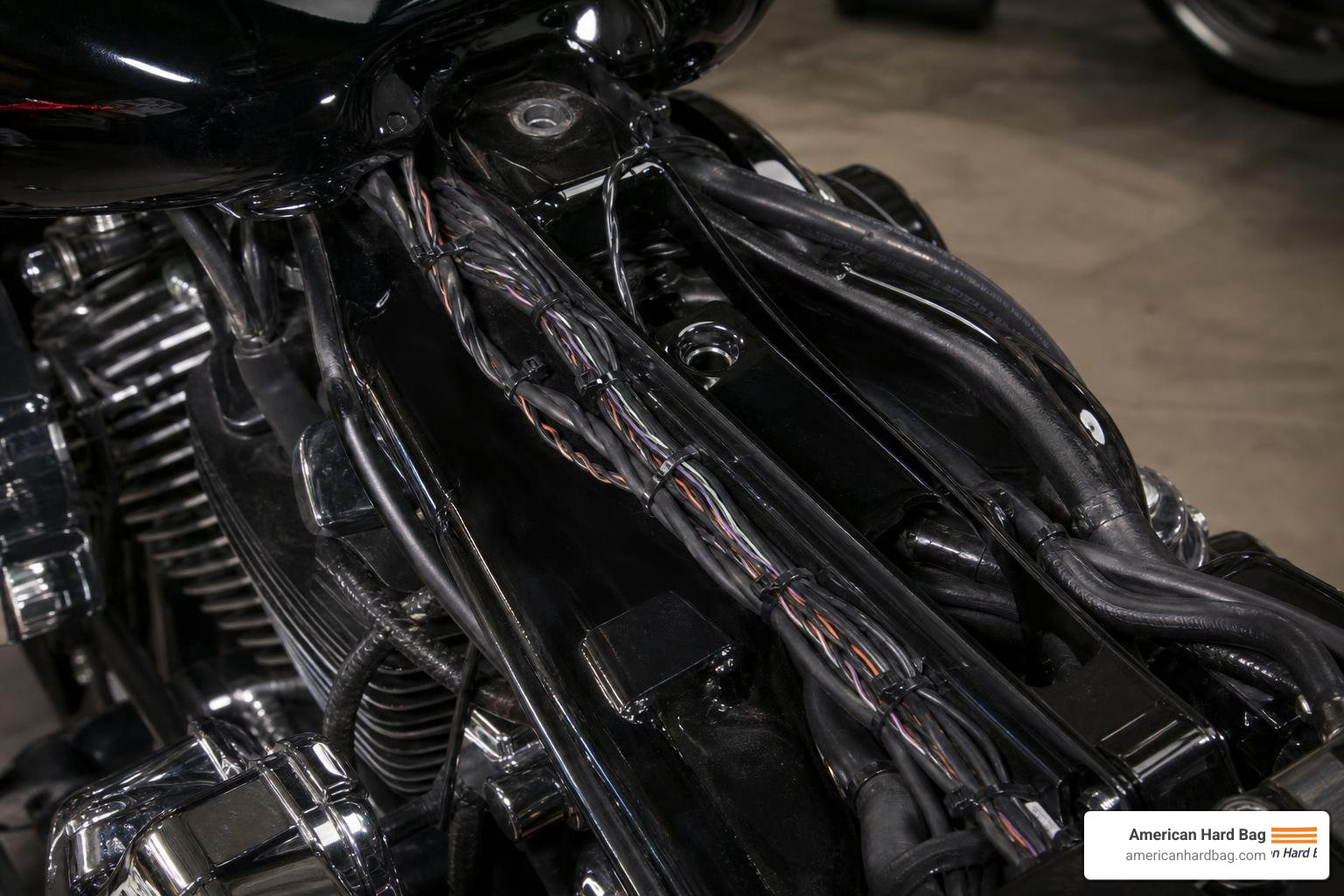
- Route the Harness Along the Backbone: When running wires from the front fairing to the rear of the bike, route the harness along the right side of the frame backbone inside the factory wire trough. Secure it tightly with cable straps, ensuring it is kept far away from hot engine components and moving steering assemblies.
-
Prepare the Saddlebags (If Installing Lid Speakers):
- Mark the drill location on the inner forward-facing wall of each saddlebag using a template.
- Using a step drill bit, drill a clean 1/2-inch hole (or 25mm hole depending on harness specifications) in each bag.
- Insert a tight-fitting rubber grommet into the hole to protect the wires from the sharp edges of the fiberglass or plastic.
- Connect the Speakers: Route the wires through the grommet into the bags, connect them to your speakers, and plug the main harness into your amplifier.
- Reinstall the Main Fuse and Test: Turn the system on at low volume to verify that all speakers are playing and that the fader controls work correctly before putting the body panels back on.
Safety and Electrical Considerations
When installing any electrical accessory on a motorcycle, safety is paramount.
- Steering Clearance: When routing wires near the front fork assembly, verify that the harness does not pull tight or pinch during full steering lock. Turn the handlebars all the way to the left and right to ensure smooth, unobstructed operation.
- Fuse Ratings: Your amplifier power lines must have an inline fuse (typically 10A for smaller cruiser amps up to 60A for high-power multi-channel amps) positioned close to the battery. Never bypass these fuses.
- Clean vs. Dirty Grounds: Harley-Davidson electrical systems differentiate between "clean" grounds (BK/GN wire) used for sensitive computer sensors and modules, and "dirty" grounds (BK wire) used for high-current devices like motors, coils, and amplifiers. Always connect your audio system's main ground directly to the battery ground or a designated chassis ground point to avoid inducing engine whine into your speakers.
The Mandatory Radio EQ Update
If you are upgrading the audio system on a 2014 or newer Harley-Davidson, you must have the radio flashed before playing music.
The factory radio comes pre-programmed with a highly distorted, aggressive equalizer (EQ) curve designed to make cheap, low-power factory speakers sound passable at highway speeds. If you hook up high-performance aftermarket speakers and a powerful amplifier to an unflashed radio, this extreme EQ curve will send highly distorted signals to your new equipment. This will immediately and permanently damage your new speakers.
To prevent this, you must have an authorized shop or professional installer use a diagnostic tool (such as the TechnoResearch Centurion or Harley's Digital Technician II) to flash a flat EQ curve onto your radio. This allows your aftermarket amplifier or digital signal processor (DSP) to handle the tuning safely and cleanly.
Frequently Asked Questions about Harley Speaker Wiring
Can I install Harley speaker wiring myself or do I need a professional?
Absolutely. If you use a high-quality, plug-and-play harness, you can easily handle the installation yourself. Our pre-wired harnesses at American Hard Bag are engineered to plug directly into factory locations, eliminating the need for complex wire stripping or soldering.
However, if you are uncomfortable removing your fairing, routing wires through the frame backbone, or drilling holes into your saddlebags, we highly recommend seeking professional installation. If you are located near California, you can find trusted local installation professionals on Yelp's Best Car Stereo Installation in Rocklin, CA. For technical support and wiring resources, visit our American Hard Bag Support and Resources.
What is the difference between clean grounds and dirty grounds on a Harley?
On a Harley-Davidson, a clean ground (typically identified by a black wire with a green stripe, or BK/GN) is reserved for sensitive digital components like the ECM, sensors, and EFI modules. A dirty ground (solid black wire, or BK) is used for high-current mechanical items like the starter motor, ignition coils, and lighting.
Connecting your audio amplifier to a clean ground can introduce massive electromagnetic interference into the bike's computer system, potentially causing running issues. Conversely, grounding your amp to a noisy dirty ground can introduce annoying alternator whine into your music. Always ground your high-power audio amplifiers directly to the negative terminal of the battery.
Why is a radio EQ flash mandatory after wiring new speakers?
The factory Harley-Davidson radio has a built-in EQ curve that heavily boosts certain frequencies to force tiny factory speakers to sound loud. When you install high-quality aftermarket speakers and feed them real power from an amplifier, this distorted factory signal will overwhelm your new speakers' tweeters and midranges, causing immediate thermal failure (burning up the voice coils). A professional radio flash flattens this output curve, giving your new system a clean, undistorted signal to work with.
Conclusion
Upgrading your motorcycle's sound system is one of the most rewarding projects you can undertake, but the success of that project hinges entirely on your harley speaker wiring. By choosing 100% OFC copper plug-and-play harnesses, respecting the differences in model year configurations, and ensuring your radio is properly flashed, you can avoid common installation pitfalls and enjoy crystal-clear sound on the open road.
Ready to take your ride's audio to the next level? Skip the generic cut-and-splice kits and invest in a system built to withstand the elements. Explore American Hard Bag Audio Kits today to find premium, American-engineered, plug-and-play upgrades tailored specifically for your Harley-Davidson Touring bike.