

What Are Saddlebag Lid Speakers — and Are They Worth It?
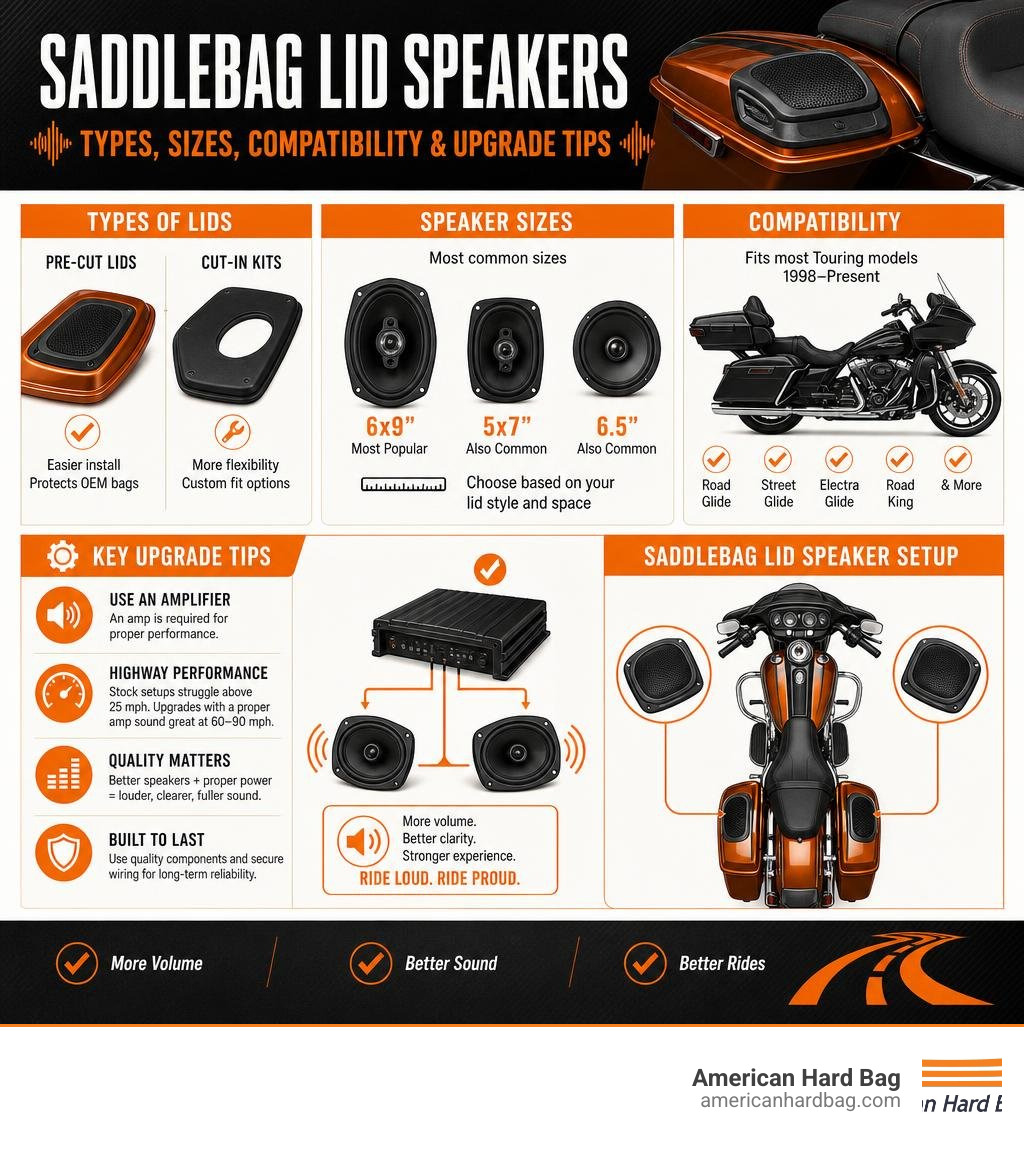
Saddlebag lid speakers are a popular audio upgrade for Harley-Davidson Touring riders who want more volume, better sound, and a fuller listening experience on the road.
Here's a quick answer if you're just getting started:
- What they are: Speakers mounted directly into your saddlebag lids, firing sound toward the rider and passenger
- Best sizes: 6x9" is the most popular; 5x7" and 6.5" are also common depending on your lid style
- Compatible bikes: Most Harley-Davidson Touring models from 1998 to present (Road Glide, Street Glide, Electra Glide, Road King, and more)
- Do you need an amp? Yes — an amplifier is required for proper performance
- Pre-cut lids vs. cut-in kits: Both options exist; pre-cut lids are easier and protect your OEM bags
- Highway performance: Stock setups struggle above 25 mph; aftermarket upgrades with a proper amp can sound good at 60–90 mph
The frustration is real. Riders consistently report that stock audio becomes useless above highway speeds — one forum user put it bluntly, saying the stock lid speakers are "worthless above 25 mph." Upgrading your saddlebag lids with quality speakers and a matching amplifier is one of the most effective ways to fix that.
At American Hard Bag, we specialize in premium hard bags and motorcycle accessories built for serious riders — including everything you need to build a rock-solid saddlebag lid speaker setup that holds up mile after mile. Whether you're starting from scratch or fine-tuning an existing system, this guide walks you through everything.
Why Upgrade to Saddlebag Lid Speakers?
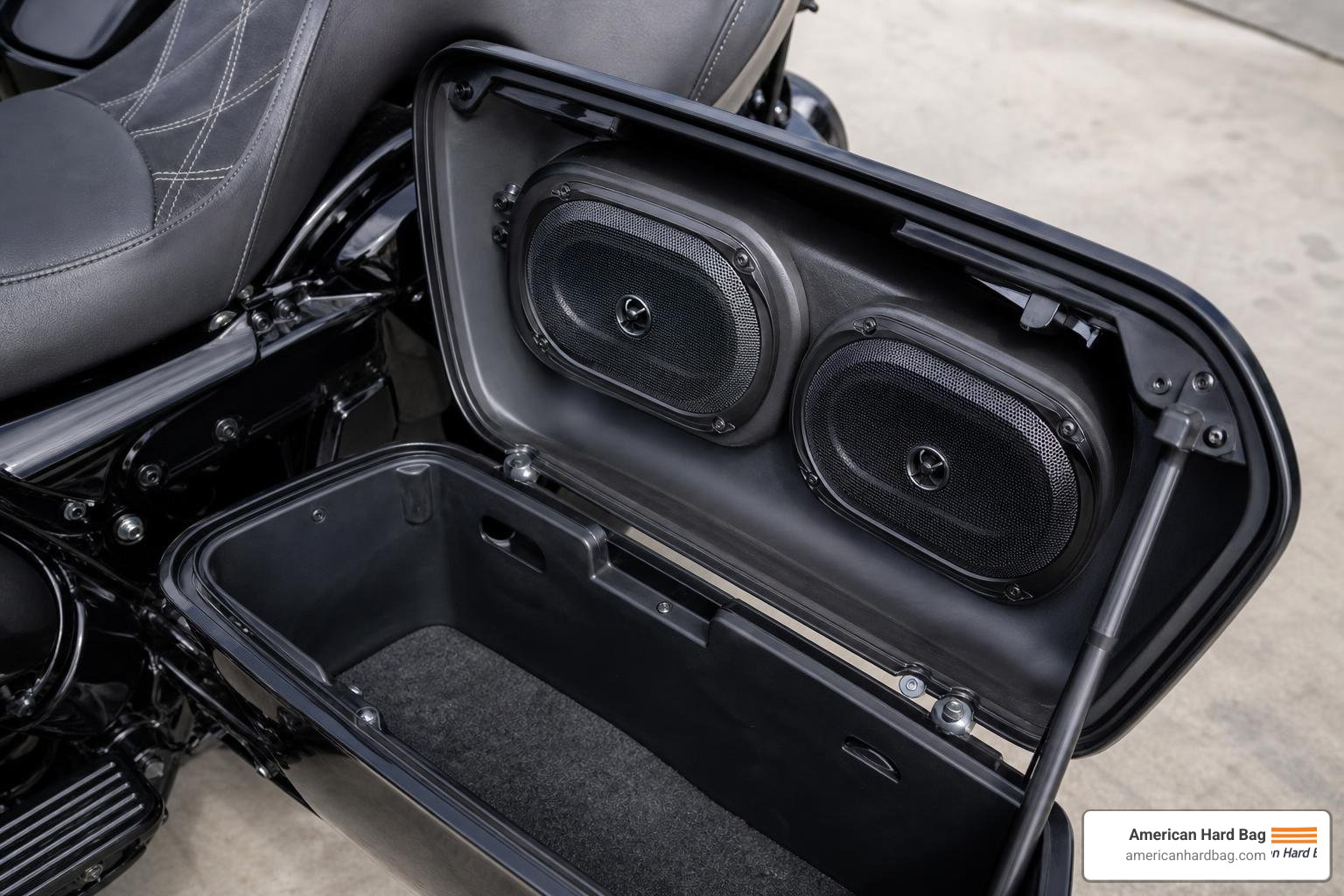
If you have ever cruised down the interstate at 75 mph, you know that wind, exhaust, and road noise are the ultimate enemies of good music. While fairing speakers do a decent job of projecting sound directly at your face, they cannot do all the heavy lifting alone. This is where saddlebag lid speakers come into play.
By adding speakers to your saddlebag lids, you create a true "surround-sound" effect. Instead of the sound strictly hitting you from the front, you are enveloped in a dome of audio. The rear-mounted placement fills in the acoustic gaps, making your music sound full, rich, and dynamic rather than thin and tinny.
Furthermore, if you frequently ride with a passenger, they will thank you. Fairing speakers are often completely blocked by the rider's body, leaving the passenger in an audio dead zone. Lid speakers project sound upward and forward, giving your co-rider a front-row seat to the concert.
However, simply throwing a pair of speakers into a hollow saddlebag can lead to muddy bass and wasted acoustic energy. To get the absolute best performance out of your 6x9" speakers, we highly recommend sealing the acoustic cavity. Using a specialized kit like the Sealed Backs for 6x9s IP-6x9-V-Sealed isolates the back-wave of the speaker, drastically improving mid-bass punch and preventing your music from sounding hollow inside your bags.
Harley-Davidson Compatibility and Fitment Guide
Before you start shopping, you need to understand how your specific motorcycle year and model affect your speaker options. Harley-Davidson Touring frames and saddlebags have evolved over the generations, meaning a lid that fits a 2005 Street Glide will not fit a 2024 Road Glide. For general factory model reference, you can also review the official Harley-Davidson Touring lineup.
Generally, Harley-Davidson Touring models are divided into three major eras for saddlebag fitment:
- 1998-2013 Models: These bags use the classic dual-turn latch system.
- 2014-2023 Models: These bags feature the redesigned one-touch latch system, which is much easier to open while sitting on the bike.
- 2024+ Models (including the redesigned Road Glide and Street Glide): These newer models feature updated styling, pre-wired factory harnesses, and updated acoustic packages. For instance, the stock amplifier on 2024 Road Glide models provides 200W (50W x 4 channels), which makes adding rear speakers much simpler, though many owners still choose to upgrade to 500W aftermarket amplifiers to get the most out of high-performance lid speakers.
If you are looking for a complete bag overhaul, you can also opt for pre-configured setups like stretched CVO-style saddlebags with speaker lids, which are stretched 4 inches longer than stock to cover the muffler while providing dedicated cutouts for speakers.
Choosing the Right Saddlebag Lid Speakers Size
The size of the speaker you choose determines both the volume and the bass response of your rear audio stage. While there are several sizes on the market, the three most common are 5x7", 6x9", and 6.5" round speakers.
- 6x9" Speakers: The undisputed king of saddlebag audio. The oval shape provides a large surface area, which translates to superior bass response and high volume levels. High-output 6x9" motorcycle speakers are often rated for serious power and are specifically voiced for open-road environments.
- 5x7" Speakers: Often found as the stock size on factory CVO models. While they sound decent, they lack the surface area of a 6x9", resulting in less bass. If your bike came with 5x7" lids, you don't have to buy entirely new lids to upgrade; you can use our 2014 Harley 5x7 to 6x9 Lid Adapter Kit to easily mount a superior 6x9" speaker into your existing factory 5x7" openings.
- 6.5" Round Speakers: Frequently used in custom configurations or with specialized cut-in adapter kits designed to adapt 6.5" speakers to OEM lids. Round 6.5" speakers offer incredibly clear vocals and highs, but they generally cannot match the low-end bass of a quality 6x9".
| Speaker Size | Bass Punch | Vocal Clarity | Ease of Fitment | Best Use Case |
|---|---|---|---|---|
| 5x7" | Moderate | Good | Direct OEM fit | Replacing factory CVO speakers without changing lids |
| 6x9" | Excellent | Very Good | Requires 6x9 lids/adapters | Maximum volume and bass response on the highway |
| 6.5" | Light to Moderate | Outstanding | Requires specific adapter kits | Audiophile setups focused on mid-range and clear vocals |
| 8" or 10" | Extreme | Good (Mid-bass) | Requires heavy modification | Custom competition bagger builds |
Factory Options and CVO Lid Compatibility
If your Harley-Davidson is equipped with premium factory options, such as CVO power locks, you must exercise caution when shopping for aftermarket saddlebag lid speakers or replacement lids.
Many budget aftermarket replacement lids are incompatible with the factory CVO power locking mechanisms. If you want to keep your power locks fully functional, you must either use a cut-in kit on your original factory lids or purchase premium aftermarket lids specifically engineered to accept the OEM locking actuator. Always verify lock compatibility before making your purchase!
Installation and Wiring: Cut-In Kits vs. Pre-Cut Lids
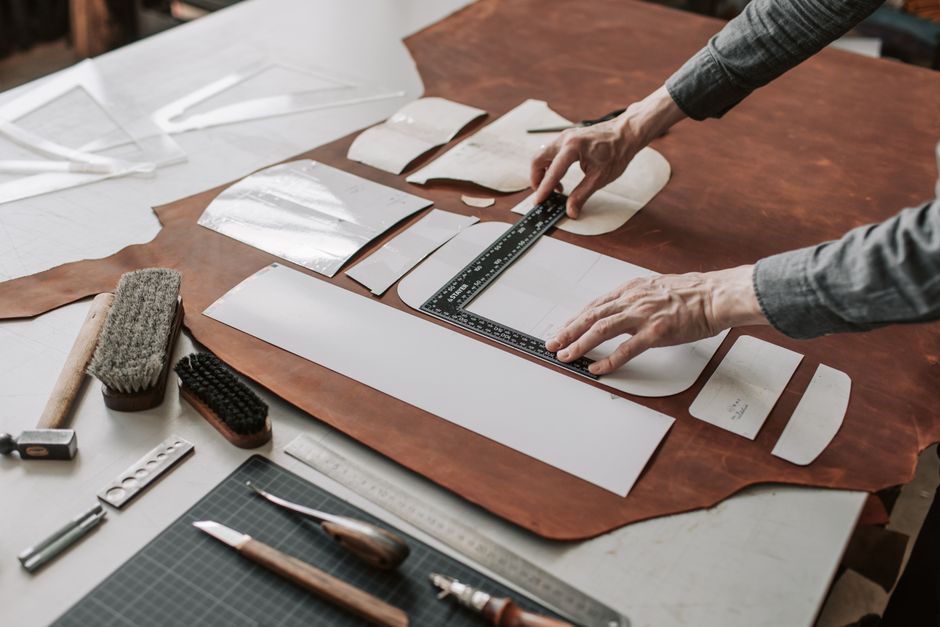
When it comes to adding saddlebag lid speakers to your motorcycle, you have two primary paths: cutting your existing factory lids or buying pre-cut aftermarket lids.
The Case for Cut-In Kits
Cut-in kits allow you to keep your original, factory-painted lids. You use a physical template to cut a hole in the top of your OEM lids, insert a speaker bucket/grille assembly, and mount your speaker.
- Pros: Saves money on paint matching; retains the perfect factory paint and pinstriping; highly rigid structure.
- Cons: You have to cut your pristine factory paint (which can be nerve-wracking); mistakes are costly; lowers the resale value of your stock parts.
The Case for Pre-Cut Aftermarket Lids
Pre-cut lids are brand-new lids manufactured from high-impact ABS plastic with speaker grilles already integrated.
- Pros: No scary cutting required; you can wrap or paint them separately; you can wrap up your stock lids and store them in the garage to preserve the bike's resale value. Premium options are available that even add custom styling and integrated flush lighting.
- Cons: You must pay to have them painted to match your bike; cheap aftermarket lids can suffer from poor weather sealing.
For those who want to protect their investment and reduce vibration inside the saddlebags, adding a high-quality sound-deadening barrier is an excellent way to eliminate plastic rattles and improve overall acoustic performance.
Step-by-Step Guide to Installing Saddlebag Lid Speakers
If you decide to tackle a cut-in kit or assemble your new pre-cut lids yourself, here is a general overview of the process:
- Protect the Paint: Apply high-quality painter's tape over the entire surface of the lid to prevent scratches from tools or plastic shavings.
- Apply the Template: If using a cut-in kit, align the precision template and mark your cut lines. Double-check your alignment before making any cuts.
- Make the Cut: Using a jigsaw or a compact air saw, carefully cut along the template lines. Take your time; let the tool do the work.
- Install the Gasket and Mount: Insert the gasketed speaker bucket or adapter from the outside of the lid. Ensure a tight, watertight seal to keep rain out of your bags.
- Secure the Speaker and Grille: Bolt the speaker into place from the underside, and secure the protective metal mesh grille on top.
- Route the Wires: Run your speaker wires down the interior hinge of the saddlebag, leaving enough slack for the lid to open and close smoothly.
Amplifiers and Wiring Harness Requirements
We cannot stress this enough: you cannot run high-quality saddlebag lid speakers directly off a stock Harley-Davidson headunit without an amplifier. Stock radio chips only put out about 15-20 watts of clean power per channel, which is not nearly enough to drive a high-performance 6x9" speaker at highway speeds.
To get clean, undistorted sound, you need an external amplifier. When choosing an amp, look for:
- RMS Power: Ensure the amp can deliver the continuous power your speakers demand. Many serious motorcycle audio builds use speakers that require anywhere from roughly 75W RMS to 250W RMS per channel, depending on the model and system goals.
- 2-Ohm or 4-Ohm Stability: Match your amplifier's output impedance to your speakers' impedance.
- Water Resistance: Since motorcycles are exposed to the elements, your amplifier should be compact and designed to live inside your fairing.
To safely run power from your front fairing back to your saddlebags, you need a high-quality wiring harness. Running loose, uninsulated wires is a recipe for electrical shorts and fire hazards.
We highly recommend using a professional-grade, plug-and-play harness. You can learn how to route and install one by reading our guide on Installing American Hard Bag Harley Saddlebag Amplifier Wire Harness. For clean, factory-style integration, utilizing the WH-SBB2 WH-SBB4 Rear Speaker Wire Harness Installation Instructions ensures you have quick-disconnect plugs at the saddlebags, allowing you to easily remove your bags for maintenance or cleaning without cutting any wires.
For more complex multi-speaker setups, you might also look into the VWH-4CHSBB Velocity 8 Saddlebag Harness or follow the WH-SBB Split Backbone Rear Speaker Wire Harness Installation Manual to achieve an ultra-clean, professional install.
Frequently Asked Questions About Saddlebag Speakers
Do I need an amplifier to run saddlebag lid speakers?
Yes. Without an amplifier, your aftermarket saddlebag lid speakers will sound quiet, hollow, and will distort heavily at moderate volumes. To achieve clear, loud sound that can cut through wind and exhaust noise, you must pair them with an external amplifier capable of supplying at least 75 to 250 watts RMS per channel depending on the speaker model.
Are saddlebag lid speakers waterproof?
High-quality motorcycle-specific speakers are weather-resistant, meaning they can handle rain, dust, and UV exposure. They typically feature reinforced polypropylene cones, santoprene surrounds, and hydrophobic mesh over the grilles to keep water from pooling on the speaker. Additionally, quality lids feature built-in water drainage channels to route water away from the speaker opening. However, you should still avoid blasting water directly into the speaker grilles with a high-pressure hose when washing your bike.
Can I hear lid speakers at highway speeds?
Yes, but only if you choose the right equipment. Cheap, underpowered speakers will get lost in the wind above 45 mph. However, if you install premium 6x9" speakers angled toward the rider, seal the backs of the speakers, and power them with a robust amplifier, you will easily be able to hear clear, detailed music at speeds of 70 to 90 mph.
Conclusion
Upgrading your Harley-Davidson with a set of premium saddlebag lid speakers is one of the most rewarding modifications you can make. It transforms your motorcycle from a simple machine into a rolling concert stage, making long highway miles fly by and leaving your riding buddies green with envy.
The secret to a great saddlebag audio system lies in the details:
- Choose the right speaker size (6x9" is highly recommended for maximum bass).
- Seal your speakers to optimize their acoustic environment.
- Use a high-quality, plug-and-play wiring harness with quick-disconnects.
- Power everything with a reliable, weather-resistant amplifier.
If you are ready to build a system that sounds incredible and stands up to the rigors of the open road, we are here to help. From custom wiring harnesses to advanced bass packages, explore our full lineup of premium motorcycle audio upgrades at American Hard Bag and let's get your bike sounding the way it deserves! If you want to take your bass game even further, check out our guides on How to Properly Set Up Razor Subwoofers Systems and Velocity 10 Razor Harley Woofer Installation.