

Why a Horn Tweeter Makes Motorcycle Audio Easier to Hear
A horn tweeter is a high-frequency speaker that uses a flared horn to focus sound more efficiently than a standard dome tweeter. For motorcycle audio, that means clearer vocals, sharper detail, and stronger output with less amplifier power - useful when wind, road, and exhaust noise compete with your music.
Before choosing one, confirm three basics: its sensitivity, impedance, and safe crossover range. High-sensitivity horn tweeters can play very loud, but they need a proper high-pass crossover and level matching to avoid harsh sound or damage.
Unlike a dome tweeter's broad, floodlight-like spread, a horn usually projects sound in a more controlled pattern. That focused output can improve clarity in open-air riding, especially when the tweeter is aimed toward the rider and integrated with compatible speakers.
American Hard Bag is a US-based maker of premium hard bags and motorcycle accessories for riders who value durable upgrades. We understand that selecting a horn tweeter is not just about buying the loudest part - it is about building a system that fits, connects safely, and performs on the road.

What Is a Horn Tweeter and How Does It Work?
At its core, a horn tweeter combines a high-frequency driver mechanism with an acoustic flare. In standard speakers, a small diaphragm vibrates against open air. Air, however, provides very low mechanical resistance (acoustic impedance) compared to the dense, heavy material of a speaker diaphragm. This mismatch makes direct-radiating diaphragms relatively inefficient—much of the electrical energy supplied by the amplifier turns into heat rather than sound waves.
A horn solves this through acoustic impedance matching. It functions like an acoustic transformer. By compressing sound energy inside a narrow throat before expanding it smoothly out through a flared mouth, the horn provides substantial air loading against the diaphragm.
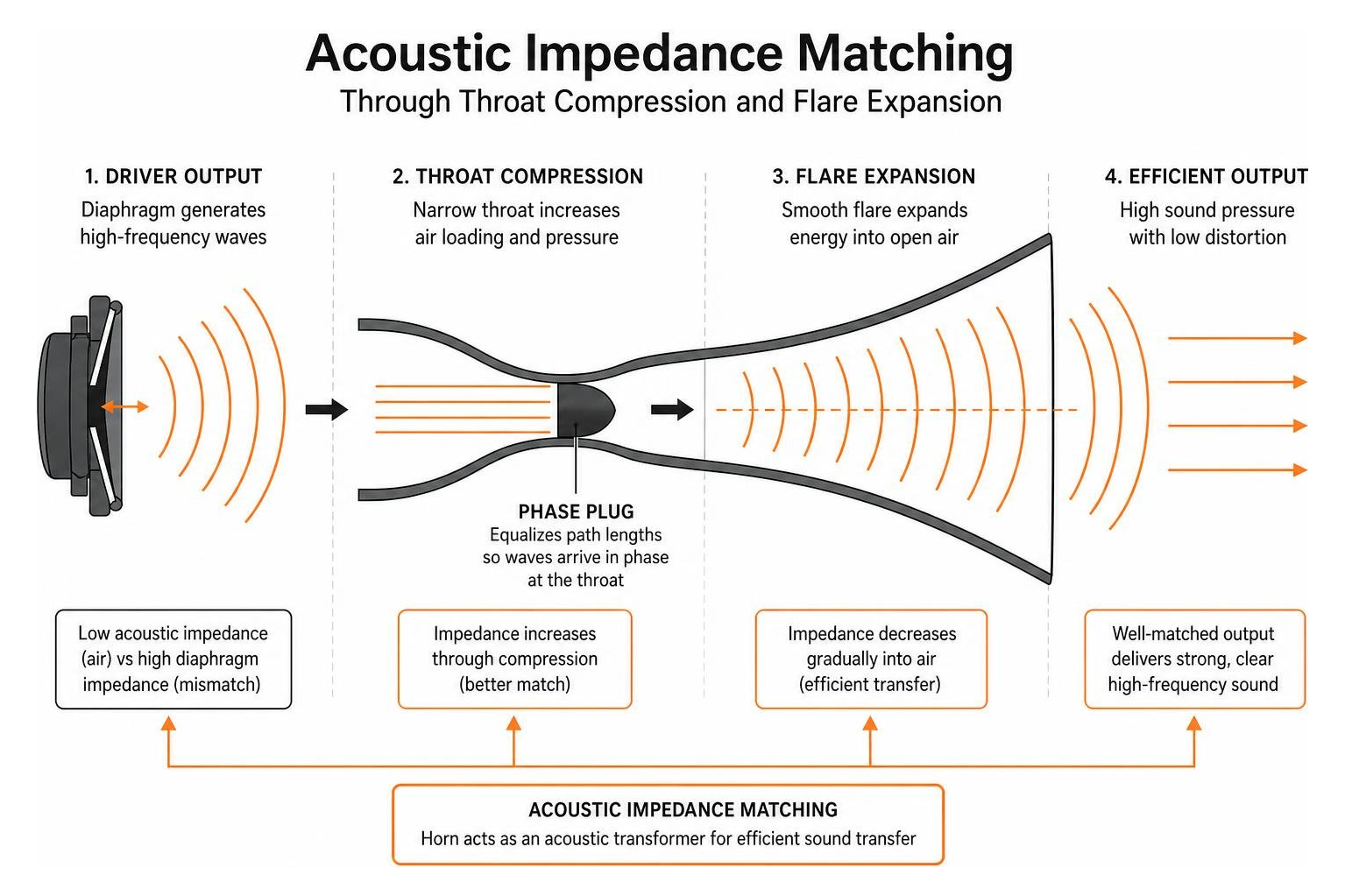
Inside the throat, a specialized component called a phase plug equalizes the path lengths of the acoustic waves generated across the diaphragm surface. This ensures that the sound waves arrive in phase at the throat entry, preventing high-frequency cancellation.
Because the horn loads the driver so effectively, the physical excursion (back-and-forth movement) required of the diaphragm to produce high sound pressure levels (SPL) drops dramatically. Less excursion directly translates to lower harmonic and intermodulation distortion (IMD). The result is massive dynamic headroom, effortless transient response, and pristine clarity even at high listening levels.
Horn Tweeter vs Dome Tweeter: Acoustic Dispersion and Dynamics
The core distinction between a horn tweeter and a conventional dome tweeter lies in their acoustic dispersion characteristics and output efficiency.
Think of a traditional 1-inch dome tweeter as a bare lightbulb or an open floodlight. It disperses sound broadly across an expansive listening area. While this creates an airy, relaxed presentation for multi-listener living rooms, it sprays acoustic energy randomly in all directions. In reflective rooms or open-air environments, this broad spray creates two problems: it reflects heavily off nearby surfaces (creating muddy comb filtering), and it dissipates rapidly over distance. Furthermore, as frequencies climb above 10 kHz, standard 1-inch domes begin to beam naturally due to the wavelength shrinking relative to the dome diameter, causing ragged off-axis shifts.
In contrast, a horn tweeter operates like a focused spotlight. It channels acoustic energy directly forward in a defined, controlled beam. This delivers immediate transient attack, surgical pinpoint imaging, and incredible dynamic punch.
| Performance Metric | Traditional Dome Tweeter | Horn-Loaded Tweeter |
|---|---|---|
| Sensitivity (1W @ 1m) | 87 dB – 92 dB | 103 dB – 108.5 dB |
| Dispersion Pattern | Wide "floodlight" (140°+ at low kHz) | Controlled "spotlight" (e.g., 90° × 40° or 60° × 60°) |
| Diaphragm Excursion | Moderate to High | Extremely Low |
| Distortion at High SPL | High (Thermal compression & breakup) | Minimal (Acoustically loaded) |
| Dynamic Headroom | Moderate | Massive / Concert-grade |
| Environmental Application | Quiet living rooms & studio near-fields | Powersports, live sound, pro audio & dedicated listening |
Horn Geometry: Waveguides, Constant Directivity, and Exponential Flares
The shape and profile of a horn define how it controls sound directivity and output across its operating frequency band.

- Exponential Flares: An exponential horn expands at an ever-increasing rate dictated by an exponential mathematical curve. Exponential horns provide exceptional acoustic loading and maximum sensitivity gain down to their design cutoff frequency. However, their dispersion pattern narrows as frequencies increase, creating a tight on-axis sweet spot.
- Constant Directivity (CD) Horns: Constant directivity horns were engineered to maintain a steady coverage pattern (such as 90° horizontal by 40° vertical) across their entire operating bandwidth. By eliminating high-frequency beaming, CD horns ensure that listeners sitting off-axis hear the exact same tonal balance as those sitting directly on-axis.
- Modern Waveguides: Specialized designs, such as the PureShape waveguide, employ convex wavefront transitions and subtle edge roundovers (such as a 25 mm baffle radius) to merge high sensitivity with smooth diffraction control. These profiles reduce edge reflections and provide up to 10 dB of acoustic loading sensitivity in the lower treble region without introducing harsh horn artifacts.
Key Specifications and Diaphragm Materials
Evaluating a horn driver requires looking past peak marketing numbers and examining raw acoustic specifications.
Sensitivity, Power Handling, and Frequency Range
Sensitivity defines how efficiently a driver converts electrical power into sound pressure, measured in decibels (dB) at 1 watt of input measured 1 meter away. Standard soft dome tweeters average between 88 dB and 91 dB. By comparison, high-performance compression horn drivers—like the Deccon Factory PAHT-307S002 Compression Horn Tweeter - Square 1.75" Titanium Driver, 300W Peak —routinely achieve sensitivity ratings of 108 dB @ 1W/1m with 150W RMS power handling.
Every 3 dB increase in sensitivity requires half the amplifier power to achieve the same volume level. A 108 dB horn tweeter requires a fraction of the wattage that a 88 dB dome demands to reach concert levels, virtually eliminating thermal power compression and preserving dynamic peaks.
To sustain continuous high-output operation, modern pro-grade horn drivers use Copper-Clad Aluminum Wire (CCAW) voice coils wound on high-temperature Kapton formers and high-flux neodymium magnets. This pairing ensures rapid heat dissipation and ultralight moving mass for clean transient reproduction extending from 1.5 kHz up to 20 kHz and beyond.
Titanium, Beryllium, Carbon Fiber, and Soft Domes
The physical composition of the diaphragm plays a defining role in transient detail, damping, and high-frequency breakup modes:
- Titanium: Renowned for structural stiffness and thermal resilience. Titanium provides explosive dynamics and cuts through aggressive ambient noise. When paired with high power handling, it delivers crisp, detailed highs, though it requires proper crossover filtering to suppress ultrasonic breakup resonance.
- Beryllium: An ultra-premium, rigid metal with an extraordinary stiffness-to-weight ratio and natural self-damping. Beryllium pushes mechanical resonance well beyond 30 kHz for effortless transparency, though at a significantly higher manufacturing cost.
- Carbon Fiber & Composites: High-tech designs—such as Wilson Benesch's Fibonacci Tweeter with its 3K carbon fiber reinforcement—add stiffness without excess mass, pushing breakup modes past 30 kHz.
- Ketone Polymers & Silk Hybrids: Flexible polymers and damped fabrics deliver a smoother, warmer high-frequency response with virtually zero listening fatigue, making them popular for high-fidelity two-way crossover integration.

When pushing extreme sound pressure levels, diaphragm wear can occur over time. Having access to an easily serviceable replacement diaphragm allows audio enthusiasts to rebuild their compression drivers to factory specifications in minutes without replacing the entire horn assembly.
Main Types of Horn Drivers and Their Applications
High-frequency horn transducers are built in several distinct form factors tailored to specific acoustic demands.
Compression Drivers, Bullet Tweeters, and AMT Super Tweeters
- Compression Drivers: These units bolt directly to standalone exponential or constant-directivity horns. The diaphragm fires into a pressurized throat chamber through a phase plug before reaching the flare mouth. Modular engines like the Horn X2 Acoustic Engine - Mid to High Frequency Horn Engine - pair – Shinjitsu Audio (and its complete crossover system counterpart, the Horn X 2 Engine with complete crossover (PAIR) – Shinjitsu Audio ) utilize compression drivers to cross over cleanly as low as 1.5 kHz, easily bridging the gap to mid-bass woofers.
- Bullet Tweeters: Compact, integrated horn drivers featuring a machined aluminum bullet-shaped center phase plug. Drivers like the Audiopipe ATR-3920ND utilize heavy neodymium magnets and shallow mounting depths to project high SPL treble across 3 kHz to 20 kHz.
- AMT Super Tweeters: Combining folded Air Motion Transformer ribbon diaphragms with shallow waveguiding, designs like the HST Dual AMT Super Tweeter - 103dB SPL - Aperion Audio reach an astonishing 30 kHz with 103 dB sensitivity, delivering ultra-high-frequency air and sparkle. Similarly, standalone audiophile super tweeters like the Fostex T900A extend flat from 5 kHz to 38 kHz to reproduce high-order harmonics.
- Piezo Horns: Budget-friendly designs, like the MR DJ TE100 3"x6" 300W Piezo Compression Horn Tweeter or the LAJS Piezo Horn Tweeter, 75-150 Watts Dual Drive Ceramic Wide ... , use ceramic piezo crystals rather than voice coils. While cost-effective for basic sound reinforcement, they lack the low distortion and linear transient response of magnetic compression drivers.
You can explore a complete spectrum of raw high-frequency drivers across professional platforms like Horn Tweeters - Madisound and Horn Tweeters to match specific project enclosures.
Selecting the Right Horn Tweeter for High-Output Audio
Choosing the right driver depends on your listening environment. For open-air vehicle applications where wind rush and engine rumble swallow high frequencies, standard dome tweeters fall flat. You need high-efficiency, directional transducers engineered for high output.
For riders looking for pure vocal articulation and screaming dynamic range on the highway, dedicated options like the best sounding horn tweeter for Harley Velocity RZ75H provide high sensitivity paired with smooth off-axis dispersion. When custom fairing space is at a premium, compact packages such as the Hertz ST-25K Neo Horn Tweeter Set with Grills Crossovers for Harley and the larger Hertz ST35K Neo Horn Tweeter Set with Crossovers Grills for Harley deliver extreme output from shallow neodymium motor assemblies.
If you prefer an all-in-one drop-in package without cutting separate holes for tweeters and woofers, horn-loaded coaxial drivers are the ideal solution. Systems like the Velocity RZ65H Full Range 6.5 Horn Loaded Coax 300W and the Velocity RZ69H Full Range 6x9 Horn Loaded Coax 300W place a high-output horn driver right in the center of the woofer cone. For step-by-step installation instructions, you can review the Velocity 6.5 Coax Horn Instruction Manual, the Velocity 6.9 Coax Horn Instruction Manual, or the Velocity RZ75H Component Horn User Manual.
System Integration: Crossovers, Tuning, and Acoustic Placement
Because horn tweeters are significantly more sensitive than conventional cone woofers, seamless system integration requires precise crossover filtering and signal balancing.
Crossover Points, Slope Selection, and Level Matching
Never connect a horn compression driver directly to a full-range amplifier signal. Without a high-pass crossover filter, low-frequency bass energy will over-excurse the delicate diaphragm and destroy the voice coil instantly.
Follow these proven steps when integrating and tuning a horn tweeter:
- Establish a Safe High-Pass Frequency: Cross the horn over at or above its manufacturer-rated cutoff frequency—typically between 2.5 kHz and 4 kHz for bullet tweeters, or 1.5 kHz to 2 kHz for larger compression horns.
- Select a Steep Crossover Slope: Utilize at least a 12 dB/octave (2nd-order Butterworth) or 24 dB/octave (4th-order Linkwitz-Riley) slope. Steeper slopes protect the driver from out-of-band energy and prevent phase distortion near the crossover point. If you ever experience filter failure, always replace it with a dedicated Replacement Crossover for Velocity RZ75H.
- Level-Match the Sensitivity: Because a 108 dB horn will overpower an 89 dB mid-woofer when given equal wattage, you must attenuate the tweeter. Use an adjustable L-pad resistor network or reduce high-frequency channel gain in your DSP to level-match the drivers seamlessly.
- Fine-Tune with Parametric EQ: Use your DSP to smooth out throat resonance peaks, commonly applying a mild high-shelf or parametric notch filter around 3.5 kHz to 6 kHz to eliminate brightness.
For complete walk-throughs on setting up gains, crossover points, and parametric EQ curves on mobile audio systems, read our comprehensive guide on How to Tune Compression Horns in a Harley Sound System.
Room Acoustics, Baffle Positioning, and Axis Alignment
In dedicated listening rooms, speaker placement and axis alignment determine how a horn interacts with room boundaries.
Because horns feature controlled vertical and horizontal directivity, they naturally avoid early side-wall and ceiling reflections that blur stereo imaging in standard dome speakers. However, their focused beam means that toe-in angle is critical. Aim the horn mouths directly toward your ear level for initial listening. If the top-end energy feels overly forward, slightly adjust the toe-in outward so the acoustic axes cross just behind your head.
In addition, ensuring mechanical time alignment—by aligning the physical voice coil of the recessed horn driver with the voice coil of the forward mid-bass woofer—guarantees a unified, cohesive wavefront.
Frequently Asked Questions About Horn Tweeters
Why are horn tweeters significantly louder than dome tweeters?
Horn tweeters achieve higher sound pressure levels because the horn flare acts as an acoustic transformer. By providing mechanical air loading against the driver's throat, the horn allows the diaphragm to transfer acoustic energy into the room with extreme efficiency, producing up to 10 times more acoustic output per watt than a direct-radiating dome tweeter.
How do you prevent a horn tweeter from sounding harsh or fatiguing?
Harshness occurs when a horn driver is under-filtered or unattenuated. To prevent fatigue, use a high-order high-pass crossover (12 dB/octave or steeper) above the horn's resonant frequency, attenuate the tweeter's output using a resistor L-pad or DSP to match the woofer's sensitivity, and adjust the toe-in angle away from direct axis if treble energy is too intense.
Can a horn tweeter be added to an existing speaker system?
Yes. You can add a horn tweeter or horn super tweeter to an existing system by connecting it in parallel with your main speakers. You must include a high-pass crossover capacitor or network to block low frequencies, and use a variable L-pad attenuator or step-down resistor to level-match the horn’s high sensitivity to your existing drivers.
Conclusion
Whether you are seeking concert-level dynamic impact in a high-fidelity home stereo build or fighting severe road noise at 75 MPH on the open highway, horn tweeters deliver unmatched acoustic efficiency, razor-sharp detail, and controlled dispersion. By understanding how horn flare geometry, diaphragm materials, and crossover networks work together, you can design a balanced, distortion-free audio system that brings every track to life.
Ready to experience dynamic, crystal-clear high-frequency performance on your bike? Explore our complete line of American-engineered high-output audio upgrades in the Horn Tweeters Collection at American Hard Bag.