

Why Getting the Loudest Motorcycle Speakers Right Changes Everything on the Road
If you've been searching for the loudest motorcycle speakers that can actually cut through highway wind and engine noise, here's a quick answer before we dive in:
The loudest motorcycle speakers available right now — ranked by key performance factors:
| Speaker Type | Best For | Sensitivity | Power Handling |
|---|---|---|---|
| High-Output Full-Range (6.5" / 6x9") | Fairing & saddlebag lids | Up to 97.5 dB | Up to 375W RMS / 750W MAX |
| Compression Horn + 6.5" Coaxial | Lid speaker packages | Up to 105.7 dB | 400W (800W dynamic) |
| NEO Highway Bar Pods (6.5") | Stripped / Road King builds | High efficiency | 480W system |
| 6x9" Saddlebag Lid Speakers | Rear fill & bass extension | High output | 300W+ system |
| Handlebar Speaker Systems | Naked / Sportster / Dyna | Moderate | 80–144W RMS |
For highway speeds (80+ mph), prioritize:
- Sensitivity ratings of 95 dB or higher
- RMS power of at least 200W per speaker
- Neodymium magnets for efficiency and low weight
- IP65 or IP67 water resistance
- A DSP-tuned amplifier for clarity at speed
Wind noise at 80 mph is roughly as loud as a lawnmower running next to your ear. Stock motorcycle speakers — and most cheap aftermarket options — simply don't have the sensitivity or power handling to compete with that wall of noise. Riders in forums consistently report that even systems with impressive wattage ratings fall flat at interstate speeds without the right combination of speaker sensitivity, placement, and amplification.
That gap between parking lot performance and real highway audio is exactly the problem worth solving.
At American Hard Bag, we manufacture premium hard bags and motorcycle accessories built for riders who won't compromise — and that includes delivering some of the loudest motorcycle speakers designed to perform where it actually matters: at speed, in the wind, on real roads.
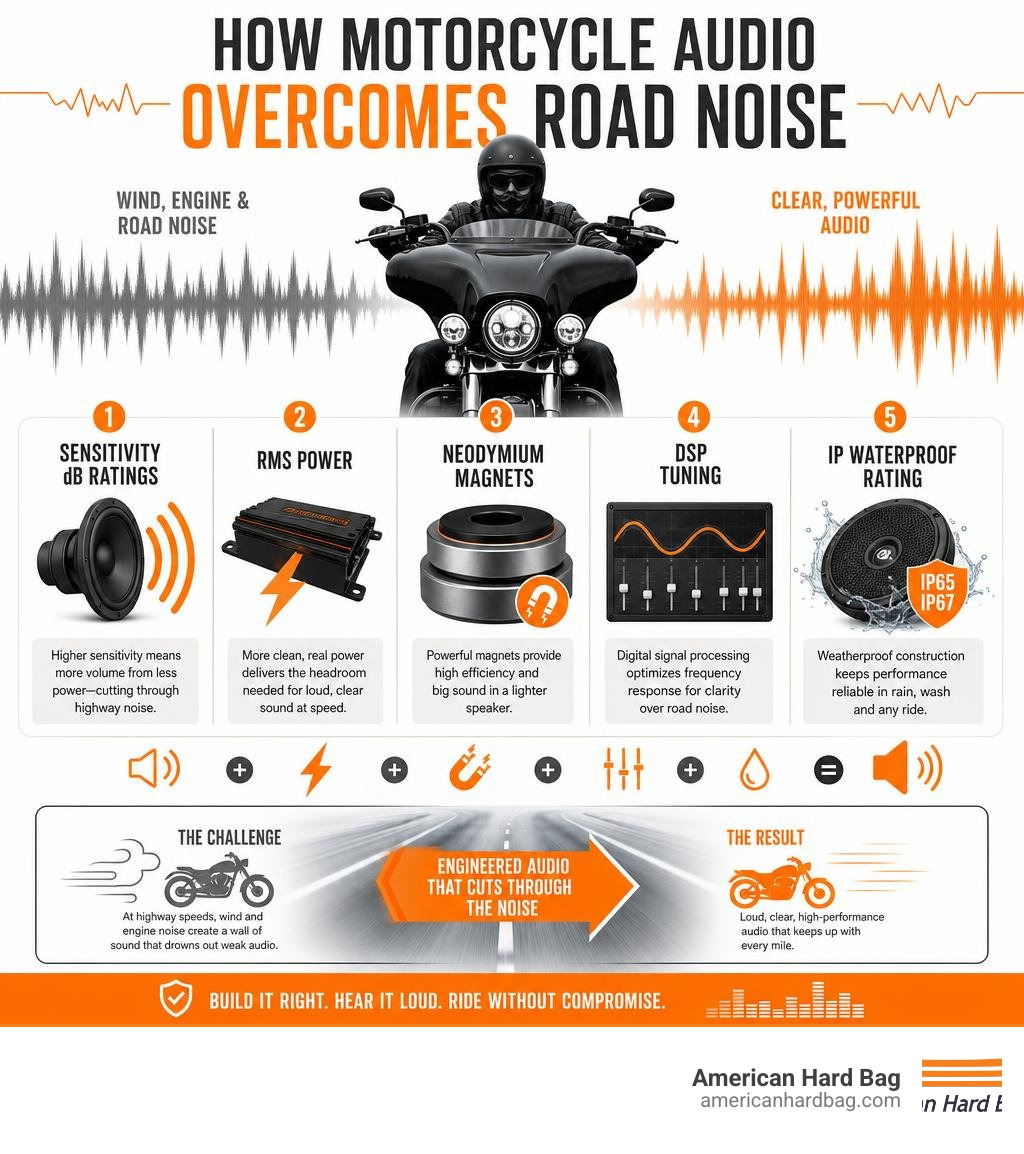
What Makes the Loudest Motorcycle Speakers Effective at Highway Speeds?
When you are cruising down the freeway in June 2026, the auditory environment is incredibly hostile. You have the roar of your exhaust, the mechanical vibration of your engine, the tires hum on the asphalt, and—most importantly—the rushing wind. To cut through this chaos, your sound system needs more than just a high price tag. It requires specific, specialized engineering.
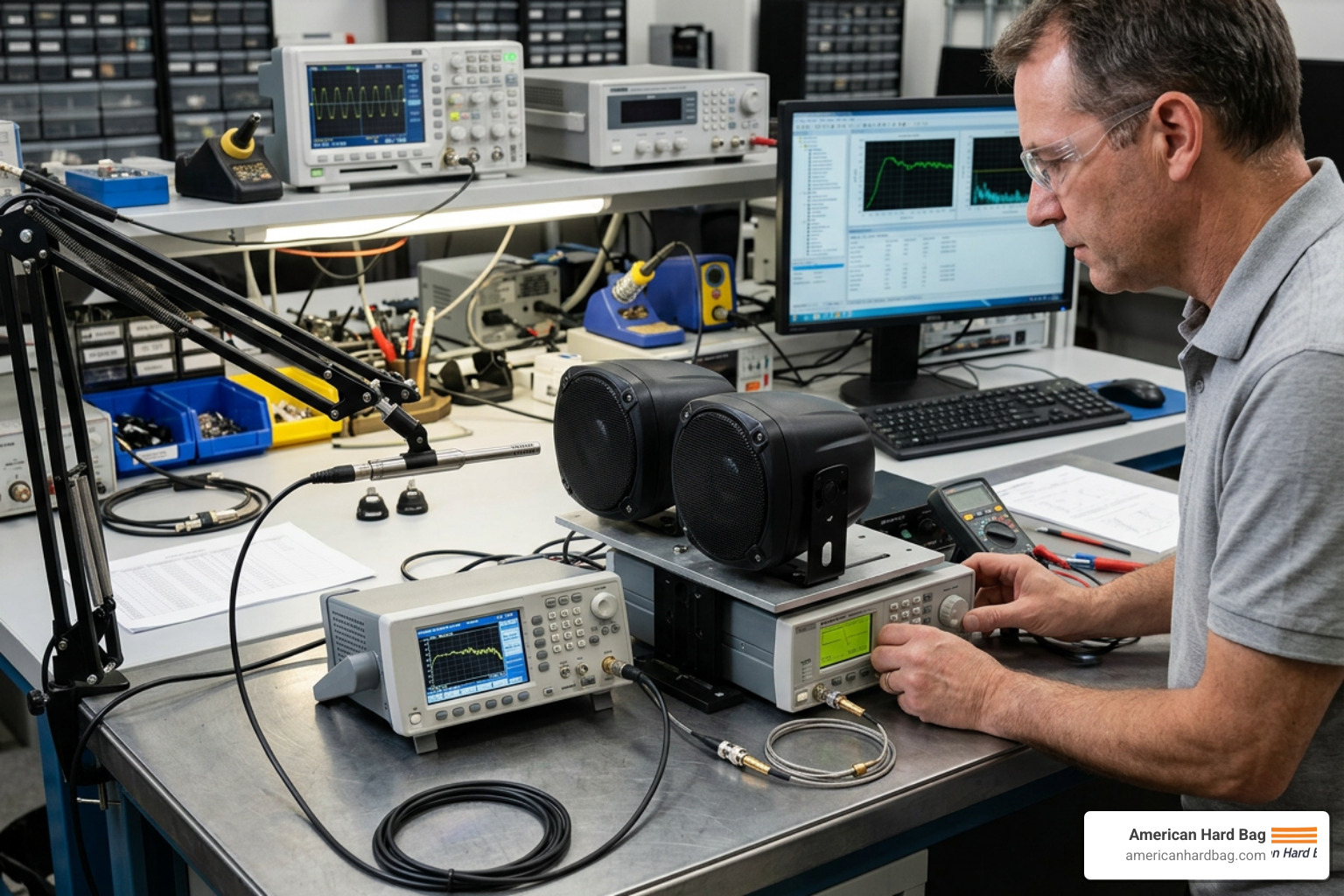
True highway performance relies on a delicate balance of three elements: raw power handling, exceptional sensitivity, and highly efficient motor structures. Let's break down the technical differences that determine whether your music sounds like a live concert or a muddy whisper at 80+ mph.
Understanding Decibels and Sensitivity in the Loudest Motorcycle Speakers
Many riders make the mistake of looking only at wattage when shopping for the loudest motorcycle speakers. However, the most critical spec for sheer volume is actually sensitivity, measured in decibels (dB) at 1 watt of power from 1 meter away.
Think of sensitivity as the speaker's efficiency. A standard car speaker might have a sensitivity of 88dB. A high-performance motorcycle speaker, like the premium pro-audio drivers we use, can feature sensitivity ratings from 97.5dB up to a staggering 105.7dB.
Because decibels are logarithmic, a 3dB increase represents a doubling of sound energy. A speaker with a 105.7dB sensitivity rating will be exponentially louder than an 88dB speaker powered by the exact same amplifier. High sensitivity is the secret weapon that allows top-tier systems to project clean, cutting vocals directly to your ears over the wind. You can see this extreme sound pressure in action during professional sound-offs, like the ones featured in this Loudest Motorcycle Sound System EVER!!!!...Epic Sound Competition video.
Power Handling: RMS vs MAX Wattage
When browsing listings on marketplaces like the Loudest Motorcycle Speakers - Amazon.com search results, you will see massive numbers like "1000W MAX!" splashed across cheap speaker boxes. Ignore them.
MAX (or peak) power is a marketing metric representing the absolute maximum wattage a speaker can survive for a fraction of a second before melting. What actually matters is RMS (Root Mean Square) power, which measures the continuous power the speaker can handle safely over a long ride.
For real highway performance, you want speakers rated for at least 150W to 300W RMS, with some ultra-high-performance pro-audio options handling up to 375W RMS / 750W MAX. To feed these hungry drivers, you must pair them with a high-quality amplifier capable of delivering clean, unclipped RMS power. Pushing a weak amplifier to its limits introduces clipping and distortion, which is the number one killer of high-end speakers. To learn how to match your power safely, check out our guide on How to Choose the Right Amplifier for Your Harley's Sound System.
To give you an idea of how magnet types affect this power delivery and overall performance, see the comparison below:
| Feature | Neodymium (NEO) Magnets | Ferrite Magnets |
|---|---|---|
| Magnetic Strength | Extremely high (10x stronger than ferrite) | Moderate |
| Weight | Very lightweight (ideal for fairings) | Heavy |
| Efficiency | Maximum output per watt | Standard output |
| Cost | Premium | Budget-friendly |
| Heat Dissipation | Excellent with proper heatsinks | Good |
As shown, Neodymium (NEO) magnets are the gold standard for motorcycle audio. They pack incredible magnetic force into a lightweight profile, preventing your front fairing brackets from snapping under heavy vibration while delivering maximum acoustic output.
Choosing the Right Speaker Sizes and Locations for Maximum Volume
Achieving the ultimate highway soundstage is all about strategic speaker placement and sizing. On a motorcycle, you don't have the luxury of a sealed cabin, meaning speaker size and mounting location dictate how much sound actually reaches your helmet.

When building a high-output system, you will generally choose between 6.5-inch fairing speakers, 6x9-inch saddlebag lid speakers, or specialized handlebar pods for stripped-down bikes. While there are many raw drivers on the market ranging from 20W up to 500W RMS, getting those raw drivers to fit and sound right on a Harley requires a tailored approach, which we cover in our breakdown of Speakers for a Harley Davidson.
Fairing Speakers vs. Saddlebag Lid Speakers
Your front fairing speakers are the foundation of your soundstage. Because they are positioned directly in front of you and partially shielded by your windshield, they do the heavy lifting at speeds over 70 mph.
However, front speakers alone can sound thin at high speeds. That is where saddlebag lid speakers come in. Upgrading to 6x9-inch lid speakers provides a massive boost in cone surface area compared to standard 6.5-inch fairing speakers. This extra surface area translates to excellent mid-bass response and "rear fill" that envelops you in a bubble of sound.
While wind will naturally deflect some of the rear speaker output at high speeds, a high-power 6x9 lid setup acts as an acoustic anchor, keeping your music full-bodied and preventing it from sounding like a tinny transistor radio. For a deep dive into choosing the right locations, check out our guide on the Harley Audio Speaker.
The Role of Compression Horns and Coaxial Designs in the Loudest Motorcycle Speakers
Standard coaxial speakers use a soft dome tweeter suspended over the center of the woofer. While these sound great in a car, their high frequencies get instantly swept away by wind on a highway.
To solve this, the loudest motorcycle speakers utilize compression horns (often featuring titanium domes). Instead of gently radiating sound, a compression horn uses a specialized phase plug and horn flare to compress and project high-frequency sound waves. This mechanical amplification shoots vocal frequencies directly through the wind barrier with surgical precision.
Many premium setups combine a high-output mid-bass driver with a horn-loaded tweeter in a single coaxial package. This design ensures that you don't just hear the beat of the music at 80 mph, but you can actually make out every lyric with crystal clarity.
These advanced configurations are designed to project sound directly to the rider. For a complete picture of how these custom horn setups integrate into your bike, read our guide on Understanding Harley Davidson Audio from Factory Systems to Custom Setups.
Overcoming Installation Challenges and Environmental Elements
Motorcycle audio is a brutal sport. Your speakers are subjected to torrential downpours, scorching engine heat, blistering UV rays, and relentless road vibration. If your speakers aren't built to handle the elements, they won't last a single season.
At American Hard Bag, we always emphasize choosing components with verified weatherproofing. Look for speakers with an IP65 or IP67 rating. IP65 means the speaker can handle water jets from any angle (like a heavy rainstorm or washing your bike), while IP67 protects against temporary immersion.
Materials matter here: look for waterproof carbon fiber or IMPP (injection-molded polypropylene) cones, UV-treated rubber surrounds, and sealed magnet motor structures to keep moisture out of the voice coil. For a complete overview of protecting your investment, read The Ultimate Guide to Upgrading Your Harley Davidson's Audio System.
Managing Weight and Mounting Depth
One of the most common installation blunders we see in our Rocklin, CA shop is riders stuffing massive, heavy-magnet car speakers into their front fairings. Standard heavy ferrite magnets can put immense physical stress on your inner fairing. Over time, the combination of weight and road vibration can literally snap your factory fairing brackets.
Furthermore, mounting depth is incredibly limited inside a motorcycle fairing and under saddlebag lids. Stock saddlebags only provide about 0.7 cubic feet of internal space, and aftermarket bag lids typically limit you to around 5.5 inches of mounting depth.
Using ultra-lightweight Neodymium magnets solves the weight issue, but you still need precision-engineered spacers and mounting rings to ensure the speaker doesn't strike your saddlebag liners or fairing components. If you are planning a lid upgrade, our step-by-step tutorial on How to Install 6x9 Speakers in Harley Saddlebag Lids is an absolute must-read.
The Importance of Amplifiers and DSP Tuning
Even the most expensive, high-sensitivity speakers will sound awful if they are underpowered or poorly tuned. To achieve maximum volume without distortion, you need a high-efficiency Class-D amplifier paired with a Digital Signal Processor (DSP).
Class-D amplifiers are essential for motorcycles because they convert almost all of their electrical draw into audio power rather than heat, putting minimal strain on your bike's charging system.
The DSP is the brain of your audio system. On a motorcycle, the acoustic environment changes drastically as you speed up. A DSP allows you to write a custom tune that uses equalization, crossovers, and time alignment to pre-compensate for wind noise. By cutting out muddy low frequencies that you can't hear at speed anyway, a DSP frees up your amplifier to focus 100% of its energy on the midrange and high frequencies that cut through the wind. To understand how this fits into your overall build plan, check out The Top 3 Audio Upgrades Every Harley Owner Should Consider.
Frequently Asked Questions about Motorcycle Audio Upgrades
Can I hear my motorcycle speakers clearly at speeds over 80 mph?
Yes, absolutely. With a properly designed system featuring high-sensitivity compression horn speakers and a DSP-tuned amplifier, you can easily hear your music clearly at 80 mph and beyond. Some high-end custom systems are reported to remain perfectly legible at speeds up to 130 mph.
That external factors play a big role. A tall windshield and a full-face or modular helmet will significantly reduce wind turbulence around your ears, making it much easier to hear your system clearly at lower volume levels than if you are riding a completely stripped-down bike with a half-helmet.
Do subwoofers work well on a motorcycle at highway speeds?
The short answer is: not on the highway. Subwoofers require a sealed or ported enclosure and a quiet environment to produce deep, felt bass. In an open-air highway environment, low-frequency bass waves are instantly swept away by the wind.
While an 8-inch subwoofer in your saddlebag sounds incredible at a stoplight or cruising around town, it won't do much for you at 80 mph. For highway riding, you should prioritize high-output 6.5-inch and 6x9-inch mid-bass drivers that focus their energy on the "punchy" mid-bass frequencies (80Hz - 250Hz) which can actually be heard over road noise.
Will upgrading to high-power speakers drain my motorcycle battery?
Not if you use modern, high-efficiency Class-D amplifiers. Your Harley's stator has a limited charging capacity, but Class-D marine and motorcycle amplifiers are designed to draw minimal current while delivering massive power.
As long as your motorcycle's charging system is functioning correctly and you don't run the stereo for hours with the engine turned off, a high-power aftermarket audio system will not drain your battery or leave you stranded.
Conclusion
Building the ultimate highway sound system isn't about buying the most expensive individual parts and throwing them together. It's about system design. To get the loudest motorcycle speakers to perform at their peak, you must match high-sensitivity drivers with lightweight NEO magnets, house them in rugged, weather-resistant enclosures, power them with a clean Class-D amplifier, and tune the entire package with a DSP.
If you ride a naked bike or a custom chopper without a fairing, you don't have to miss out either—specialized handlebar pods offer fantastic, compact alternatives to get real audio on stripped-down builds.
At American Hard Bag, we specialize in taking the guesswork out of motorcycle audio. We design and sell American-engineered, plug-and-play audio upgrades specifically tailored for Harley-Davidson Touring bikes. Our packages are designed to fit perfectly, install cleanly, and withstand the harshest road conditions.
Ready to stop listening to the wind and start rocking your ride? Discover why our custom-engineered systems outperform the off-the-shelf competition by reading 5 Reasons Why American Hard Bag Speakers Outperform the Competition, or head straight to American Hard Bag to find the perfect plug-and-play system for your bike today!