

What Is Audio DSP and Why Does It Transform Your Sound?
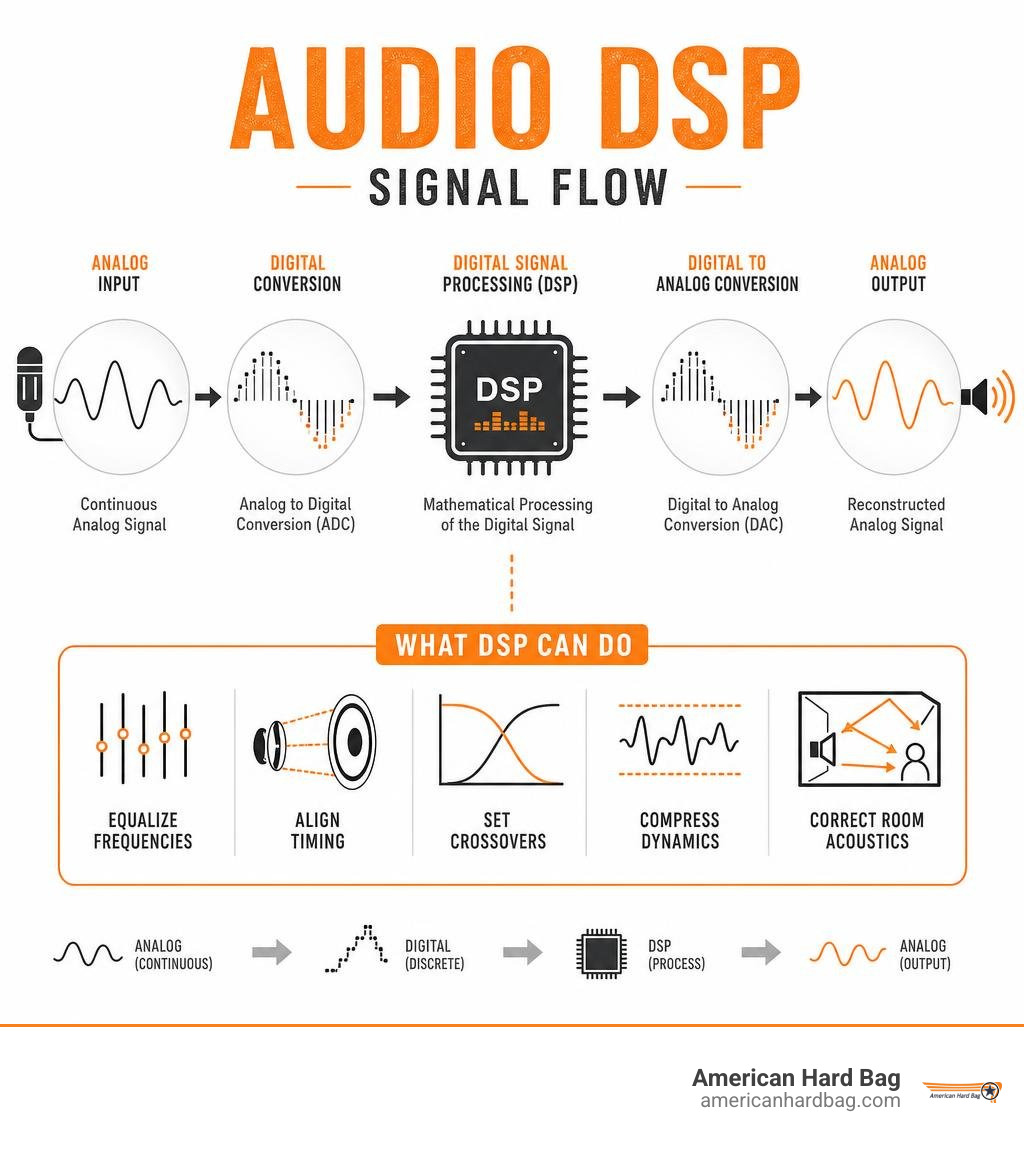
Audio DSP (Digital Signal Processing) is the technology that takes your music signal, converts it to numbers, mathematically reshapes it, and converts it back to sound — giving you precise control over tone, timing, and volume that analog circuits simply cannot match.
Quick answer — what audio DSP does:
- Equalizes frequencies (boost bass, cut harsh highs, fix speaker deficiencies)
- Aligns timing between speakers so sound arrives at your ears simultaneously
- Sets crossovers to send the right frequencies to the right drivers
- Compresses dynamics to protect speakers and control volume swings
- Corrects room/environment acoustics to compensate for reflections and noise
Think of it this way: an amplifier makes sound louder. A DSP makes sound better. It's the difference between simply hearing music and actually listening to it with clarity.
For motorcycle riders, that distinction matters enormously. Wind noise, engine rumble, and open-air acoustics are brutal on audio quality. Without DSP, even expensive speakers sound thin, muddy, or unbalanced at speed.
At American Hard Bag, we've spent years helping riders integrate premium audio systems — including DSP-based solutions — into their motorcycles, and we know how transformative the right audio DSP setup can be. This guide covers everything you need to understand the technology and apply it confidently to your build.
What is an Audio DSP and How Does It Work?
To understand an audio DSP, we first have to look at how real-world signals behave. Sound in the physical world is inherently analog—it consists of continuous, varying waves of air pressure. When these waves hit a microphone or travel through a traditional audio cable, they exist as a continuously varying electrical voltage.
An audio DSP cannot work directly with these continuous analog voltages. Instead, it must translate the analog signal into a language it understands: binary numbers (0s and 1s).
This translation happens in two fundamental steps:
- The Analog-to-Digital Converter (ADC): The ADC samples the incoming continuous analog voltage at an extremely high rate (for example, 48,000 times per second, or 48 kHz). Each sample measures the voltage level at that exact microsecond and assigns it a digital value based on the system's bit depth (such as 16-bit or 24-bit resolution).
- Mathematical Manipulation: Once the sound is digitized, the DSP's processor performs rapid mathematical operations—addition, subtraction, multiplication, and division—on this stream of numbers. By multiplying a sample's value, the DSP changes its volume. By applying mathematical equations called algorithms, it can filter out specific frequencies, delay the signal, or compress its dynamic range.
- The Digital-to-Analog Converter (DAC): Once the calculations are complete, the processed numbers are sent to a DAC. The DAC reads the digital values and reconstructs a smooth, continuous analog voltage wave. This analog signal is then sent to your amplifier, which boosts the signal's power to drive your physical speakers.
This complete silicon-level architecture is beautifully demonstrated by industry-standard hardware like the AD1940 (Rev. B) datasheet, which showcases how 28-bit and 56-bit processing engines handle multichannel digital audio routing, volume ramping, and complex biquad filtering in real-time.
The Core Architecture of an Audio DSP
Inside every dedicated digital signal processor chip, four key internal components work together in perfect harmony to handle these real-time calculations:
- Compute Engine: The heart of the DSP. Unlike a general-purpose CPU, which is designed to handle a wide variety of tasks (like running an operating system or handling internet traffic), the DSP's compute engine is highly specialized. It is optimized to perform "multiply-accumulate" (MAC) operations at blistering speeds, which are the exact mathematical foundation of all digital audio filters.
- Program Memory: This dedicated memory space stores the software programs or processing algorithms (such as equalizers, crossovers, or limiters) that dictate how the incoming signal should be manipulated.
- Data Memory: This holds the digitized audio samples while they wait to be processed. Because audio delay and filtering require comparing current samples to past samples, this memory must be incredibly fast and deterministic.
- Input/Output (I/O): This block connects the DSP to the outside world, managing incoming digital audio streams from sources like USB or S/PDIF and routing the processed digital outputs to DACs or external digital devices.
When developing software-based DSP engines, software engineers rely on highly optimized libraries to execute these operations without causing audio glitches. For instance, the DSP-CORE library is a zero-allocation, single-header C library designed specifically for real-time biquad filtering. By avoiding dynamic memory allocation (heap usage) entirely, it ensures deterministic execution.
On standard x86-64 hardware, this library achieves real-time performance of 5391x for low-pass filters and 2105x for peaking EQ at a 48 kHz sample rate. It also utilizes SIMD (Single Instruction, Multiple Data) vectorization to process multiple channels in parallel, yielding a 2.50x speedup for stereo (using SSE2) and a 4.39x speedup for quad-channel (using AVX) configurations.
Analog vs. Digital: Why We Process Signals Digitally
In the early days of car and motorcycle audio, tuning was done entirely in the analog domain using physical inductors, capacitors, and potentiometers. While analog circuits have their charm, they suffer from severe physical limitations.
Here is why digital signal processing has completely taken over modern system design:
- Programmability: To change a crossover frequency in an analog system, you have to physically swap out capacitors or turn stiff analog dials. With an audio DSP, you simply change a value in a software interface. This allow us to instantly update, customize, or reprogram an entire system on the fly.
- Accuracy and Consistency: Analog components are subject to manufacturing tolerances and degrade with age, temperature, and vibration. A 100 Hz analog crossover might actually filter at 95 Hz on a cold morning and 105 Hz on a hot afternoon. A digital filter is mathematically perfect; it will perform exactly the same way every single time, regardless of the physical environment.
- Noise Immunity: Analog signals traveling through long copper cables are highly susceptible to electromagnetic interference, engine whine, and ground loops. Once a signal is digitized inside a DSP, it is immune to this noise. The numbers do not change just because a spark plug fires nearby.
To see how these principles are integrated into real-world hardware, you can explore the Helix M Four DSP Amplifier Sound Processor Functions and Interface Guide, which highlights how digital control gives you pinpoint command over every phase of your system's signal path.
Inside the Digital Audio Signal Chain and Hardware Architectures
To build a high-performance audio system, we must understand how digital audio travels from the source to the final output. In a typical modern digital audio signal chain, the signal is routed through several specialized hardware interfaces:
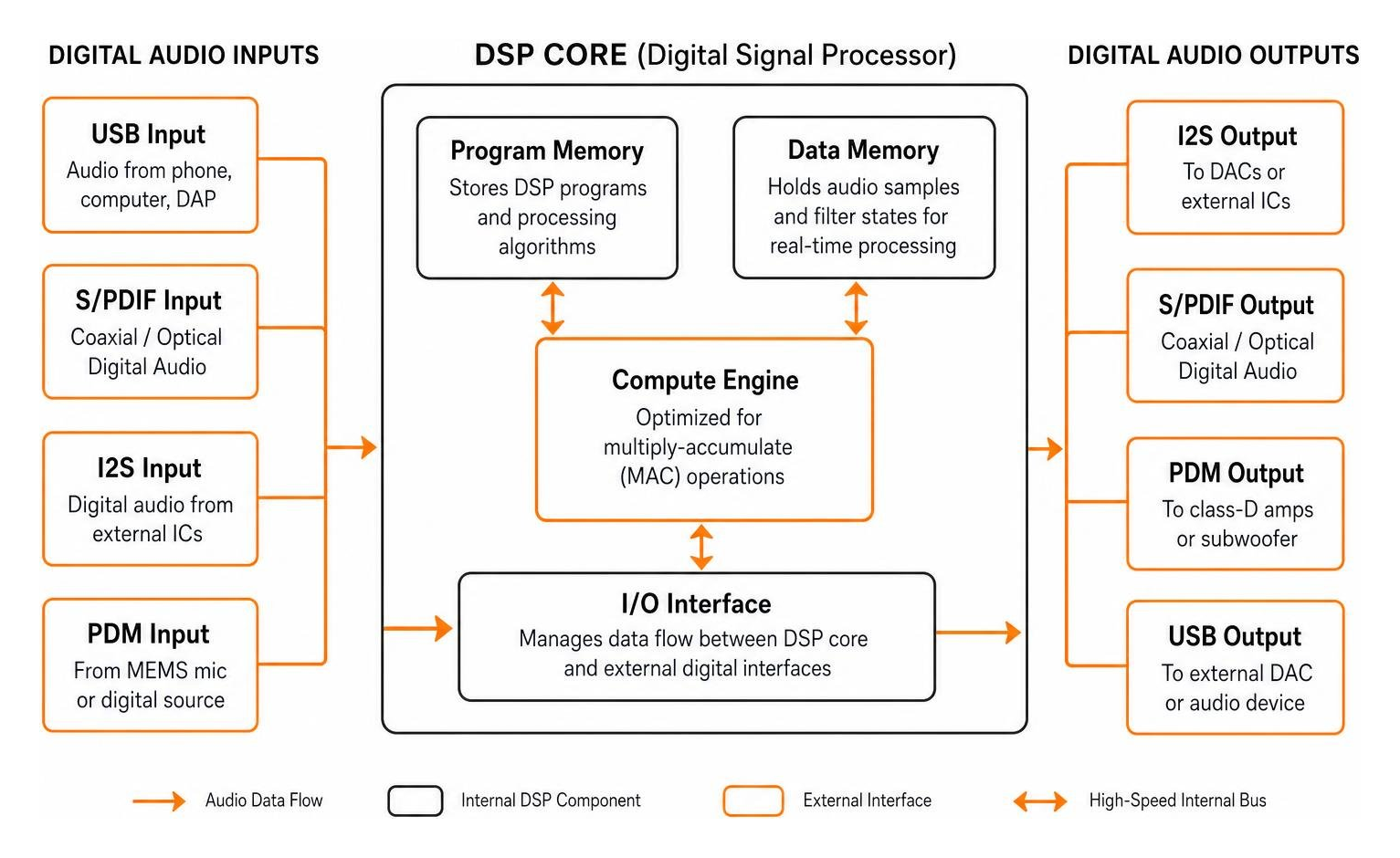
- USB Input: Often used to stream high-resolution audio directly from a phone, digital audio player, or computer into the DSP.
- I2S (Inter-IC Sound): A common serial bus standard used to transmit digital audio data between integrated circuits (like passing audio from a USB interface chip to the DSP core, or from the DSP to a DAC).
- S/PDIF (Sony/Philips Digital Interface): A standard for transmitting digital audio over coaxial copper or optical fiber cables, ideal for keeping the signal entirely digital over longer distances.
- PDM (Pulse Density Modulation): A 1-bit high-frequency digital stream often used for micro-electro-mechanical systems (MEMS) microphones or highly efficient class-D and subwoofer outputs.
Fixed-Point vs. Floating-Point Audio DSP Architectures
When choosing or designing an audio DSP system, one of the most important architectural decisions is whether the processor uses fixed-point or floating-point arithmetic.
- Fixed-Point DSPs: These processors represent numbers using a fixed number of digits (often 24-bit or 32-bit integers). They are highly cost-effective, consume very little power, and are incredibly fast. However, they have a limited dynamic range. If a mathematical calculation exceeds the maximum integer value, it causes harsh digital clipping. To prevent this, developers must carefully manage gain staging throughout the software.
- Floating-Point DSPs: These processors represent numbers in a scientific-notation format (like a decimal multiplied by an exponent). This offers a virtually infinite dynamic range. It is almost impossible to clip a floating-point processor internally. This architecture simplifies software development and virtually eliminates quantization noise (the rounding errors that occur during calculations).
In modern high-performance software frameworks like the DSPark C++ framework, developers leverage C++20 concepts and compile-time templates to build zero-dependency, real-time audio processing chains. This framework utilizes float-based processing to handle up to 16x oversampling (to prevent aliasing in saturation algorithms), while enforcing zero memory allocation in the hot audio thread to guarantee glitch-free playback.
Microcontrollers as Modern DSPs: The RP2040 and RP2350 Revolution
In recent years, a massive shift has occurred in the DIY and low-cost audio markets. Highly affordable, general-purpose microcontrollers have become powerful enough to handle complex real-time audio DSP tasks that once required dedicated, expensive silicon.
At the forefront of this revolution are the Raspberry Pi RP2040 and its successor, the RP2350. By running specialized firmware, these tiny microchips can be transformed into high-performance USB audio processors for less than the price of a cup of coffee.
Two primary open-source projects showcase this capability:
- The stncmp/DSPi firmware demonstrates how the dual-core RP2040 can be overclocked to 307.2 MHz to process 16-bit and 24-bit PCM audio at sample rates up to 96 kHz. It can handle up to 10 parametric EQ bands per channel, offering a total of 70 filter bands across 7 channels.
- The advanced KentLee86/DSPi firmware leverages the newer RP2350 microcontroller. Thanks to the RP2350's hardware floating-point unit (FPU), the firmware supports up to 11 active channels (2 master, 8 S/PDIF/I2S, and 1 PDM) with a whopping 110 total filter bands. It utilizes a hybrid State Variable Filter (SVF) and biquad architecture to maintain incredible low-frequency accuracy.
Additionally, these microcontrollers can handle complex output tasks on their secondary cores. For example, the DSPi firmware's subwoofer PDM output uses a 2nd-order delta-sigma modulator with a 256x oversampling ratio (creating a 12.288 MHz bit clock at a 48 kHz sample rate) combined with triangular probability density function (TPDF) dither and noise shaping. This allows a simple resistor-capacitor (RC) filter to convert a digital pin's output into a clean, pop-free analog subwoofer signal without requiring an expensive external DAC.
Key Audio Processing Tasks and Tuning Features
An audio DSP performs a wide variety of tasks to optimize sound quality. To understand how these filters behave, we must look at the math behind them. The two most common digital filter structures used in audio are Biquad filters and State Variable Filters (SVFs).
| Feature / Metric | Biquad Filter (Direct Form II Transposed) | State Variable Filter (SVF) |
|---|---|---|
| Mathematical Complexity | Low (highly optimized, fast execution) | Moderate (requires slightly more calculations) |
| Low-Frequency Stability | Poor at high sample rates (prone to coefficient quantization noise) | Excellent (remains highly accurate down to single-digit Hz) |
| Parameter Sweeping | Can produce audible clicks/pops during real-time tuning | Smooth, continuous parameter changes without artifacts |
| Best Use Case | Mid-range and high-frequency EQ, crossovers | Subwoofer filters, low-frequency shelving, dynamic EQ |
Essential DSP Functions: From Parametric EQ to Time Alignment
When we tune a high-performance audio system, we rely on a core suite of DSP functions to overcome physical acoustic challenges:
- Parametric EQ: Unlike basic bass/treble controls, a parametric equalizer allows you to target exact frequencies, adjust the bandwidth (Q-factor) of the filter, and boost or cut the signal with surgical precision. This is critical for smoothing out harsh peaks or filling in acoustic dead spots.
- Active Crossovers: Instead of using passive crossovers after the amplifier (which waste power and degrade sound quality), a DSP splits the audio signal before amplification. High frequencies are routed to the tweeter channels, mid-range to the mids, and low frequencies to the subwoofers. This allows each amplifier channel to work with maximum efficiency.
- Time Alignment & Delay Compensation: In a vehicle or motorcycle, you are rarely sitting exactly in the center of the speakers. This means sound from the closer speaker reaches your ears a few milliseconds before the sound from the farther speaker, destroying the stereo image and causing phase cancellation. A DSP lets us add precise delays (up to 85ms or 4096 samples at 48 kHz in the DSPi firmware) to the closer speakers so the sound from all drivers arrives at your ears at the exact same microsecond.
- Speaker Protection: By using high-precision brick-wall limiters and compressors, the DSP prevents the audio signal from clipping, protecting expensive compression horns and woofers from thermal or mechanical damage at high volumes.
To learn how to apply these professional-grade tuning principles to your own ride, check out our guide on How to Use Pro Tune with a Harley Sound System.
Advanced Listening Enhancements: Matrix Mixing, Crossfeed, and Volume Levelling
Beyond standard EQ and crossovers, modern audio DSP firmware offers advanced algorithmic processing to elevate the listening experience:
- Matrix Mixing: This allows you to route and blend any input channel to any output channel with independent gain controls. For example, you can sum left and right channels to create a mono subwoofer channel, or route a navigation voice-prompt input to override only the front speakers.
- Headphone Crossfeed: When listening to stereo tracks on headphones, the extreme channel separation can cause listening fatigue. Crossfeed slightly blends a delayed, filtered version of the left channel into the right channel (and vice versa) to mimic the natural acoustic cross-talk of physical room speakers.
- Loudness Compensation: The human ear is naturally less sensitive to low bass and high treble frequencies at low volumes (as mapped by the ISO 226:2003 equal-loudness contour standard). A DSP can dynamically boost these frequencies at lower listening levels, ensuring the music sounds full and rich even when turned down.
- Volume Levelling: By utilizing a lookahead limiter (such as a 10 ms lookahead with a -6 dBFS safety threshold), the DSP can automatically smooth out massive volume jumps between different songs or input sources without introducing pumping artifacts.
For a detailed walkthrough on configuring these advanced routing matrices and file setups, refer to our Helix M Four DSP Quick Start Guide File Configuration.
How to Select and Integrate an Audio DSP into Your System
When selecting an audio DSP for your vehicle or motorcycle build, several key specifications must be carefully evaluated to ensure maximum performance:
- Sample Rate and Bit Depth: For high-resolution audio, look for processors supporting at least 24-bit/48 kHz or 24-bit/96 kHz. Higher sample rates allow for more accurate high-frequency reconstruction, while higher bit depths lower the noise floor.
- Channel Count: Ensure the DSP has enough input channels to accept your factory radio's signals, and enough independent output channels to drive every speaker in your system actively (e.g., a 3-way active front stage plus a subwoofer requires 7 output channels).
- Latency: In live sound or video-synchronized systems, latency (the time it takes for audio to enter, process, and exit the DSP) must be kept under a few milliseconds to prevent lip-sync issues.
- Preset Management: High-quality DSPs feature multi-slot preset systems (like the 10-slot flash storage in the DSPi firmware) that let you save complete tuning configurations—including channel names, startup settings, and pin assignments—allowing you to switch between "highway riding" and "parking lot show" tunes instantly.
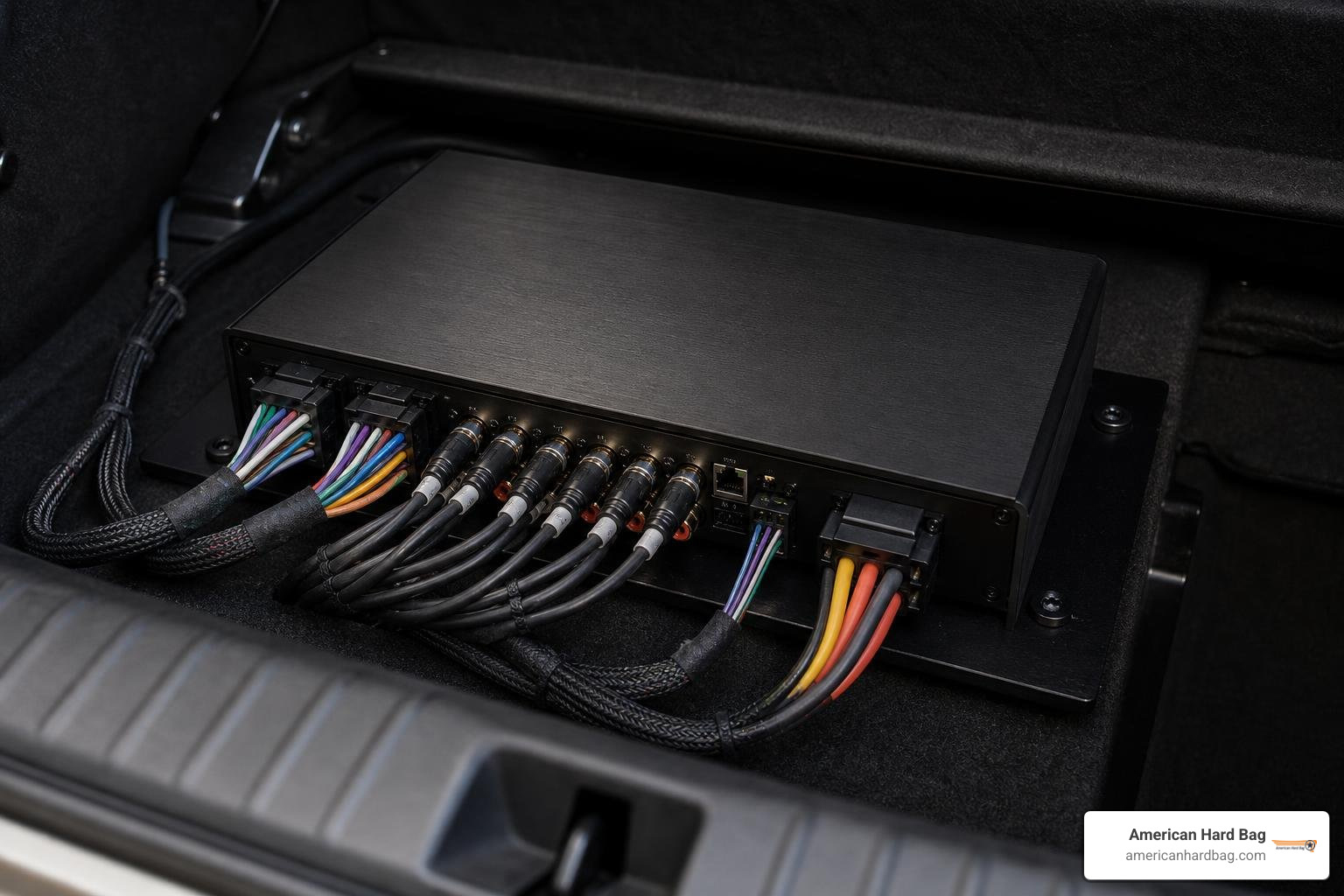
For a step-by-step breakdown of how to physically wire a processor into your vehicle's electrical and audio systems, read our comprehensive guide on DSR1 Installation Connections.
Frequently Asked Questions About Audio DSPs
What is the difference between a DSP and an amplifier?
An audio DSP and an amplifier perform two entirely different, yet highly complementary, roles in an audio system:
- The DSP is the "Brain": It operates on low-voltage line-level signals. It performs all the equalization, time alignment, and crossover filtering, shaping the digital or low-voltage analog signal to perfection. However, it cannot directly drive a speaker.
- The Amplifier is the "Muscle": It takes the perfected low-voltage signal from the DSP and boosts its electrical power (voltage and current) to a level high enough to physically move your speaker cones.
For maximum performance, you must set your amplifier's input sensitivity (gain) correctly to match the output voltage of your DSP. To do this without introducing distortion, follow our step-by-step guide on Harley Amplifier Setting Gains by Voltage the Correct Way.
How does time alignment improve soundstage in a vehicle?
When you sit in a vehicle, you are physically closer to one side of speakers than the other. Because sound travels at a fixed speed (approximately 1,125 feet per second), the sound from the closer speaker reaches your left ear before the sound from the farther speaker reaches your right ear. This time offset causes:
- Phase Cancellation: Specific frequencies clash and cancel each other out, making the system sound thin or hollow.
- Poor Soundstage: The music feels like it is pulling to one side, rather than sounding like a live band performing right on your dashboard.
By using the DSP to delay the closer speakers by a few milliseconds, we align the acoustic centers of all drivers. This ensures that the soundwaves reach your ears in perfect phase alignment, creating a wide, deep, and perfectly centered soundstage. To see how to configure this step-by-step, check out our DSR1 Setup Wizard Tutorial.
Why do biquad filters struggle with low frequencies, and how do State Variable Filters help?
Standard biquad filters (specifically Direct Form II Transposed structures) are highly efficient, but they suffer from mathematical limitations at very low frequencies (below about Fs/7.5, or roughly 200 Hz at a 48 kHz sample rate).
Because the math engine must represent very small filter coefficients with a limited number of bits, fixed-point processors experience "coefficient quantization." This rounding error introduces digital noise, causes the filter's actual frequency response to drift from its target, and can even create "limit cycles"—faint, high-pitched idle tones in quiet passages.
To solve this, advanced software libraries like zbuc/infinitedsp utilize State Variable Filters (SVFs) or double-precision (56-bit or 64-bit) internal processing. SVFs use a different mathematical structure that remains incredibly stable and accurate all the way down to single-digit frequencies, ensuring your subwoofers and low-end bass filters perform with absolute precision.
Conclusion
Integrating an audio DSP is the single most impactful upgrade you can make to a high-performance sound system. By taking control of the digital domain, you can overcome the harsh acoustic challenges of open-air riding, engine noise, and imperfect speaker placement.
At American Hard Bag, we specialize in designing premium, plug-and-play audio upgrades engineered specifically for Harley-Davidson Touring motorcycles. Whether you are tuning high-output compression horns or setting up a multi-channel active crossover network, we provide the hardware, custom-tuned setup files, and professional support to help you get the absolute most out of your audio system.
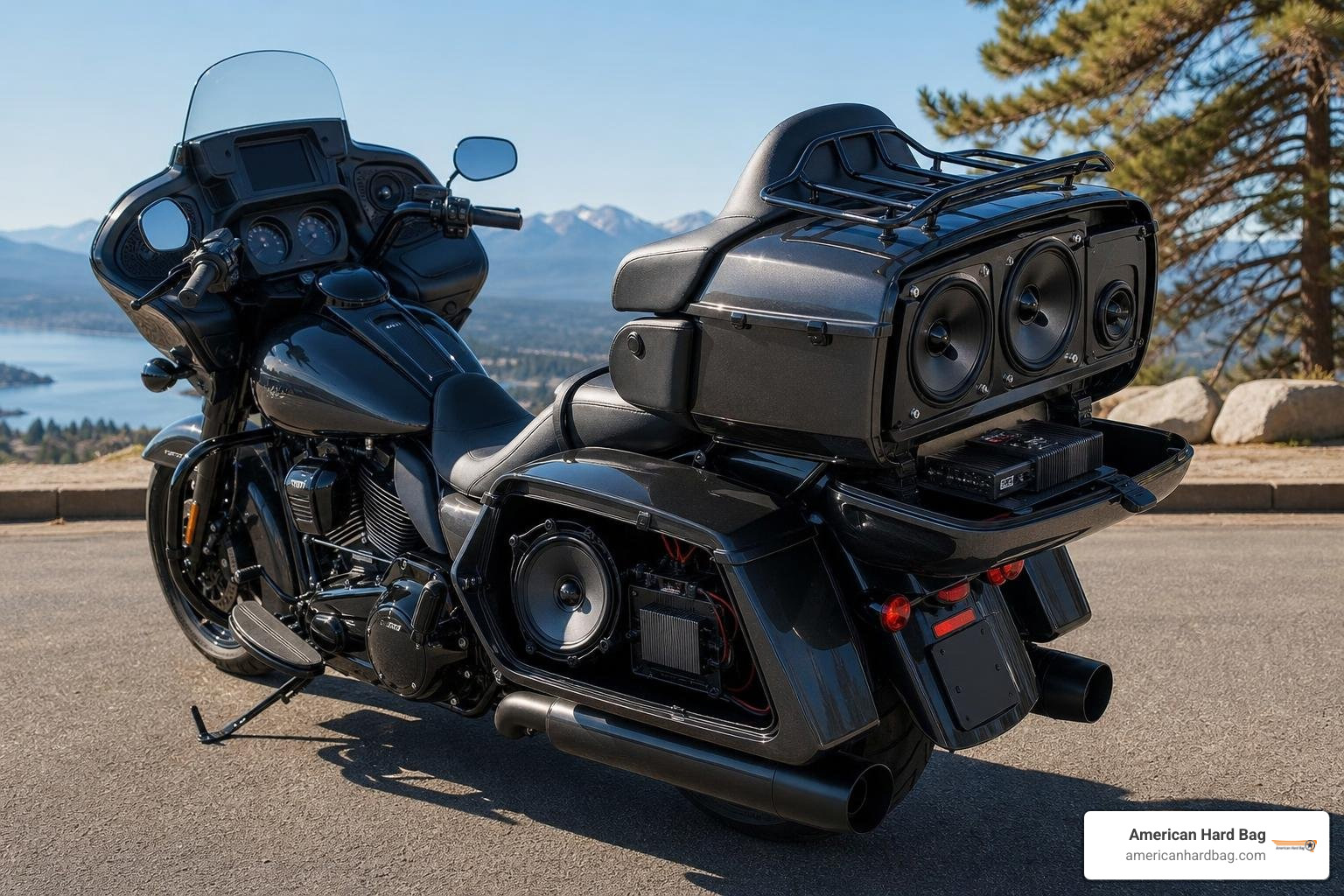
Ready to take your system's sound quality to the next level? Explore our premium, high-power solutions like the Velocity 8 DSP Amplifier and experience the power of professional digital tuning on your next ride!