

Comparing Compression Drivers and Tweeters: Acoustic Mechanics and Output
To understand why high-output systems rely on horn-loaded transducers, we have to look at acoustic impedance matching. A traditional dome tweeter pushes air directly into open space. While simple, air provides poor mechanical resistance against a vibrating dome. This mismatch forces the dome to work harder, generating heat and distortion when driven to high volumes.
A compression driver solves this problem by using an acoustic transformer: the horn throat. Inside the driver, a diaphragm vibrates inside an enclosed compression chamber. The surface area of this diaphragm is significantly larger than the narrow exit throat.
When the diaphragm moves, it forces air through that constricted opening, building intense acoustic pressure. The attached horn flare then gradually expands that high-pressure sound wave down to ambient atmospheric pressure.
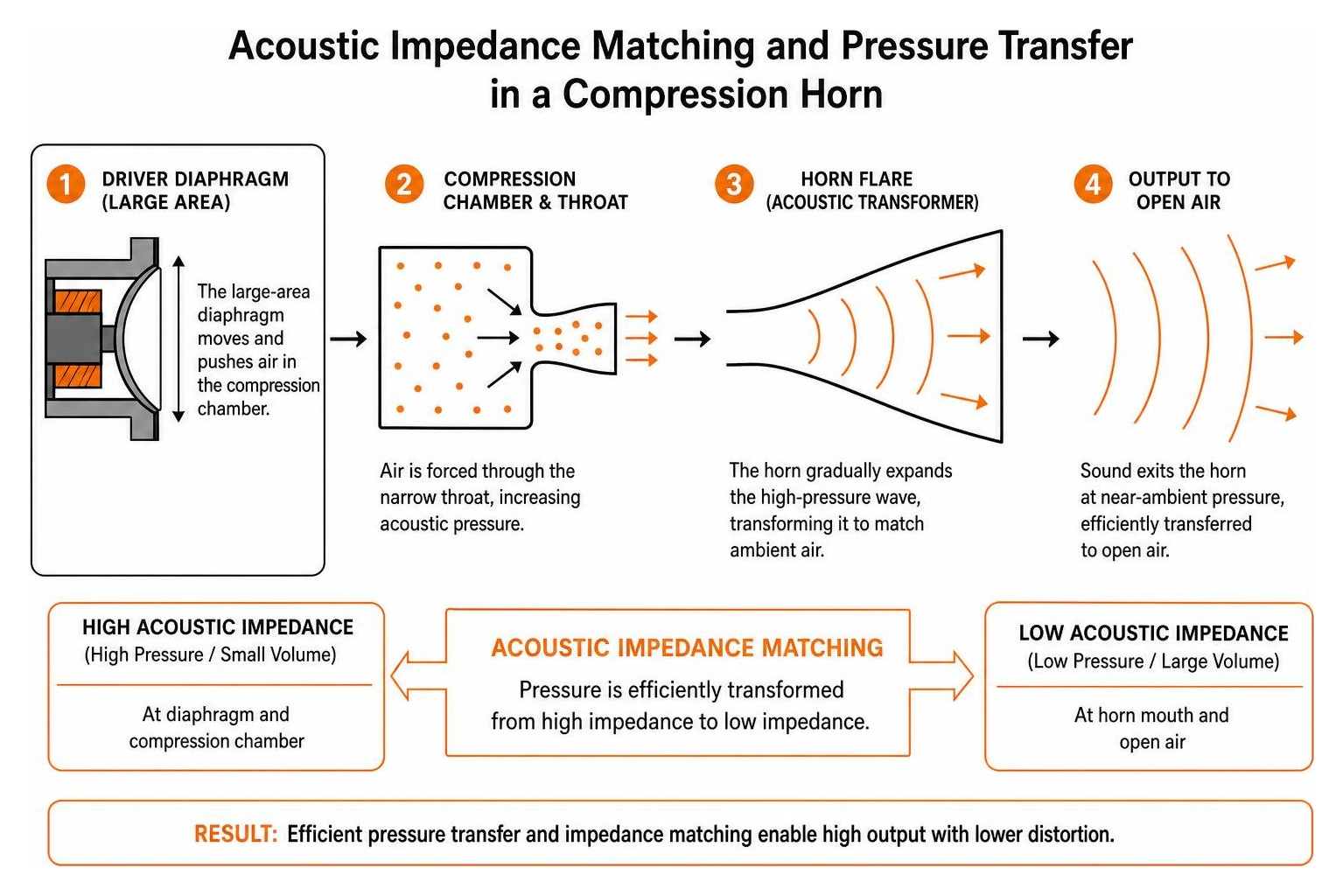
This acoustic mechanical impedance correction allows horn-loaded compression drivers to achieve roughly 10 times the efficiency of direct-radiating cone loudspeakers. While a standard high-end dome tweeter might deliver a sensitivity between 88 dB and 92 dB (1W/1m), professional pro audio compression drivers routinely measure between 105 dB and 110 dB.
| Feature / Metric | Direct-Radiating Dome Tweeter | Horn-Loaded Compression Driver |
|---|---|---|
| Typical Sensitivity (1W/1m) | 88 dB – 93 dB | 105 dB – 110 dB |
| Acoustic Efficiency | ~1% to 2% | ~10% to 20% (approx. 10x higher) |
| Dispersion Pattern | Wide, spherical, uncontrolled | Directional, pattern-controlled by horn flare |
| Diaphragm Excursion Needed | Moderate to High | Extremely Low (fraction of a millimeter) |
| Output Projection | Rapid drop-off over distance | High acoustic velocity, long projection |
| Best Application | Nearfield listening, low ambient noise | Open-air mobile, PA, live sound, high wind noise |
Key Differences Between Compression Drivers and Tweeters in High-Output Systems
Direct-radiator tweeters struggle in high ambient noise environments. Because an open dome radiates sound spherically, high-frequency energy scatters in all directions. To hear cymbals or vocal harmonics at highway speeds, you must feed significant amplifier power to the tweeter. This quickly pushes the voice coil past its thermal limits, causing compression, harshness, and eventual burnout.
Compression horn tweeters operate differently. Because the diaphragm barely needs to move to create high sound pressure levels, harmonic distortion stays low even at extreme volume.
The directed pattern of the horn delivers sound straight to the listener rather than bouncing off windshields, fairings, and open air. For riders building an uncompromising front stage, options like the Best Sounding Horn Tweeter for Harley Velocity RZ75H provide high output without the brittle, ear-piercing harshness common to poorly engineered bullet tweeters.
Phase Plug Design and Acoustic Physics
The secret weapon inside every compression driver is the phase plug. Without it, high-frequency sound waves generated at the outer edges of the diaphragm would collide out-of-phase with sound waves generated at the center, canceling out upper-octave detail.
The physics behind phase plug design date back to fundamental acoustic milestones:
- 1924 (Hanna & Slepian): First theoretical proposal demonstrating how horn throats increase acoustic radiation resistance.
- 1928 (Wente & Thuras): Introduction and patenting of the initial phase plug design, establishing equalized physical sound paths.
- 1953 (Bob Smith): Mathematical modeling that suppressed destructive air-chamber resonances, forming the foundation of modern high-frequency phase plugs.
Modern phase plugs use concentric annular slits or radial channels modeled through finite element analysis (FEA). These channels equalize the path lengths from every section of the vibrating diaphragm to the horn throat, ensuring smooth wave-summing and extending frequency response past 20 kHz.
Diaphragm Materials and Magnet Topologies
A compression driver's sonic character and reliability come down to two primary components: the diaphragm assembly and the motor structure. Because the voice coil is bonded directly to the diaphragm dome, managing thermal dissipation and mechanical stiffness is essential.
Titanium, PEEK, and Aluminum Diaphragm Performance
Different diaphragm materials offer distinct sonic characteristics, breakup modes, and thermal tolerances:
- Titanium: Renowned for exceptional rigidity and high stiffness-to-weight ratios. Titanium diaphragms deliver fast transient response, high power handling, and crisp vocal projection that cuts through heavy background noise.
- PEEK (Polyether Ether Ketone): A high-performance engineering thermoplastic. PEEK diaphragms provide superior internal mechanical damping, eliminating high-frequency ringing while resisting severe thermal stress.
- Aluminum: Lightweight with natural transient speed, offering smooth treble response, though slightly more fragile under prolonged square-wave clipping.
- Phenolic: Heavier and highly compliant, common in dedicated midrange compression horns running down to 500 Hz, but naturally rolling off around 10 kHz.
Even top-tier drivers can suffer accidental damage from over-powering or clipping. Keeping a precision Replacement Diaphragm for Velocity RZ75H Horn Tweeter on hand ensures your high-output front stage can be restored to factory spec in minutes without replacing the entire motor structure.
Neodymium vs. Ferrite Motor Structures
The magnetic motor structure drives voice coil movement. In pro audio and mobile installations, you will encounter two main magnet types:
- Ferrite (Ceramic): Traditional, reliable, and cost-effective. Ferrite magnets offer large physical thermal mass to absorb voice coil heat. However, they are heavy and bulky, making them difficult to fit in tight fairing locations.
- Neodymium (Rare Earth): Delivers vastly higher magnetic flux density in a package up to 70% lighter and significantly smaller than an equivalent ferrite motor.
Compact neodymium motor designs make advanced horn systems like the Hertz ST-25K Neo Horn Tweeter Set with Grills Crossovers for Harley and the larger Hertz ST35K Neo Horn Tweeter Set with Crossovers Grills for Harley easy to package behind tight fairing panels and gauge clusters while maintaining extreme output levels.
Integrating Compression Horns for Balanced Soundstage Imaging
A compression driver cannot function properly on its own; it requires a matched horn or waveguide to control dispersion and acoustically load the diaphragm.
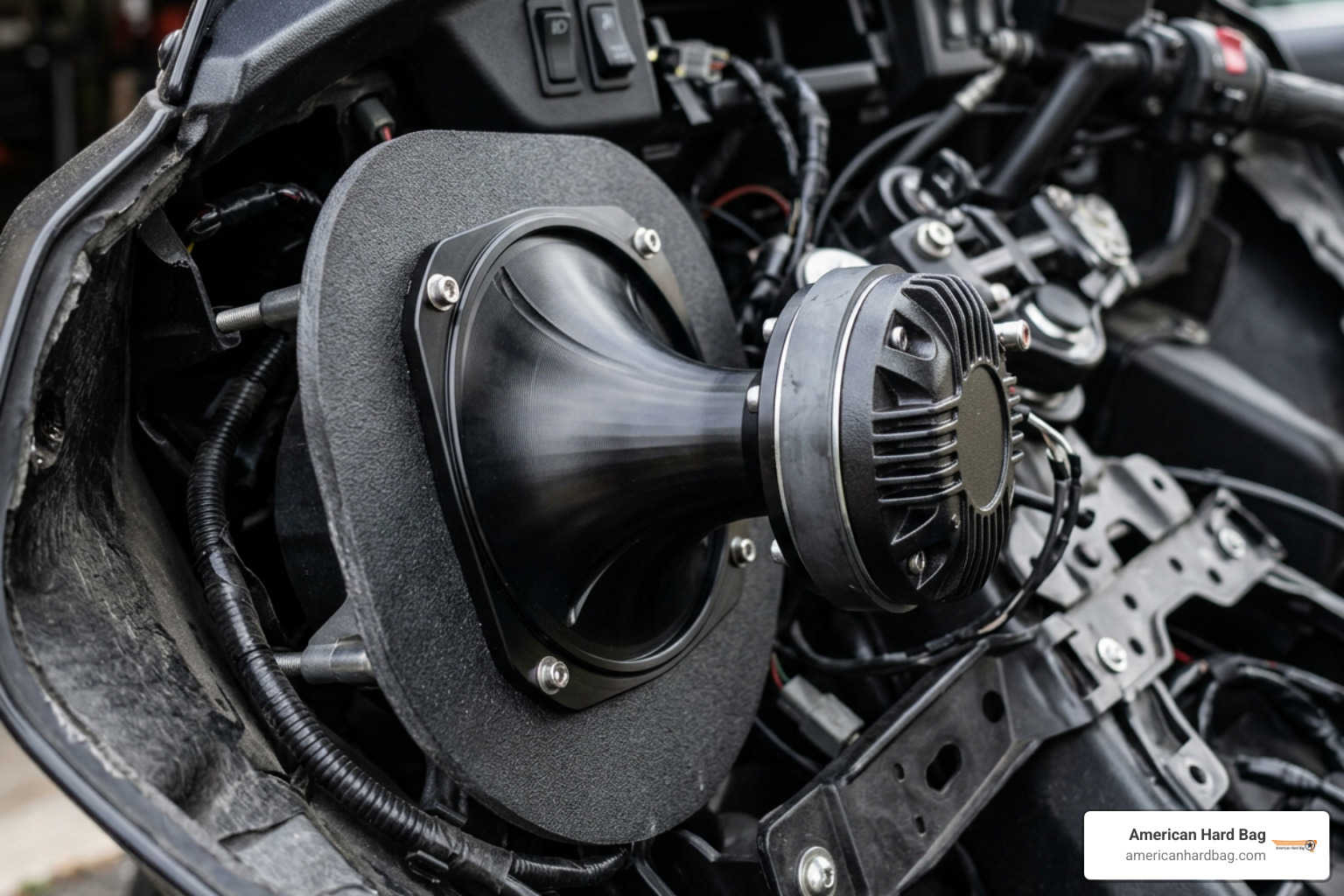
Matching Compression Drivers and Tweeters with Horn Waveguides
Connecting a compression driver to an unmatched horn flare leads to throat reflections, response peaks, and severe listening fatigue. When matching drivers to horns, focus on physical and acoustic compatibility:
- Throat Diameter: Standard pro-audio exits are 1-inch (25 mm) or 1.4-inch (35 mm). The exit angle of the driver must match the entry angle of the waveguide to avoid acoustic turbulence.
- Mounting Interface: Standard 1-inch drivers frequently feature an industry-standard 1 3/8-inch 18 TPI (threads per inch) screw-on mount or a two/four-bolt flange pattern.
- Dispersion Angles: Horn flares dictate horizontal and vertical coverage patterns (such as 60° x 40° or 90° x 90°), allowing you to steer treble energy toward your ears rather than into inner fairing cavities.
For seamless full-range integration without complex custom fabrication, horn-loaded coaxial drivers provide point-source clarity. Our Velocity RZ65H Full Range 6.5 Horn Loaded Coax 300W and the saddlebag-ready Velocity RZ69H Full Range 6x9 Horn Loaded Coax 300W feature integrated, studio-grade horn tweeters centered inside the midbass cone.
If you are custom-mounting standalone drivers over existing bag lids, specialized solutions like the Pancake Horn Tweeter Mount for 6x9 1998-2023 maintain low physical profiles without blocking woofer cone excursion.
Crossover Selection, Power Handling, and Overload Protection
Because compression drivers achieve high sensitivity (often 105 dB to 110 dB @ 1W/1m), matching them to midbass drivers requires proper crossover filtering and attenuation.
Follow these proven rules when dialing in horn tweeters:
- High-Pass Crossover Cutoff: Never run a small-format horn tweeter below its resonant frequency. A minimum high-pass filter cutoff between 2.5 kHz and 4 kHz is essential.
- Steep Slopes: Use at least a 12 dB/octave slope (or a 24 dB/octave Linkwitz-Riley digital slope via DSP) to prevent low-frequency excursion damage.
- Overload Protection: Pro audio networks protect compression drivers using dynamic light bulb limiters (which increase resistance as their filaments heat up) or self-resetting PTC polyswitches.
Dialing in gain staging and equalization is critical to keep horn tweeters from overpowering your midbass drivers. Learn the step-by-step setup in our guide on How to Tune Compression Horns in a Harley Sound System.
Frequently Asked Questions about Horn Tweeters and Compression Drivers
Why are compression drivers significantly more efficient than standard dome tweeters?
Compression drivers are roughly 10 times more efficient because the horn acts as an acoustic transformer. By forcing sound from a larger diaphragm through a narrow throat, acoustic mechanical impedance is matched to open air, converting up to 20% of amplifier power into acoustic sound compared to just 1–2% for standard dome tweeters.
What crossover frequency is best to prevent diaphragm failure in high-output horns?
Most 1-inch exit horn tweeters perform best when crossed over between 2.5 kHz and 4 kHz using a minimum 12 dB or 24 dB/octave high-pass filter. Frequencies below 2 kHz cause excessive mechanical excursion, which can fatigue and fracture the voice coil or diaphragm suspension.
Can horn tweeters be installed in shallow mobile and motorcycle enclosures?
Yes, provided you choose purpose-built shallow-mount neodymium compression horns. Using dedicated accessories like our Overdrive Velocity Shallow Horn Grills for Harley Lowers or Tour Pack allows you to package high-output horn tweeters in tight spots without modifying structural fairings or losing saddlebag volume.
Conclusion
A well-engineered soundstage should deliver high clarity, dynamic impact, and smooth tonal balance—not harsh, fatiguing treble that ruins your ride. While standard dome tweeters fall flat in open-air, high-noise environments, matching the right compression driver, diaphragm material, and horn flare gives you studio-grade detail that cuts through road noise effortlessly.
Explore our curated Horn Tweeters Collection to find American-engineered horn tweeters, coaxial drivers, and plug-and-play mounting hardware built specifically for high-output motorcycle sound systems.