

Why a DSP Processor Car Audio System Makes a Bigger Difference Than More Watts
A dsp processor car audio system is the best upgrade for clearer, more balanced sound when speakers are unevenly placed and the cabin creates reflections. It adjusts the music signal before it reaches the amplifier, using equalization, crossover filters, and timing control to help each speaker play its proper role.
For a quick buying answer, choose a DSP based on your system:
| Your system goal | Best DSP type to consider |
|---|---|
| Keep a factory radio and add aftermarket speakers or amplifiers | Standalone DSP with high-level inputs and vehicle-compatible integration |
| Build an active system with separate channels for tweeters, mids, and subwoofers | Standalone DSP with enough outputs for every amplified speaker channel |
| Save space and simplify wiring | DSP amplifier |
| Need basic frequency control on a tight budget | Entry-level DSP or digital crossover |
| Want precise tuning and premium sound quality | Higher-channel DSP with parametric EQ, time alignment, and flexible crossover settings |
Cars and motorcycles are difficult places for sound. Glass, plastic, seat surfaces, road noise, and unequal speaker distances can pull vocals toward the nearest speaker, blur bass, and make treble sound harsh. A capable DSP cannot change the shape of the vehicle, but it can correct much of what that shape does to your music.
American Hard Bag builds premium hard bags and motorcycle accessories for riders who value durable, well-planned upgrades. Our experience with dsp processor car audio systems and motorcycle audio installations helps us focus on the practical details: fitment, clean wiring, factory compatibility, and sound that stays clear on the road.
Core Functions of a DSP Processor Car Audio Unit
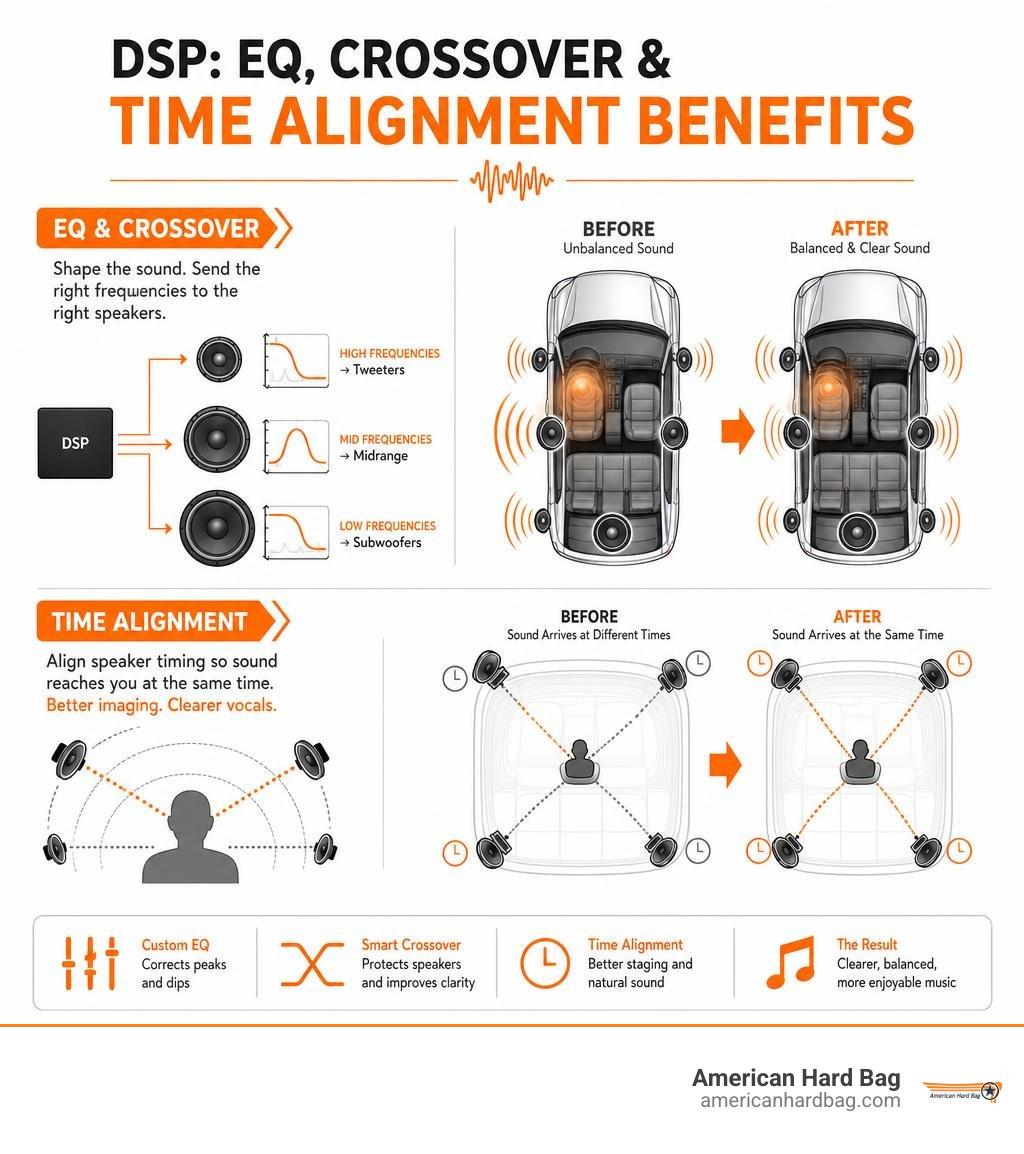
At its foundation, a dsp processor car audio unit acts as the brain of your sound system. In a vehicle interior, sound bounces off windshields, side windows, and plastic dashboards while absorbing into seats and carpet. These cabin reflections cause severe acoustic distortion, frequency spikes, and unwanted cancellation dips. A digital signal processor resolves these physical acoustic challenges by taking the raw audio signal, converting it into digital data, and manipulating it before sending clean signals to your amplifiers.
The main functions executed by an automotive digital signal processor include:
- Parametric Equalization (EQ): Unlike basic tone controls on a factory head unit that only boost or cut general bass and treble, a DSP offers fully parametric EQ across 10 to 30+ bands per channel. This lets you pinpoint precise problem frequencies caused by vehicle acoustics and smooth out the overall frequency balance.
- Active Crossover Filters: Traditional passive crossovers route audio using physical capacitors and coils after power leaves the amplifier, wasting energy as heat. A DSP handles active crossovers digitally, allowing you to set high-pass and low-pass filters with extreme precision (slopes ranging from 6 dB/octave up to 48 dB/octave). This ensures tweeters, midrange speakers, and subwoofers receive only the exact frequencies they are designed to handle.
- Level Matching & Signal Routing: Each channel can be attenuated independently to ensure balanced output levels between all speakers, regardless of their distance or power handling.
By mastering these core features, a DSP transforms harsh, uneven audio into a smooth, full-range listening experience.
Sound Staging Benefits of a DSP Processor Car Audio Unit
One of the most noticeable improvements when adding a dsp processor car audio processor is proper sound staging and acoustic imaging. In a home theater, you sit equidistant between the left and right speakers. In a vehicle, you sit far closer to the driver-side speaker than the passenger-side speaker. Because sound takes time to travel through the air, audio from the left speaker reaches your ears several milliseconds before audio from the right speaker. This causes the soundstage to collapse into the door panel right next to your knee.

A DSP solves this acoustic asymmetry through precise time alignment (also known as signal delay). By delaying the audio signal sent to the closest speakers by fractions of a millisecond, sound from every speaker in the vehicle reaches the driver's ears at the exact same instant.
Time alignment delivers key sound quality advantages:
- Centered Acoustic Staging: Vocals and instrumentals center themselves across your dashboard, replicating the experience of sitting in front of a live stage performance.
- Elimination of Comb Filtering: When identical sound waves hit your ears at slightly offset times, they create acoustic comb filtering—canceling out specific frequencies and creating a hollow, phase-smeared sound. Time alignment eliminates phase interference, restoring mid-bass impact and vocal clarity.
Key Signal Inputs for a DSP Processor Car Audio Unit
Selecting the right dsp processor car audio unit requires matching its input capabilities to your head unit or factory audio source. Modern DSPs provide several ways to capture and process audio signals:
- High-Level (Speaker Level) Inputs: Modern OEM factory audio head units often do not feature low-voltage RCA outputs. High-level differential balanced inputs accept high-voltage speaker output wires directly from a factory head unit or OEM factory amplifier. High-level inputs are critical for factory integration builds.
- Low-Level (RCA) Outputs & Inputs: Standard RCA connections route clean, unamplified signals between aftermarket head units, standalone DSPs, and external amplifiers.
- Optical SPDIF & Digital Inputs: Higher-end processors support toslink optical or coaxial SPDIF digital inputs. These allow you to stream high-resolution audio directly from digital players or high-end head units directly into the processor, bypassing noisy analog-to-digital conversions entirely. Advanced processors utilize optical and SPDIF digital inputs along with 32-bit float internal processing to maintain strict signal integrity.
- Vehicle Integration & T-Harnesses: Integrating aftermarket processing with complex OEM factory audio systems often requires specialized vehicle T-harnesses. T-harnesses plug directly into factory wiring looms, allowing you to intercept speaker signals and retain factory steering wheel controls, chime alerts, and navigation prompts without cutting factory wires.
Types of Signal Processors: Standalone DSP vs DSP Amplifier
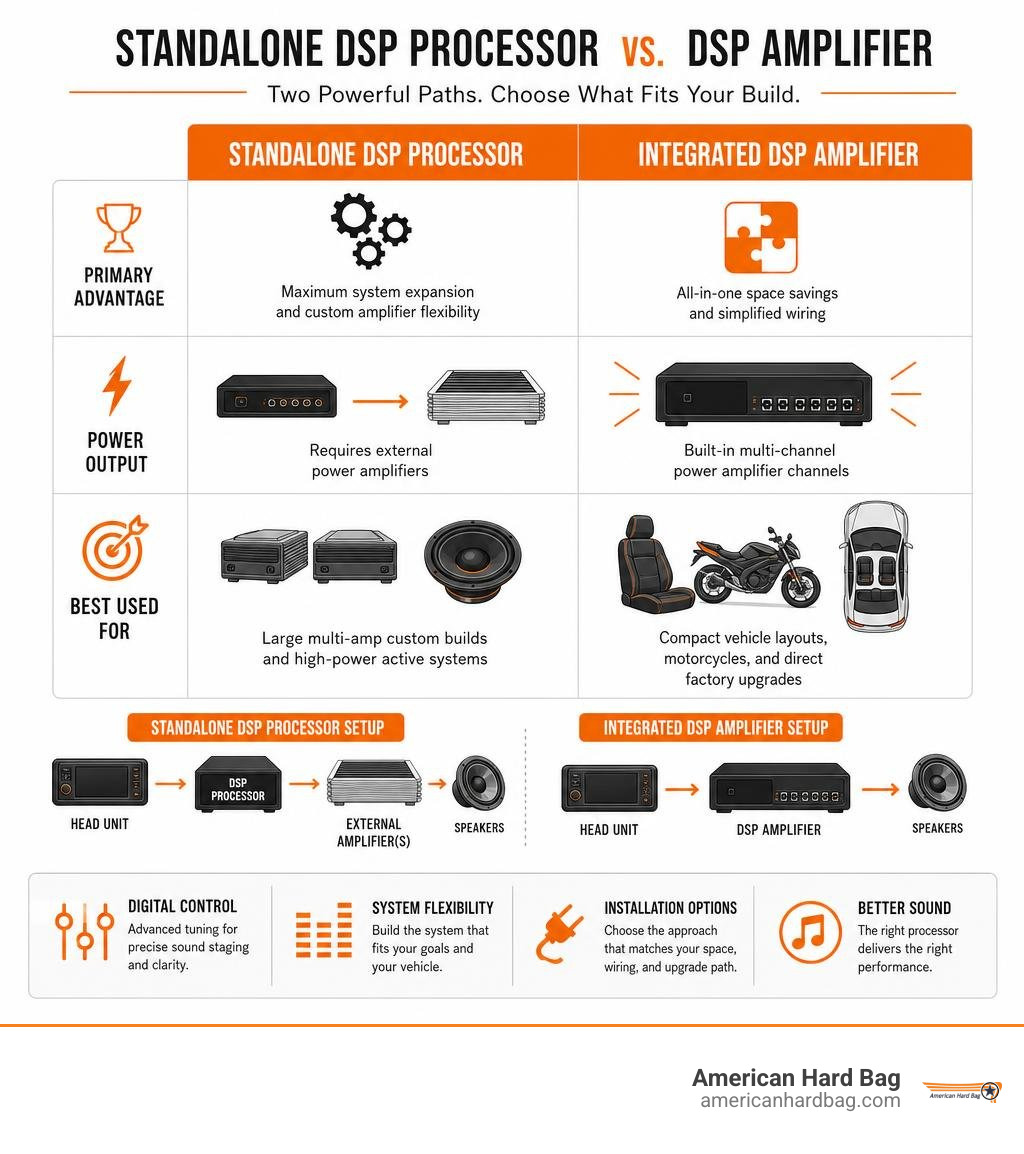
When shopping for signal processors, you will find two primary hardware layouts: standalone digital signal processors and integrated DSP amplifiers. Choosing between them depends on your space constraints, channel count requirements, and overall build strategy.
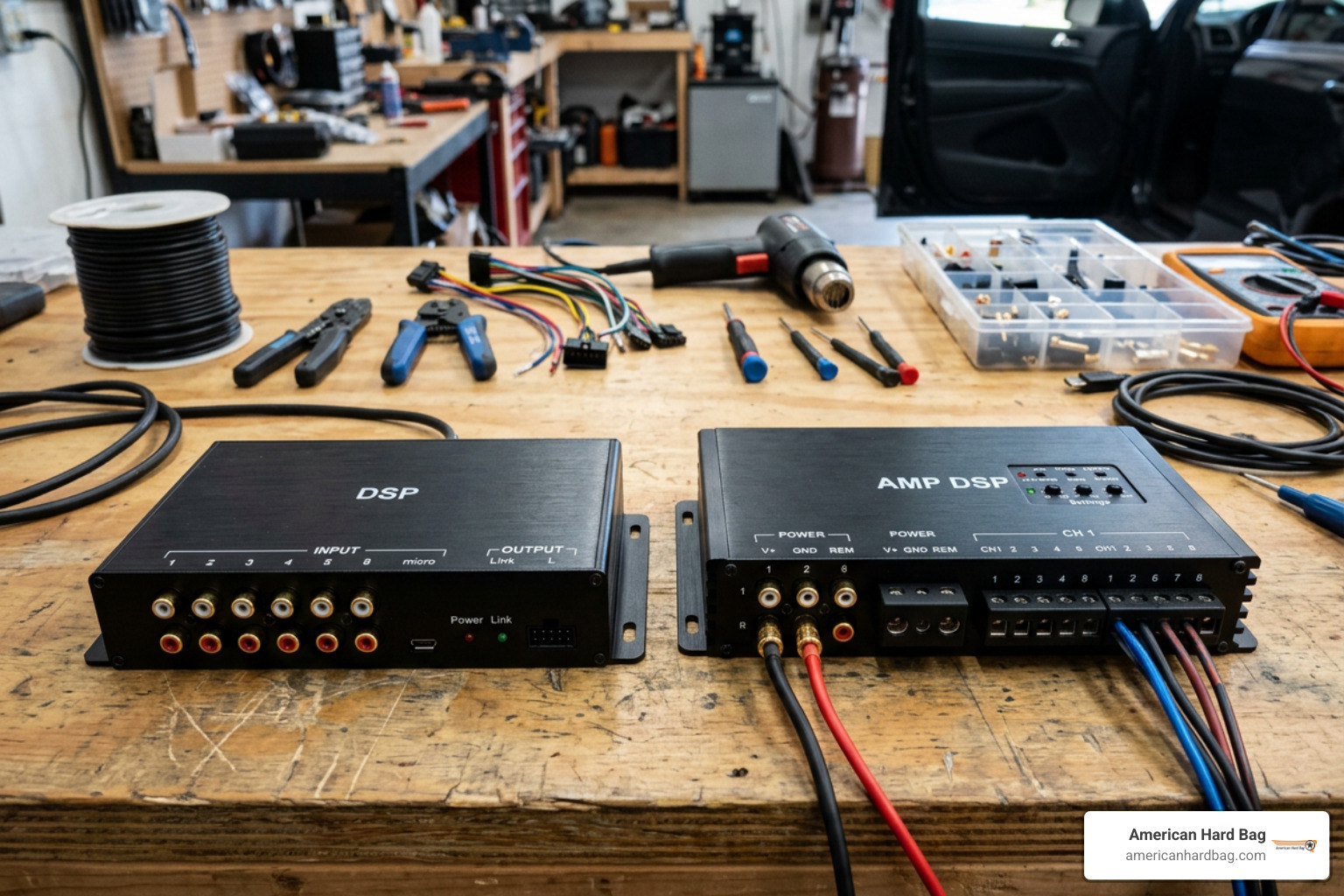
A standalone DSP serves strictly as an audio processing engine. It takes input signals from your head unit, processes the audio digitally, and sends low-level RCA signals out to dedicated external amplifiers. Standalone processors offer maximum system flexibility, higher processing power, and the ability to drive massive high-output external amplifiers.
Conversely, a DSP amplifier combines a multi-channel signal processor and a high-efficiency multi-channel power amplifier into a single compact chassis. A DSP amp drastically reduces installation complexity and saves valuable space under seats or in tight compartments. To better understand how integrated multi-channel units operate, read our complete guide on Helix M Four DSP Amplifier Sound Processor Functions and Interface Guide.
| Feature / Aspect | Standalone DSP Processor | Integrated DSP Amplifier |
|---|---|---|
| Primary Advantage | Maximum system expansion and custom amplifier flexibility | All-in-one space savings and simplified wiring |
| Power Output | Requires external power amplifiers | Built-in multi-channel power amplifier channels |
| Best Used For | Large multi-amp custom builds and high-power active systems | Compact vehicle layouts, motorcycles, and direct factory upgrades |
| Wiring Complexity | High (multiple RCA interconnects and power leads) | Moderate (single chassis connection point) |
| Upgrade Path | Easy to upgrade amplifiers without changing the DSP | Upgrading power requires adding external amplifiers to pass-through channels |
Key Hardware Features to Look For
To ensure your dsp processor car audio setup delivers reference-grade performance, evaluate key internal hardware specifications before buying:
- Channel Count (Inputs & Outputs): Count the individual speakers in your active setup. A 2-way front active system (tweeters, mid-woofers, subwoofer) requires 5 output channels. A complex surround system with rear fill and multi-stage front speakers may require 8 to 12+ channels. Ensure your chosen DSP has enough processing output channels for each individual speaker component.
- Processing Architecture & Speed: Look for floating-point digital signal processors running at 32-bit architectures with clock speeds of 400 MHz or higher (such as SHARC processor chips). High-speed floating-point processing prevents mathematical rounding errors during EQ calculation, maintaining audio clarity. OEM automotive processing chips, such as those detailed in the DRA78x Infotainment Applications Processor datasheet (Rev. H) , highlight how modern VLIW DSP cores handle concurrent multi-channel audio processing without latency.
- Signal-to-Noise Ratio (SNR) & THD+N: Premium car audio processors maintain high Signal-to-Noise Ratios (typically 105 dB to 115+ dB) and ultra-low Total Harmonic Distortion plus Noise (THD+N ratings around 0.0007%). High SNR ensures background engine hum and electrical hiss remain completely silent during quiet musical passages.
- Tuning Software & GUI Interface: Hardware is only as good as the software used to control it. Look for processors that offer clean, intuitive software interfaces for Windows, Mac, or mobile devices via Bluetooth.

How to Install and Tune an Automotive DSP System
Installing and tuning a dsp processor car audio unit requires systematic execution to achieve peak acoustic performance without damaging sensitive speaker components.
Follow these critical steps during installation and configuration:
- Physical & Electrical Connections: Securely mount the processor in a ventilated area away from high-current vehicle wiring. Connect ground directly to chassis metal and run constant 12V power through an inline fuse. Review proper pinout wiring by referencing our guide on DSR1 Installation Connections.
- Initial Crossover Safety Setup: Before turning on your amplifiers, launch the DSP setup software and immediately configure high-pass crossover filters for sensitive tweeters and midrange drivers. Playing low-frequency signals through unprotected tweeters will burn out their voice coils instantly!
- Gain Matching: Adjust input gain stages to ensure clean signal transfer from the factory head unit without clipping the DSP's analog-to-digital converters.
- Signal Routing & Configuration Wizard: Use the software routing matrix to assign input channels to output speaker terminals. You can streamline software routing setup by following the steps in our DSR1 Setup Wizard Tutorial.
- Acoustic RTA Measurement & Tuning: Place a calibrated Real-Time Analyzer (RTA) measurement microphone at the driver's listening position. Play pink noise through the system and analyze the frequency response curve. Adjust parametric EQ bands to match a smooth target curve, flattening cabin resonance peaks and filling acoustic dips. Finally, measure physical distances from each speaker to the microphone to calculate exact millisecond time alignment delays.
While DIY enthusiasts can successfully tune a system using software auto-tuning tools and RTA microphones, professional installation and tuning by an experienced technician ensures maximum staging accuracy and equipment safety.
Frequently Asked Questions About Car Audio Processors
Can I integrate a DSP with a factory OEM head unit?
Yes! Integrating a DSP with a factory head unit is one of the most popular uses for a modern dsp processor car audio unit. Factory head units often feature built-in equalizers that flatten bass output as volume increases to protect cheap factory speakers. A quality DSP with high-level inputs, signal summing, and de-equalization can flatten the factory head unit's altered output signal, providing a clean, full-range audio signal to your aftermarket amplifiers.
How much does a high-quality car audio DSP cost?
Car audio processors span a wide price spectrum based on feature sets, output channel counts, and processing capability:
- Budget & Entry-Level ($85 – $200): Basic 4-channel digital crossovers and entry-level signal processors provide fundamental frequency division and output control.
- Mid-Range Performance ($400 – $800): Versatile 8-channel to 10-channel standalone processors and interactive signal processors deliver robust parametric EQ, time alignment, and active crossovers.
- High-End Reference Grade ($1,200 – $6,000+): Premium processors offer up to 12+ channels of high-resolution processing, ultra-low harmonic distortion, and unmatched signal routing.
What is the difference between an active crossover and a DSP?
A traditional active crossover splits an audio signal into high, mid, and low frequency bands before sending them to amplifiers. While a DSP includes active digital crossovers, it goes far beyond simple frequency splitting. A digital signal processor also incorporates multi-band parametric equalization, signal time delay/alignment, phase correction, channel level balancing, signal de-equalization, and matrix mixing within a single software-controlled platform.
Conclusion
Upgrading your sound with a dsp processor car audio system is the single most effective way to unlock true high-performance sound in an acoustically challenging vehicle or motorcycle cabin. Rather than throwing raw amplifier wattage at acoustic reflections and uneven speaker distances, a DSP precise-tunes your system to overcome physical cabin limitations.
By taking control of crossovers, time alignment, and parametric equalization, you build an immersive soundstage with crystal-clear vocals, punchy mid-bass, and zero distortion. Whether you choose a compact multi-channel unit like our Velocity 8 DSP Amplifier or design a complex multi-amp custom build, adding digital signal processing transforms good hardware into an extraordinary listening experience.
To explore how tailored audio routing and custom signal processing elevate open-air rides, check out our guide on Understanding Harley Davidson Audio from Factory Systems to Custom Setups. For expert guidance on system design, component selection, or custom fitment questions, reach out to our team at American Hard Bag today!