

How to Compare Speaker Grills for Protection and Sound
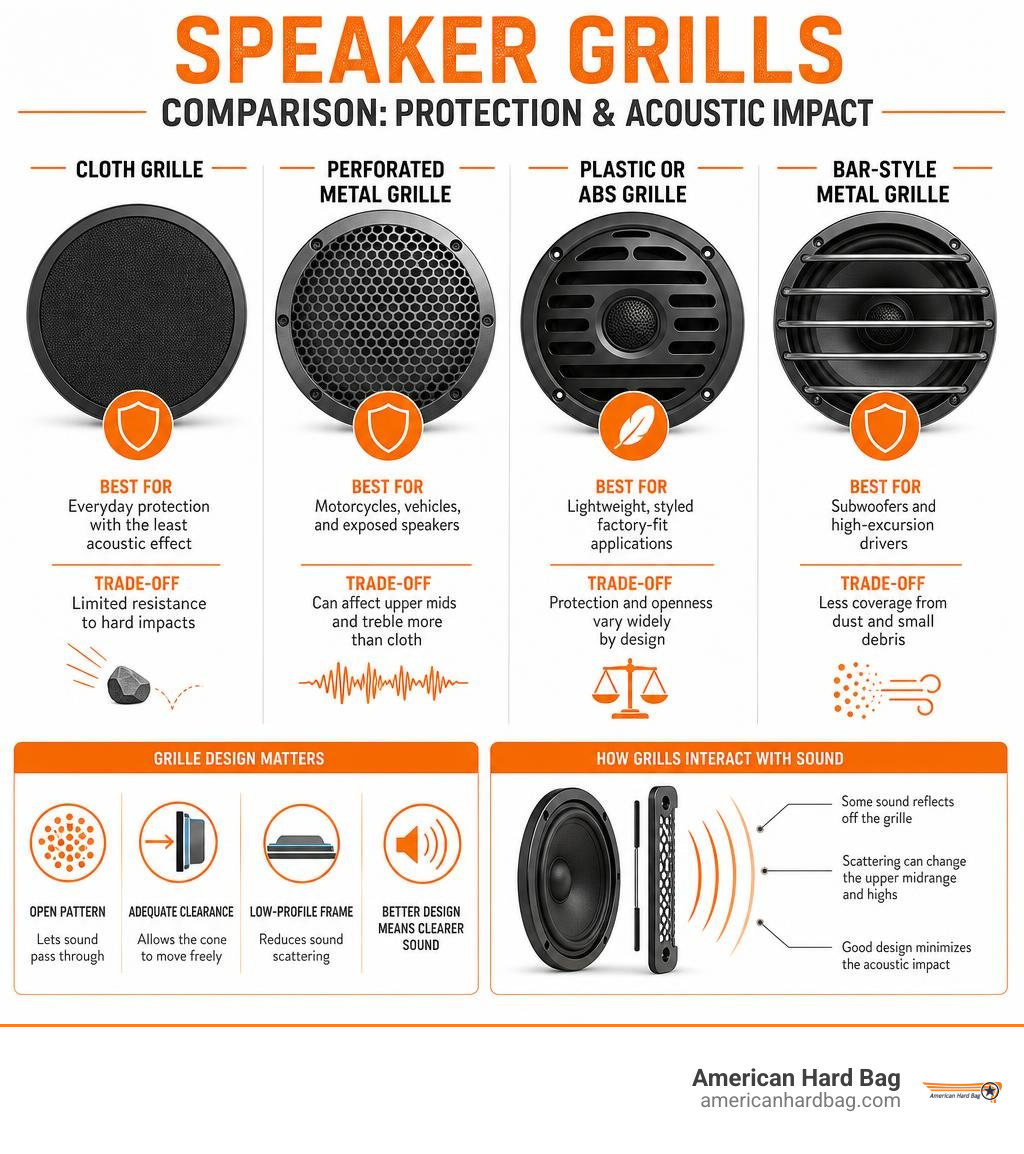
Speaker grills protect delicate speaker cones and tweeters from impact, dirt, and accidental contact. When comparing options, choose the grille that gives your motorcycle audio system enough physical protection without blocking airflow, rattling, or causing more sound change than you can accept.
| Speaker grille type | Best for | Main trade-off |
|---|---|---|
| Soft cloth grille | Everyday protection with the least acoustic effect | Limited resistance to hard impacts |
| Perforated metal grille | Motorcycles, vehicles, and exposed speakers | Can affect upper mids and treble more than cloth |
| Plastic or ABS grille | Lightweight, styled factory-fit applications | Protection and openness vary widely by design |
| Bar-style metal grille | Subwoofers and high-excursion drivers | Less coverage from dust and small debris |
The grille material matters, but the frame matters too. Raised, thick frame edges can scatter sound around the driver, causing small response changes that are most noticeable in the upper midrange and high frequencies. A well-designed grille uses an open pattern, adequate clearance from the moving cone, and a low-profile frame to reduce that effect.
For motorcycle owners, the choice is usually practical: exposed fairing, saddlebag, or trunk speakers need stronger protection than a home bookshelf speaker. Fit, mounting security, vibration control, corrosion resistance, and room for driver movement are just as important as the look.
American Hard Bag builds durable motorcycle accessories for riders who need gear that holds up on the road. Our experience with rugged audio-focused components and speaker grills informs this guide to balancing protection, fit, style, and clear sound.
Primary Purpose and Acoustic Impact of Speaker Grills
At its core, the primary purpose of a speaker grille is straightforward: to act as a physical barrier shielding vulnerable driver components—such as rubber surrounds, paper cones, and delicate dome tweeters—from physical harm, airborne dust, UV radiation, and environmental moisture. However, placing any object directly in front of an active acoustic driver introduces physical interaction with sound waves.
When sound waves pass through a grille, two main phenomena occur: acoustic transmission loss and edge diffraction. Transmission loss refers to the reduction in acoustic energy caused by physical blockage. While acoustically transparent fabrics cause negligible loss across audible frequencies, solid or densely perforated materials reflect or absorb a fraction of the sound energy.
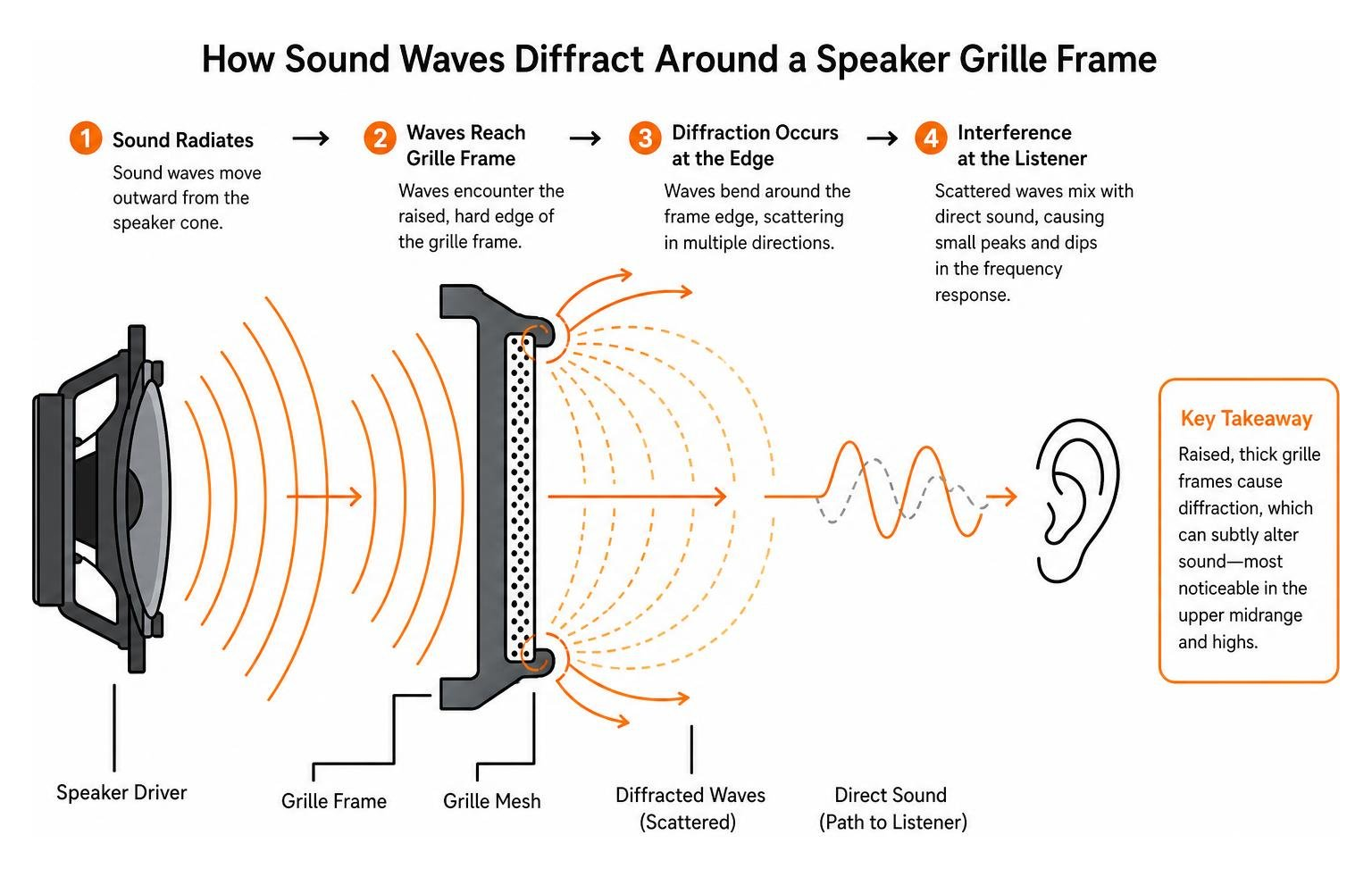
Edge diffraction poses a more noticeable challenge to sound clarity. As sound waves propagate outward from the speaker cone across the front baffle, they hit the raised perimeter edges of the grille frame. These hard edges cause sound waves to refract and scatter, creating tiny phase cancellations and peaks. The practical result is subtle shifts in frequency response, primarily impacting upper midrange and high-frequency dispersion (typically between 2 kHz and 10 kHz).
To compensate for these physical realities, some advanced active speaker systems incorporate smart sensors on the front baffle. When a grille is attached, internal micro-sensors signal the digital signal processor (DSP) to adjust compensation EQ curves automatically. For high-output applications like motorcycle or car audio, choosing well-engineered speaker grills minimizes the need for drastic equalization.
Soft vs Hard Speaker Grills: Protection vs Sound Clarity
Selecting between soft and hard speaker grills comes down to evaluating your physical environment against your acoustic performance goals. Soft grilles—typically constructed from woven fabric or open-cell foam stretched across a lightweight frame—offer superior acoustic transparency. The fabric moves synchronously with minor pressure variations and absorbs cabinet resonance without rattling.
Hard grilles, fabricated from cold-rolled steel, aluminum mesh, or high-impact molded ABS plastic, prioritize extreme impact protection. In environments like high-speed motorcycle rides, crowded vehicle trunks, or marine applications, road debris and accidental bumps will easily tear soft cloth covers. However, hard grilles must be designed with sufficient open area to avoid restrictive acoustic drag.
-
Soft Cloth Grilles:
- Protection: Guards against dust, light debris, and indirect solar exposure; easily punctured by sharp objects.
- Acoustic Effect: Minimal transmission loss; ideal for controlled indoor environments.
- Vibration Characteristics: Natural resonance dampening; virtually immune to high-SPL frame rattling.
-
Hard Metal or Plastic Grilles:
- Protection: Shield against direct impacts, flying gravel, passenger footwear, and heavy cargo.
- Acoustic Effect: Moderate potential for high-frequency reflection and edge diffraction if perforations are too restrictive or frames are bulky.
- Vibration Characteristics: Requires dampening gaskets or firm mechanical fasteners to prevent sympathetic vibrations at high volume levels.
When evaluating subwoofers and high-excursion woofers, peak-to-peak cone motion—known as maximum mechanical excursion ($X_{max}$)—demands primary attention. If a hard grille sits too close to the woofer surround, the cone will strike the internal face of the mesh during deep bass hits, leading to mechanical distortion or driver damage. High-excursion subwoofers often utilize multi-bar steel guards that maintain extreme impact resistance while leaving ample forward clearance for the surround.
Should You Leave Grilles On or Take Them Off?
Audio enthusiasts often debate whether keeping speaker grills attached improves or degrades the listening experience. High-end loudspeaker manufacturers often tune crossover networks and driver alignment under specific operating assumptions. For instance, brands like Dynaudio optimize their drivers without grilles attached, explicitly noting that adding a grille might make critical listening sound slightly less open.
The deciding factors depend on your application:
- Critical Listening and Studio Monitoring: In controlled indoor environments where maximum acoustic detail, pinpoint imaging, and transparent high frequencies are paramount, removing soft grilles eliminates frame diffraction entirely. This is why studio monitors rarely feature grilles.
- Everyday Home Use: If you have pets, young children, or active living spaces, leaving grilles on provides invaluable protection against poked tweeter domes and torn cone surrounds.
- Powersports, Motorcycles, and Marine Systems: On a Harley-Davidson cruising down the highway, taking grilles off is simply not an option. Rain, bugs, kicked-up gravel, and extreme wind resistance will destroy exposed drivers in short order. Here, leaving heavy-duty speaker grills on ensures long-term operational survival.
Material Comparison: Cloth, Metal, and Plastic Covers
The material chosen for a speaker grille defines its durability, aesthetic finish, and resistance to environmental stress. The matrix below outlines how primary materials perform across key criteria:
| Material Type | Structural Rigidity | Environmental Resistance | Acoustic Transparency | Primary Application |
|---|---|---|---|---|
| Acoustically Transparent Fabric | Low | Low (absorbs moisture/UV damage) | Very High (98%+) | Indoor home audio, vintage hi-fi |
| Stamped Steel Mesh | Very High | Medium to High (requires coating) | Medium to High | Powersports, heavy subwoofers, pro audio |
| Aluminum Mesh | High | Excellent (naturally rust-proof) | High | Custom automotive, marine environments |
| Molded ABS Plastic | Medium to High | High (UV and moisture resistant) | Medium (depends on pattern design) | Factory automotive, architectural ceiling speakers |
Architectural, In-Wall, and In-Ceiling Applications
Architectural audio installations in luxury residences, restaurants, and corporate environments demand discreet visual integration. In-wall and in-ceiling speaker grills utilize ultra-thin, low-profile bezel designs that sit virtually flush against drywall or ceiling panels. Modern implementations, such as those detailed in the Spec Sheet: SPKA‑GRILLE, rely on paintable steel and aluminum micro-perforated faces backed by acoustically transparent scrim cloth.
By allowing installers to spray paint the metal mesh and ABS bezel to match exact wall paint colors, architectural grilles visually disappear without smothering high-frequency clarity.
Outdoor, Marine, and High-Vibration Enclosures
Outdoor environments introduce harsh elements like saltwater spray, direct ultraviolet radiation, road grime, and heavy engine vibration. Standard indoor fabric covers or raw steel grilles quickly deteriorate, rust, or tear under these conditions.
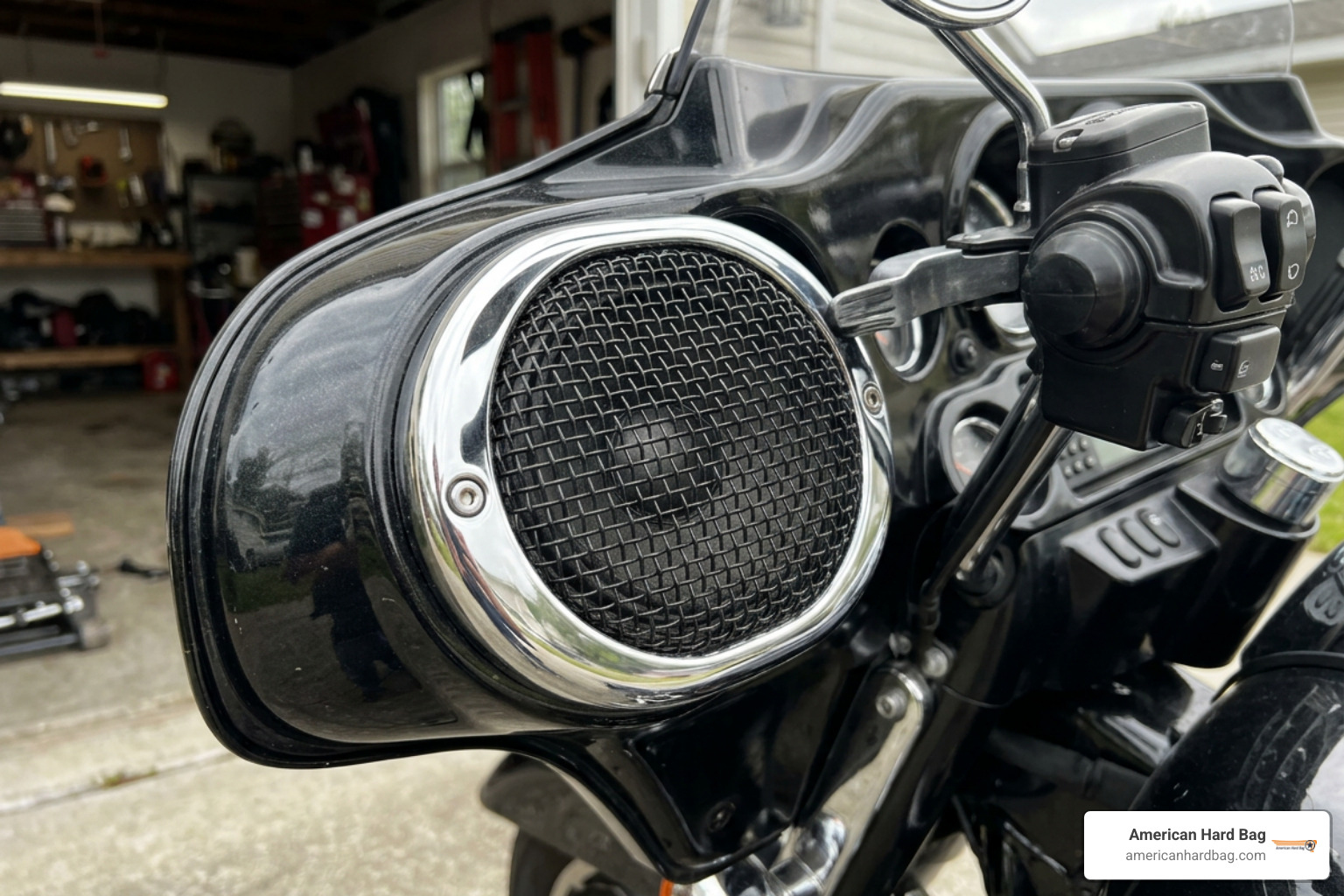
High-grade marine and motorcycle systems utilize electroplated steel or powder-coated aluminum. Electroplating applies a protective metallic layer that undergoes rigorous salt spray testing to prevent oxidation in coastal or wet weather conditions. Specialized mounting mechanisms, like those seen in the GLI Series - TwistFix™ grill for CIRA ceiling speakers, use bayonet-style locking tabs or heavy-duty rubberized retainers to withstand sustained structural vibrations without backing off.
For detailed recommendations on fitting rugged, weatherproof protection on mobile platforms, review our Car Speaker Grill Covers Guide 2026 to learn how material thickness and mounting security keep drivers safe on the open road.
Modern Mounting Systems and DIY Fabrication
How a grille attaches to an enclosure or fairing determines its serviceability, visual appearance, and resistance to high-SPL vibration. Traditional installations relied on friction-fit plastic ball-and-socket pins or direct perimeter screws. Modern designs have evolved significantly:
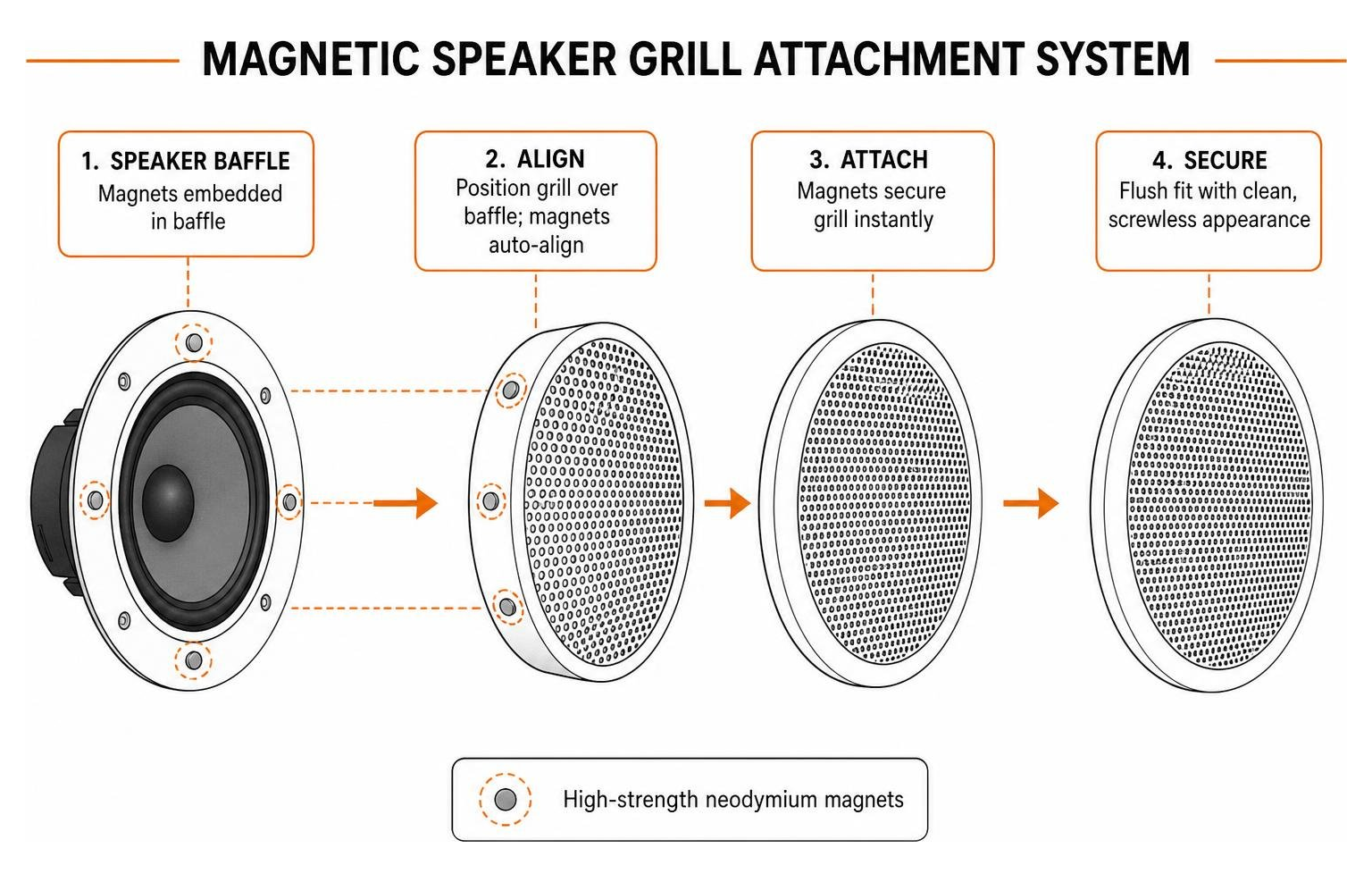
- Magnetic Attachment: High-strength neodymium (rare earth) magnets are embedded directly into the speaker baffle and grille frame. This system provides a clean outer appearance free from screw heads, installs instantly without tools, and automatically aligns the grille face.
- Twist-Lock / Bayonet Systems: Used frequently in ceiling and outdoor applications, internal tabs slide into matched retention slots and lock with a short rotational turn.
- Direct Screw Flange: Preferred for extreme powersports environments where intense high-frequency vibration and wind shear require an unshakable mechanical bond.
Key Engineering Considerations for Custom Speaker Grills
Building or customizing your own speaker grills offers complete freedom over styling and acoustics, but attention to engineering details is mandatory. Enthusiasts sharing practical knowledge in community discussions like the speaker grill tips | diyAudio thread emphasize several critical steps:
- Frame Depth and Cone Clearance: Measure the total driver cone and surround excursion ($X_{max}$) during full playback. Ensure the inside frame depth leaves at least 3/8-inch of clearance beyond maximum peak excursion so the driver surround never impacts the frame face.
- Evaluating Acoustic Transparency (The Light Test): When selecting fabric covers, hold the material up to a bright direct light source. If light passes through the open weave easily and you can see shapes through it, air sound waves will pass through with minimal high-frequency dampening. Heavy upholstery fabrics block light and will muffle your audio.
- Perforation Hole Patterns: For custom sheet metal or aluminum grilles, use staggered hole configurations (typically 1/16", 5/32", or 3/16" hole diameters). Staggered hole layouts maximize structural impact resistance while maintaining a 60% or higher open surface area for acoustic transmission.
- MDF and Polymer Frame Selection: Medium-Density Fiberboard (MDF) or CNC-machined ABS plastics make stable frame materials. Maintain frame perimeter widths of 1 inch or less to preserve structural strength without creating a wide physical barrier in front of the speaker.
Optimizing Frame Geometry to Reduce Edge Diffraction
To prevent grille frames from degrading stereo imaging and trebles, pay close attention to frame geometry. A thick, boxy frame with sharp 90-degree internal edges acts as a secondary sound radiator, scattering upper-frequency acoustic waves.
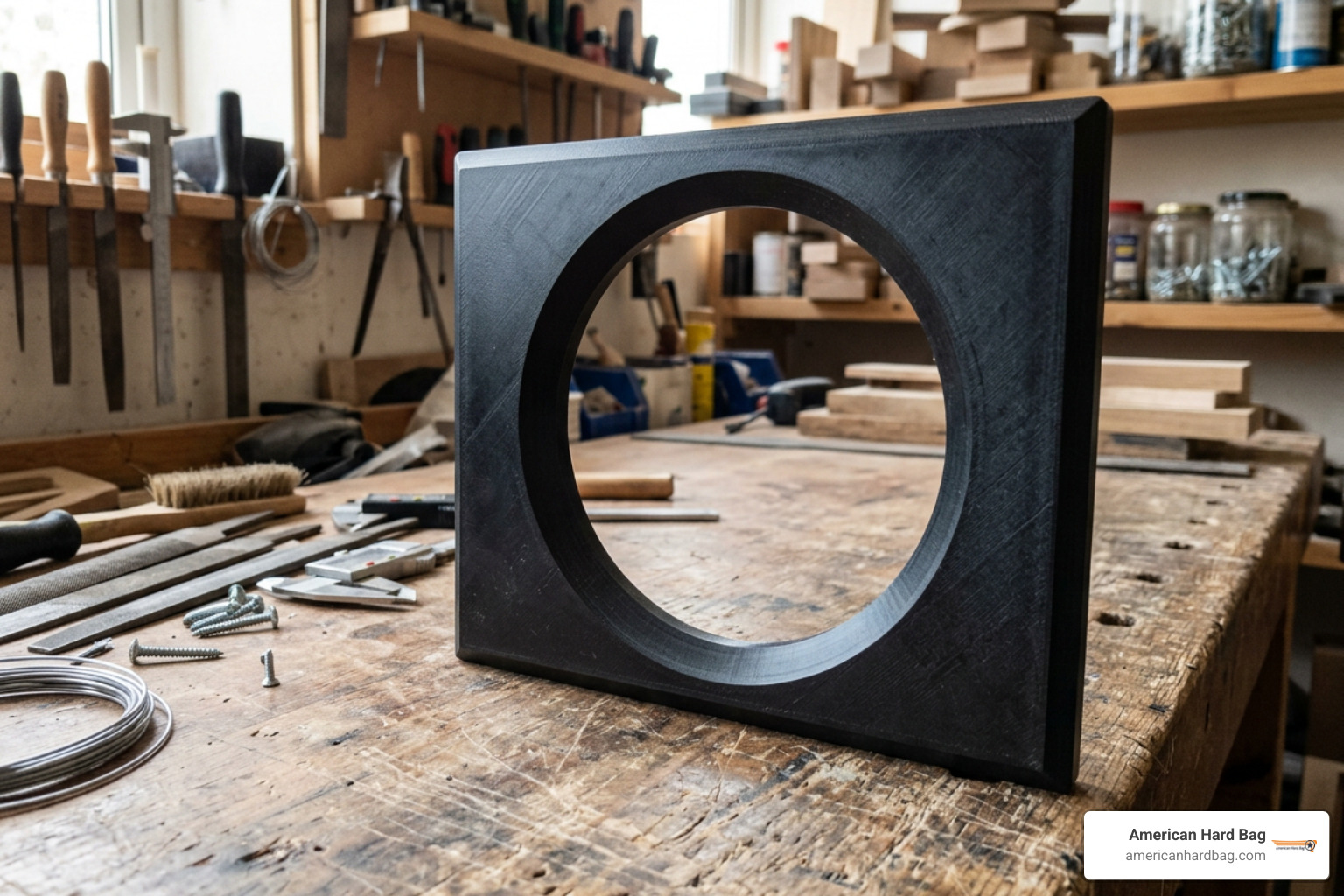
You can significantly reduce edge diffraction by applying a 45-degree chamfer or generous radius curve to the inside perimeter edge of the grille frame facing the speaker cone. Slanted inner walls allow high-frequency sound waves radiating at wide dispersion angles to clear the frame smoothly without bouncing back toward the cone surface. Smoothly contoured outer frame edges further prevent secondary reflections across the front baffle.
Frequently Asked Questions
Do grilles muffle treble frequencies?
Heavy, solid materials or non-breathable fabrics will attenuate high frequencies, making audio sound dull or muffled. However, acoustically transparent polyester fabric or perforated metal mesh with a high open-area percentage allows treble frequencies to pass through with less than 1 dB of loss. The most noticeable sound alteration usually comes from edge diffraction off thick frame walls rather than the grille fabric itself.
How do magnetic mounts stay secure on motorcycles?
Motorcycle applications require specialized magnetic mounting systems compared to indoor home speakers. High-energy neodymium (rare earth) magnets are recessed into high-impact composite frames, creating an exceptionally strong magnetic lock. Combined with custom-molded fairing recesses that lock the outer lip in place against wind shear, modern magnetic designs—such as those featured in our Road Glide Speaker Grills with Tweeters—stay firmly attached even under heavy highway vibration and sudden bumps.
How can you test if fabric is acoustically transparent?
The simplest field test is the visual light transmission test. Hold the fabric up toward a bright lamp or natural daylight. If light shines through the weave structure easily and you can clearly see light patterns, air and sound waves can move through with minimal restriction. Alternatively, place the fabric over your face and blow air through it; if you feel virtually zero resistance, the fabric is suitable for speaker applications.
Conclusion
Choosing the right speaker grills requires balancing physical protection against uncompromised acoustic fidelity. Soft fabric grilles work exceptionally well for indoor environments where acoustic clarity is critical and impact risks are low. Conversely, rugged motorcycles, vehicles, and exposed enclosures demand cold-rolled steel, aluminum mesh, or reinforced ABS plastic designed to absorb heavy impacts, resist weather exposure, and stay securely fastened at high speeds.
By selecting low-profile frames with chamfered inner geometry, verifying adequate cone excursion clearance, and using high-transparency perforation patterns, you enjoy maximum driver safety without sacrificing sound quality.
At American Hard Bag, we engineer high-performance audio upgrades specifically built to withstand the demands of the open road. Explore The Ultimate Guide to Upgrading Your Harley Audio System to discover how our plug-and-play speakers, amplifiers, and custom speaker grills deliver high-power sound engineered for your ride.