

Why a Lithium Battery Can Transform Your Motorcycle Power Setup
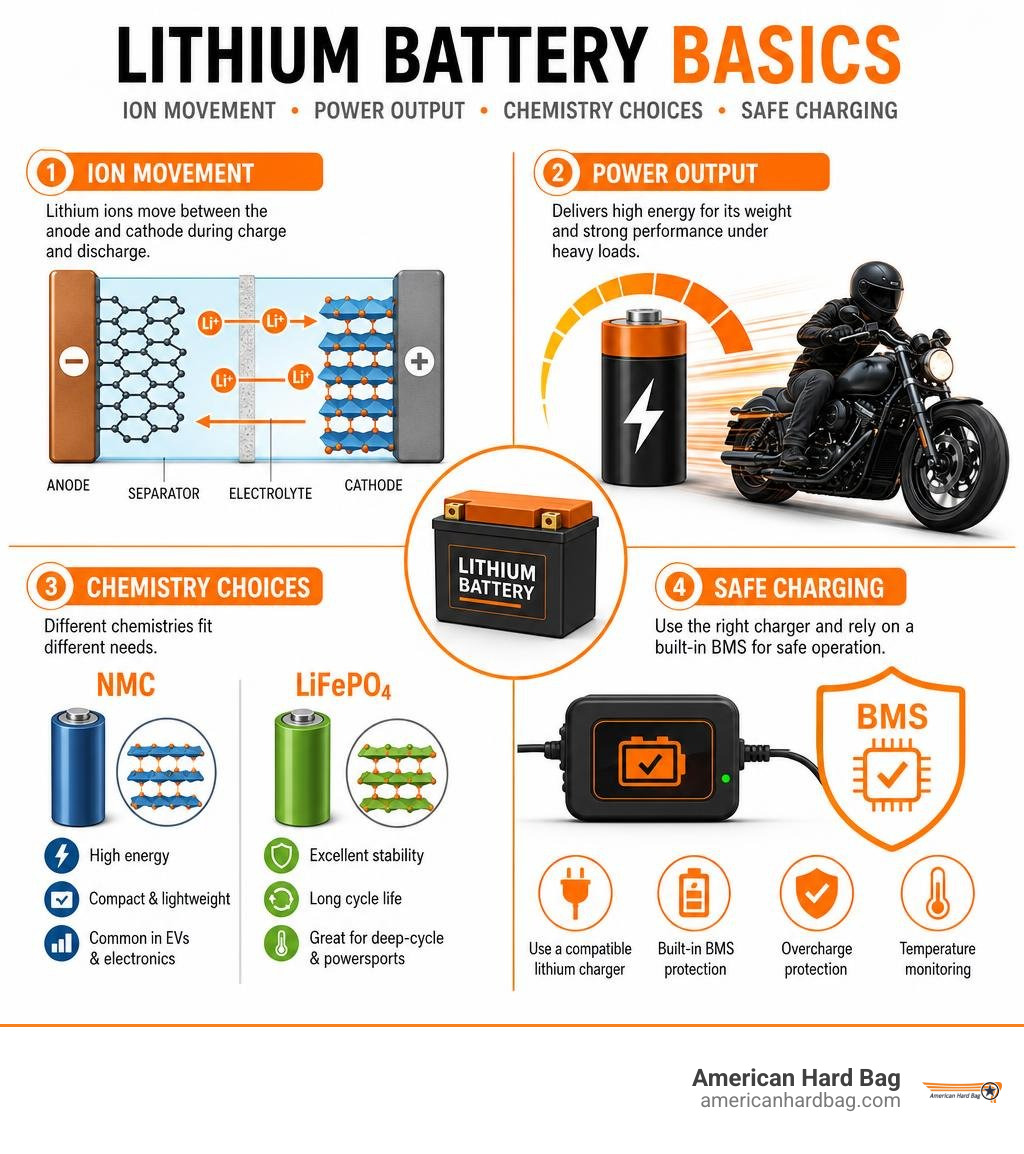
A lithium battery stores and releases electrical energy by moving lithium ions between two internal electrodes. Compared with a traditional lead-acid or AGM battery, it can deliver far more energy for its weight, hold voltage more steadily under heavy loads, and recharge efficiently. That makes lithium especially useful for motorcycle audio systems, where amplifiers can demand short bursts of high current.
For a motorcycle upgrade, start with three checks:
- Match the battery's voltage to your bike's electrical system.
- Confirm its continuous and peak discharge ratings can support the amplifier.
- Use a compatible lithium charger and a battery with a built-in Battery Management System (BMS).
Lithium-ion batteries come in several chemistries. High-energy types such as NMC are common in compact electronics and electric vehicles, while lithium iron phosphate (LiFePO4) is often preferred for deep-cycle and powersports use because it offers strong thermal stability and a long service life. Modern lithium-ion cells can provide roughly 160 to 300 Wh/kg, while typical designs lose only about 0.35% to 2.5% of their charge each month.
American Hard Bag builds durable motorcycle hard bags and accessories for riders who need reliable gear on the road. Our experience around lithium battery upgrades for motorcycle accessories and audio-focused setups helps us explain the power, fitment, charging, and safety details that matter before you install.
Introduction
Modern electrical systems demand more power in smaller, lighter enclosures than ever before. Since the commercial introduction of rechargeable lithium cells in 1991, the global energy storage landscape has evolved dramatically. Between 1991 and 2024, the unit cost of lithium storage declined by roughly 99%—dropping by about 19% for every doubling of cumulative installed capacity—while volumetric energy density more than tripled. By late 2024, annual global demand surged past 1 terawatt-hour (TWh), with widespread adoption spanning electric transportation, residential off-grid systems, and high-performance powersports.

At its foundation, an advanced energy storage unit relies on precision-layered electrochemistry. Standard commercial cells achieve specific energies of 160–300 Wh/kg (and up to 450 Wh/kg in specialty designs) alongside volumetric energy densities of 250–842 Wh/L. In high-demand powersports and touring platforms, switching from legacy lead-acid units to modern cell formats eliminates up to 65% of battery weight while delivering flat discharge curves that sustain high voltage under extreme amplifier draw.
Core Chemistry: How a Modern Lithium Battery Generates and Stores Power
A lithium cell operates as an electrochemical transducer, converting chemical energy into electrical current through reversible oxidation-reduction reactions. Unlike disposable primary cells, rechargeable secondary cells utilize specialized host matrices that allow lithium ions to enter and exit without destroying the host material's physical lattice.
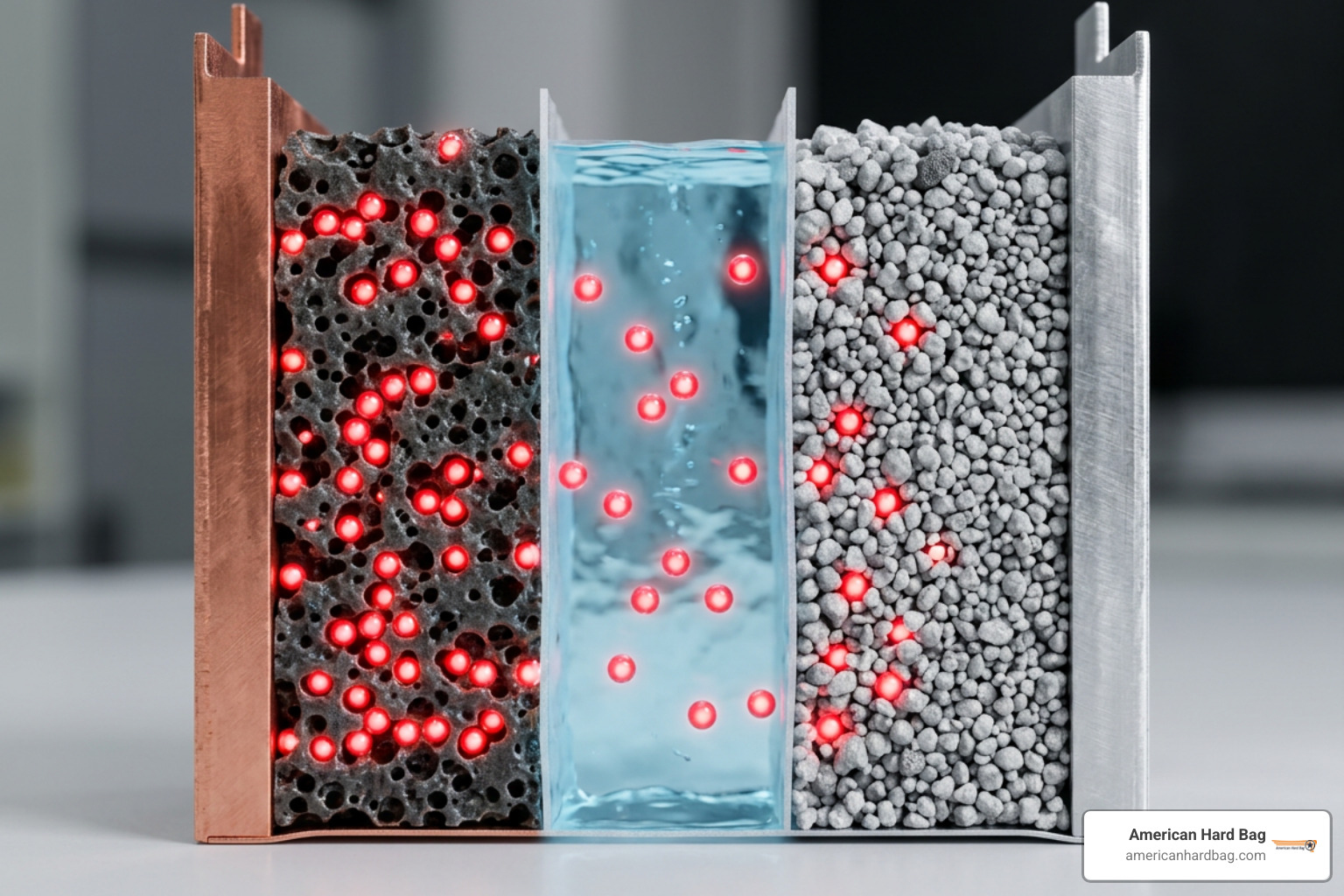
The basic architecture includes four primary components:
- Cathode (Positive Electrode): A transition metal oxide or metal phosphate substrate (such as LiCoO₂, NMC, NCA, or LiFePO₄) applied onto an aluminum current collector foil.
- Anode (Negative Electrode): A layered crystalline carbon matrix (graphite) or a silicon-graphite composite applied onto a copper current collector foil.
- Electrolyte: An organic carbonate solvent solution (e.g., ethylene carbonate and dimethyl carbonate) holding dissolved lithium salts like lithium hexafluorophosphate (LiPF₆).
- Separator: A microporous polyolefin membrane that physically isolates the anode and cathode to prevent internal short circuits while allowing solvated lithium ions to pass freely.
The cell operates via reversible intercalation mechanisms. The open-circuit nominal cell voltage (typically 3.2V to 3.7V depending on chemistry) reflects the potential difference between the negative anode (~0.1V vs. Li/Li⁺) and the positive cathode (up to ~3.9V–4.2V vs. Li/Li⁺). Modern cells achieve Coulombic efficiencies exceeding 99%, meaning nearly all electrons pumped into the cell during charging are recovered during discharge.
Intercalation Dynamics and Cell Architecture
Because lithium ions swing back and forth between the positive and negative electrodes during alternating charge and discharge states, electrochemists frequently refer to these designs as "rocking-chair batteries."
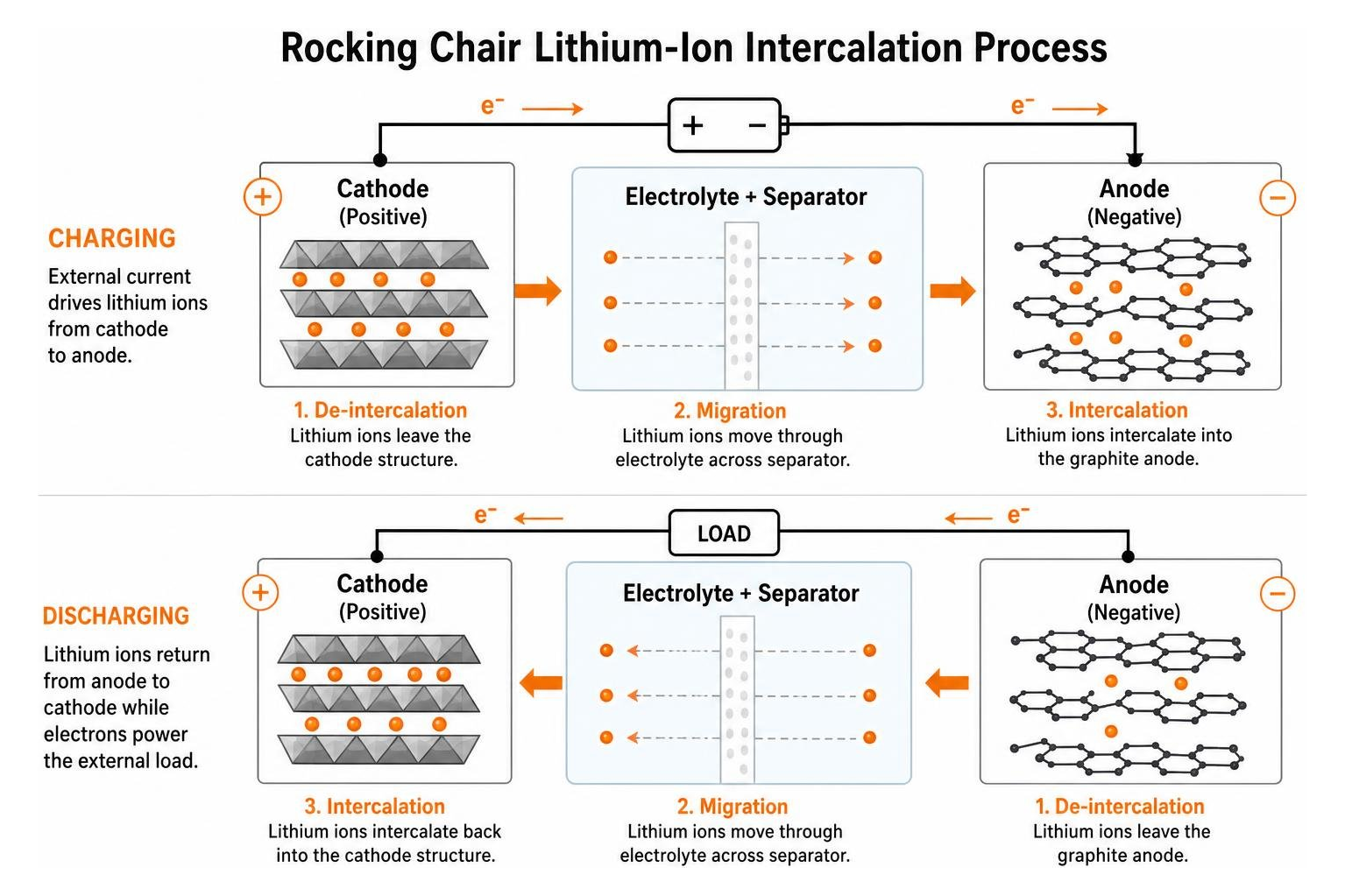
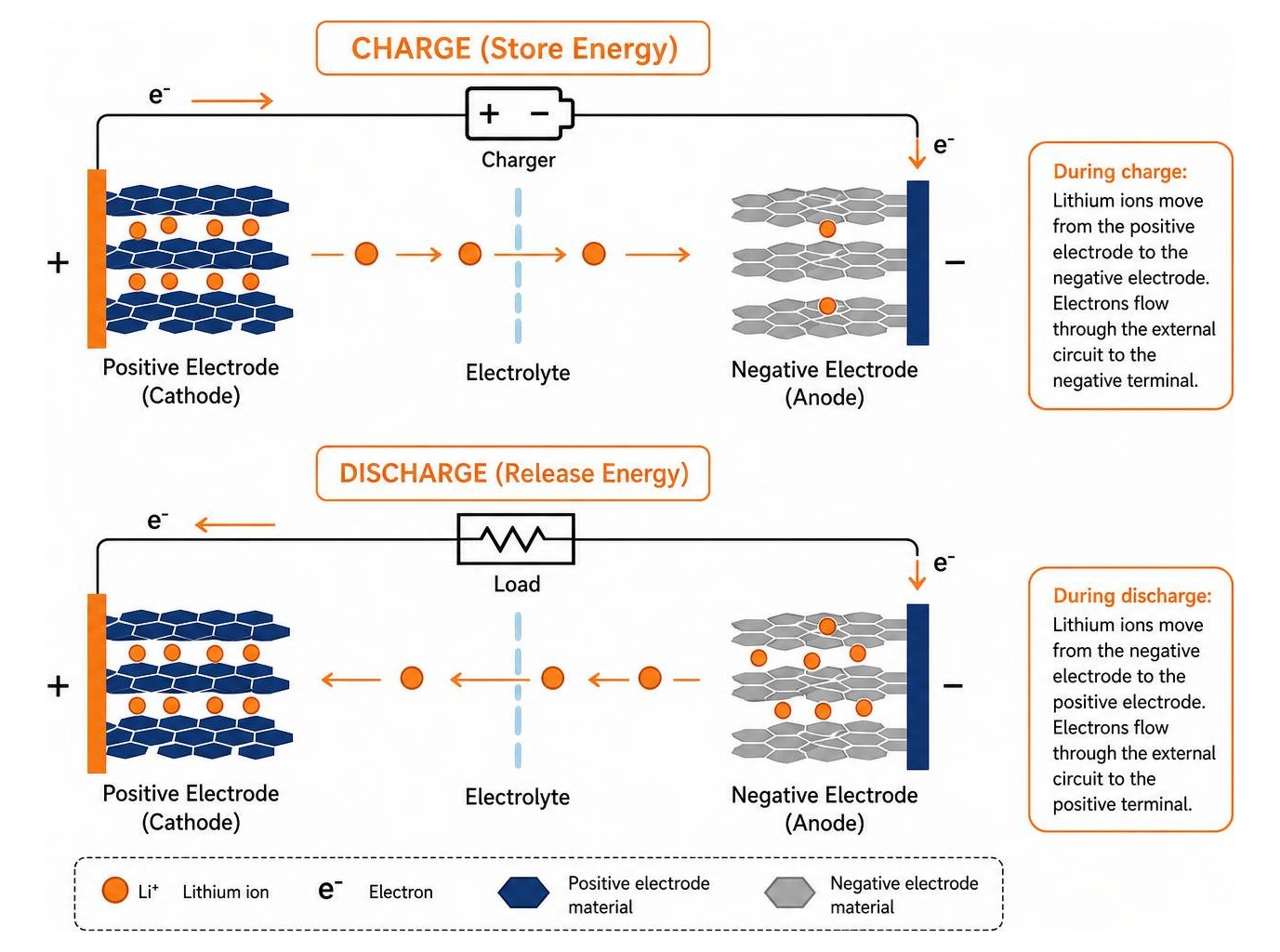
During charging, external current forces electrons out of the positive transition metal cathode. Lithium ions de-intercalate from the cathode crystal structure, dissolve into the organic electrolyte, migrate across the porous separator membrane, and intercalate between the graphene sheets of the negative graphite anode. When powering an external load (like a motorcycle audio amplifier), this dynamic reverses: lithium ions de-intercalate spontaneously from the anode, migrate through the separator, and re-enter the cathode lattice, while electrons flow through the external electrical circuit.
Cell architecture fundamentally dictates internal resistance (IR) and heat dissipation. Common formats include:
- Cylindrical Cells (e.g., 18650, 21700, 4680): Feature tightly wound "jelly-roll" electrode layers enclosed in rigid steel cans equipped with internal current interrupt devices (CID) and pressure-relief vents.
- Prismatic Cells: Large-format rectangular cells housed in welded aluminum or steel enclosures that optimize packaging efficiency in heavy-duty battery banks.
- Pouch Cells: Layered or folded electrode assemblies sealed in flexible laminated aluminum foil packages, maximizing active volume at the expense of external structural rigidity.
Solid Electrolyte Interphase (SEI) Formation and Degradation
During a newly assembled cell's initial charging cycle (formation cycling), the operating potential of the graphite anode drops below the electrochemical reduction threshold of the organic carbonate solvent. The electrolyte decomposes against the anode surface, creating a protective, passivating film known as the Solid Electrolyte Interphase (SEI).
A stable SEI layer is electrically insulating to prevent unchecked electrolyte breakdown, yet ionically conductive to allow Li⁺ ions to pass through. However, initial SEI growth irreversibly consumes 5% to 15% of the cell's active lithium inventory, representing the primary initial cycle capacity loss. Over thousands of operational hours, physical expansion and contraction of the electrode particles crack this protective film. As fresh electrode surfaces are exposed, further electrolyte decomposition occurs, causing gradual impedance growth, capacity fade, and calendar aging.
Comparing Battery Chemistries: Performance, Lifespan, and Energy Density
Selecting an energy storage setup requires matching chemical properties to operational demands. While deep-cycle leisure and powersports platforms benefit from exceptional thermal safety and extended cycle counts, consumer electronics demand maximum volumetric runtime. For heavy-duty audio applications where traditional charging parameters are mandatory, some riders still evaluate dedicated AGM battery options, though modern lithium chemistries deliver distinct weight and voltage stability advantages.
| Chemistry Metric | Lithium Iron Phosphate (LiFePO4 / LFP) | Nickel Manganese Cobalt (NMC / Li-ion) | Absorbed Glass Mat (AGM Lead-Acid) |
|---|---|---|---|
| Nominal Cell Voltage | 3.2 V | 3.6 V – 3.7 V | 2.0 V (12V Pack = 6 cells) |
| Specific Energy | 90 – 160 Wh/kg | 160 – 280 Wh/kg | 30 – 50 Wh/kg |
| Volumetric Energy Density | 220 – 350 Wh/L | 300 – 700 Wh/L | 60 – 100 Wh/L |
| Cycle Durability (80% DoD) | 3,000 – 5,000+ cycles | 1,000 – 2,000 cycles | 300 – 500 cycles |
| Thermal Runaway Threshold | ~270°C (518°F) | ~150°C – 210°C (302°F–410°F) | N/A (Thermal dry-out risk) |
| Round-Trip Efficiency | 92% – 96% | 85% – 92% | 70% – 80% |
| Weight Comparison (100Ah eq.) | ~25 – 30 lbs | ~18 – 22 lbs | ~65 – 75 lbs |
Li-Ion vs. LiFePO4: Choosing the Right Lithium Battery Chemistry
The primary performance differences between lithium chemistries stem from their positive cathode crystal structures. Nickel-rich formulations like NMC (LiNixMnyCozO₂) and NCA (LiNixCoyAlzO₂) utilize layered oxide structures. These dense lattices yield exceptional energy density, making them ideal for long-range electric vehicles and lightweight electronics. However, their layered metal-oxygen bonds can destabilize at elevated temperatures (~150°C to 210°C), releasing oxygen gas that can fuel internal combustion.
In contrast, Lithium Iron Phosphate (LiFePO₄) incorporates a three-dimensional olivine crystal structure. The robust covalent phosphorus-oxygen (P–O) bonds hold oxygen firmly within the molecular framework, raising the thermal runaway threshold to roughly 270°C.
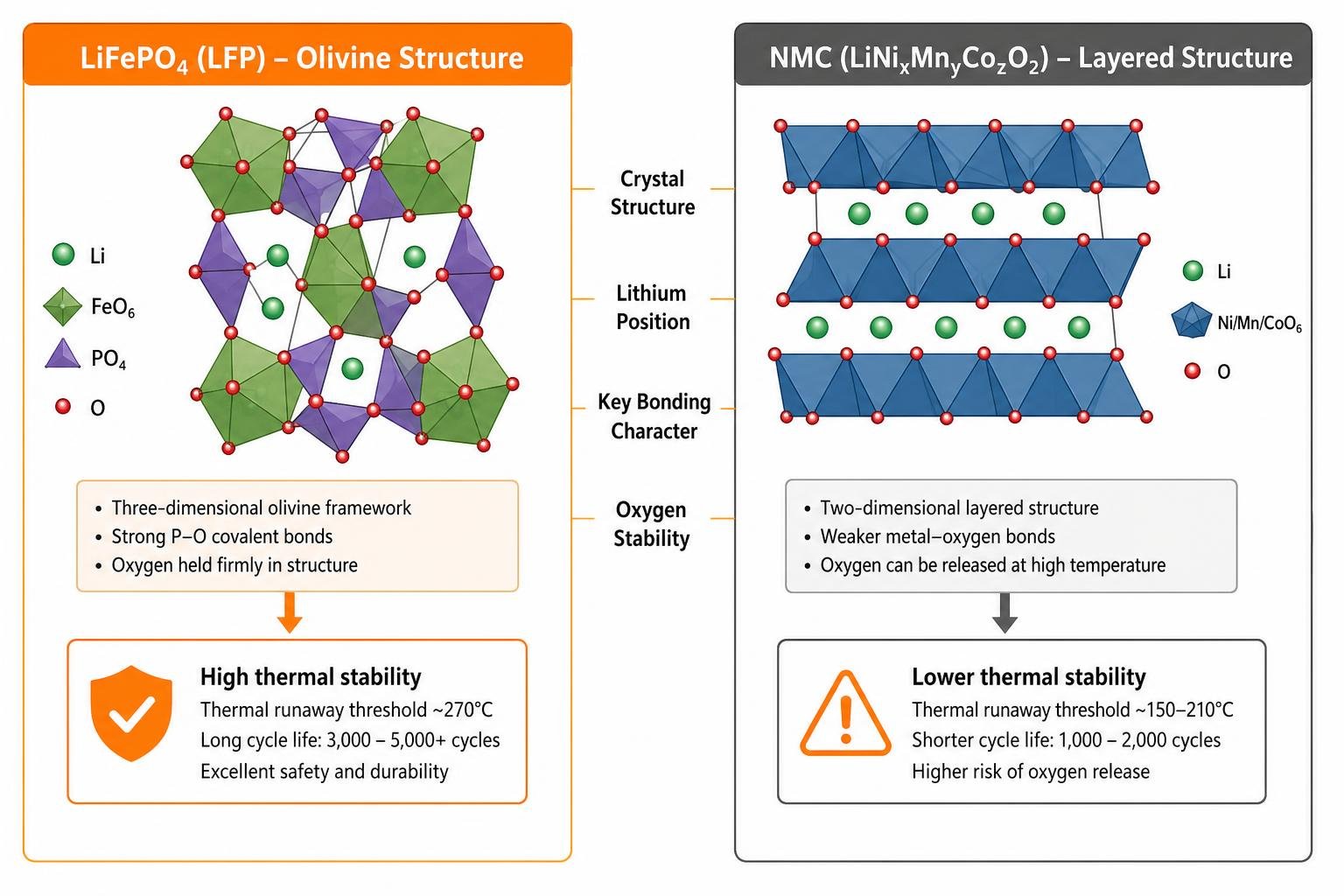
Because LFP cells avoid thermal runaway under normal stress, offer over 5,000 cycles at 80% Depth of Discharge (DoD), and handle rapid transient electrical draws without voltage drop, they serve as the industry benchmark for powersports, marine trolling, and high-performance audio systems. Riders seeking superior continuous output regularly choose high-output battery lithium upgrades built on stable LiFePO₄ cells.
Pouch Cells and Lithium Polymer Alternatives
Lithium polymer (LiPo) designs replace liquid organic carbonates with gel polymer electrolytes (GPE) or dry solid polymer electrolytes (SPE) housed in ultra-thin laminated aluminum foil packaging. The flexible lithium polymer architecture allows manufacturers to mold cells into custom shapes for drones, smartphones, and tight audio fairings.
Despite their packaging flexibility and high discharge rates, pouch-style polymer cells present unique mechanical risks. Without a rigid metal exterior to contain internal pressure, abusive overcharging or elevated temperatures can cause the polymer layers to delaminate and gas out, inflating the casing like a balloon. Consequently, rugged mobile applications rely on rigid cylindrical or aluminum-jacketed prismatic cells for maximum impact and vibration resistance.
Safety Systems and Thermal Management in Advanced Packs
High-energy-density batteries require integrated electronic and mechanical safety systems. Pack designs certified to UL 1973 (stationary and motive power systems) and constructed using UL 1642 recognized cells undergo severe mechanical abuse testing, including nail penetration, crush resistance, overcharge tolerance, and external short-circuit exposure.
A high-performance lithium pack incorporates multiple protective layers:
- Microprocessor-Controlled Battery Management System (BMS): An intelligent circuit board that monitors individual cell voltages, aggregate current flow, and pack temperatures.
- Solid-State MOSFET Switches: High-speed electronic disconnects that instantly isolate the battery terminals under short-circuit, over-current, or extreme voltage conditions.
- Active/Passive Cell Balancing: Resistor networks that bleed energy from high-voltage cells or transfer charge between cells to maintain consistent state of charge across the entire pack.
- Ceramic-Coated Separators: Micro-porous barriers engineered to maintain physical separation between anode and cathode even under localized thermal stress.
Mitigating Thermal Runaway with Smart BMS and Non-Flammable Electrolytes
Thermal runaway occurs when an internal fault, extreme overcharging, or physical trauma triggers exothermic chemical decomposition inside a cell. As rising internal temperatures break down the SEI layer, the electrolyte oxidizes against the cathode, generating self-sustaining heat and combustible gases.
Modern smart BMS architectures prevent this cycle by maintaining multi-point temperature monitoring and executing sub-millisecond high-voltage cutoffs. Recent breakthroughs in non-flammable electrolyte formulations—such as solvent blends containing weakly solvating fluorinated additives (like DFEC and PFPN) paired with LiBF₄ salts—speed up lithium desolvation while eliminating flammable vapor production under direct mechanical penetration.
Low-Temperature Operation and Vertical Heat Conduction
A critical physical limitation of lithium batteries is low-temperature charging. Charging standard cells below freezing (0°C / 32°F) slows ion diffusion through the electrolyte and increases graphite intercalation resistance. Instead of smoothly intercalating into the anode, incoming lithium ions accumulate on the graphite surface as metallic lithium dendrites. These sharp metallic formations can pierce the separator membrane and cause catastrophic internal short circuits.
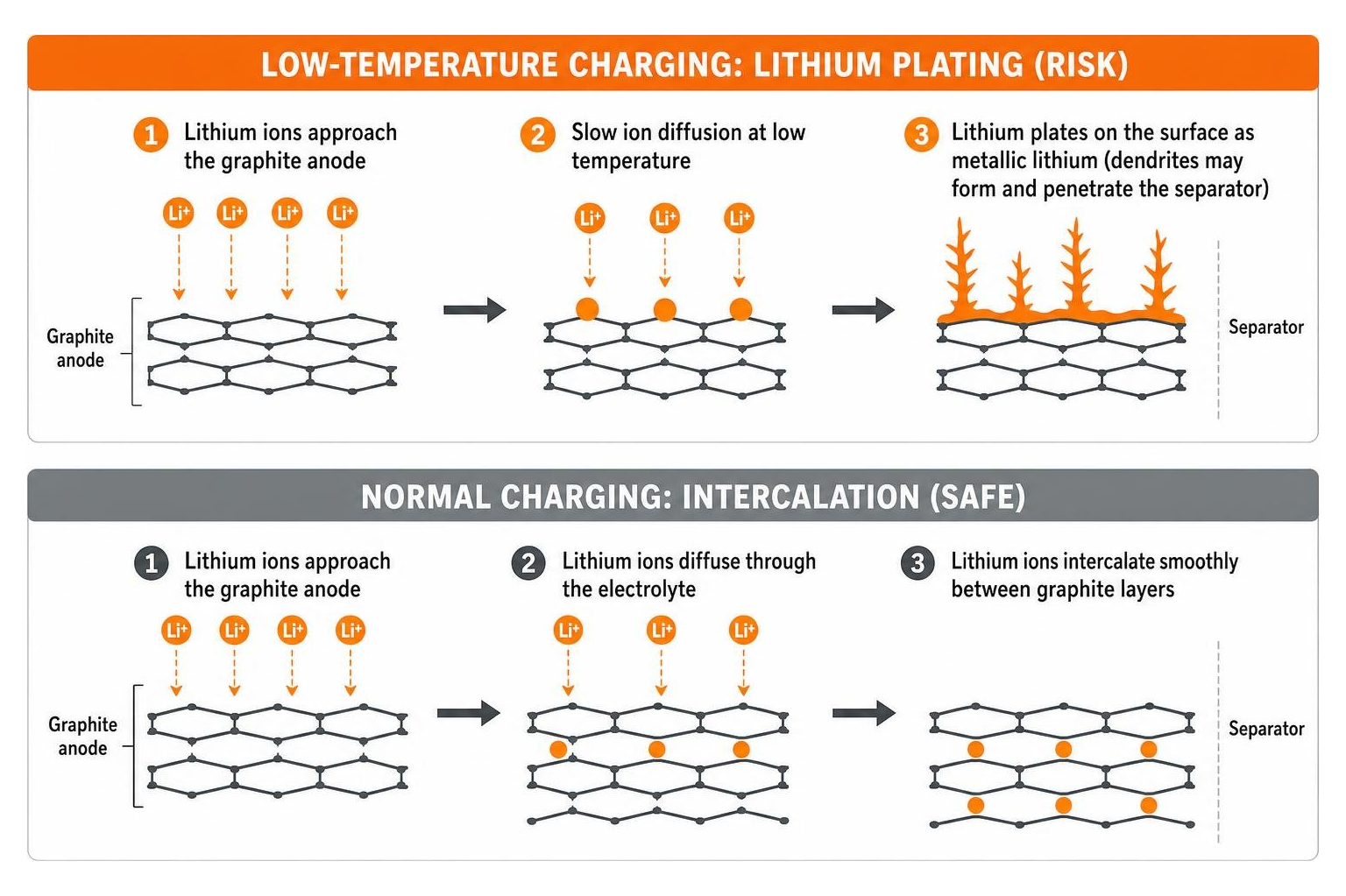
To solve this issue, advanced packs feature Vertical Heat Conduction (VHC™) or internal resistance-heating elements. When charging current is introduced in freezing conditions, the BMS automatically blocks power to the cell terminals and diverts current to integrated core-heating elements. Once the internal core reaches a safe operating temperature (typically above 5°C / 41°F), the BMS switches current back to the electrochemical cells for safe, reliable charging.
Charging Protocols, System Integration, and Maintenance
Rechargeable lithium chemistries require precise charging algorithms. Unlike legacy lead-acid batteries that use multistage bulk, absorption, and high-voltage desulfating float phases, lithium batteries use a Constant Current / Constant Voltage (CC/CV) charging profile.
- Constant Current (CC) Phase: The charger supplies a steady, regulated current while battery terminal voltage rises smoothly toward its target threshold (typically 14.4V to 14.6V for a 12V LiFePO₄ pack). Around 80% to 90% of total capacity is restored during this phase.
- Constant Voltage (CV) Phase: Upon reaching the target voltage, the charger locks that voltage level while charging current naturally tapers down toward zero as cell potentials equalize.
- Charge Termination (Float / Rest): Once current drops below a designated threshold (often 0.05C), charging stops completely. The pack settles at its nominal resting voltage (~13.3V to 13.6V) without continuous float charging.
Using an incompatible legacy lead-acid charger can damage lithium cells. Many lead-acid chargers feature automatic equalization modes that push voltage spikes above 15.5V to remove lead-sulfate crystals from lead plates. On a lithium pack, this overvoltage will trigger BMS safety shutdowns or degrade the electrolyte. To prevent this, always use a dedicated lithium unit such as the Lithium Battery Charger XS Power 12V 15A Intellicharger LI1215.
Proper Charging Protocols and Lithium Battery Maintenance
Maintaining a lithium pack requires observing temperature and storage limits:
- Avoid Trickle Charging: Lithium cells have an exceptionally low self-discharge rate (0.35% to 2.5% per month). They do not require continuous float or maintenance charging during seasonal storage.
- Storage State of Charge (SoC): For long-term storage, keep the battery between 40% and 60% SoC in a dry environment between 10°C and 25°C (50°F to 77°F). Storing cells at 100% SoC in hot ambient conditions accelerates electrolyte oxidation and capacity fade.
- Periodic Top-Off and Balancing: When preparing a battery for service after extended storage, charge it to 100% using an intelligent charger to let the internal BMS balance individual cell groups. For powersports setups requiring dedicated reserve capacity, high-output solutions like the Lithium Battery by XS Power RSV-S5-30Q provide dependable starting energy alongside deep reserve capacity.
High-Discharge Demands in Audio and Powersports Applications
High-output motorcycle audio systems place unique, severe electrical demands on a vehicle's battery. Multi-channel Class-D amplifiers reproducing dynamic musical transients draw massive bursts of instantaneous current. When an amplifier demands 150 amps on a heavy bass hit, a battery with high internal resistance will suffer immediate voltage sag, dropping supply voltage below 11.5 volts. This starves the amplifier, introduces audible harmonic distortion, and generates excess voice-coil heat.
Lithium iron phosphate packs deliver ultra-low internal resistance, allowing them to discharge massive peak cranking and transient currents while holding terminal voltage above 13.0 volts. This stable voltage delivery keeps high-power amplifiers operating at peak efficiency, yielding punchy, distortion-free sound on the open road.
Environmental Impact, Sourcing, and Future Recycling Horizons
As global electrification scales, the environmental footprint of raw material extraction and battery disposal remains an essential engineering focus. Traditional lithium production relies on two primary methods: mining spodumene ore via open-pit operations and extracting mineral-rich brine from high-altitude salt flats. Brine extraction requires significant water evaporation, which can stress arid regional ecosystems.
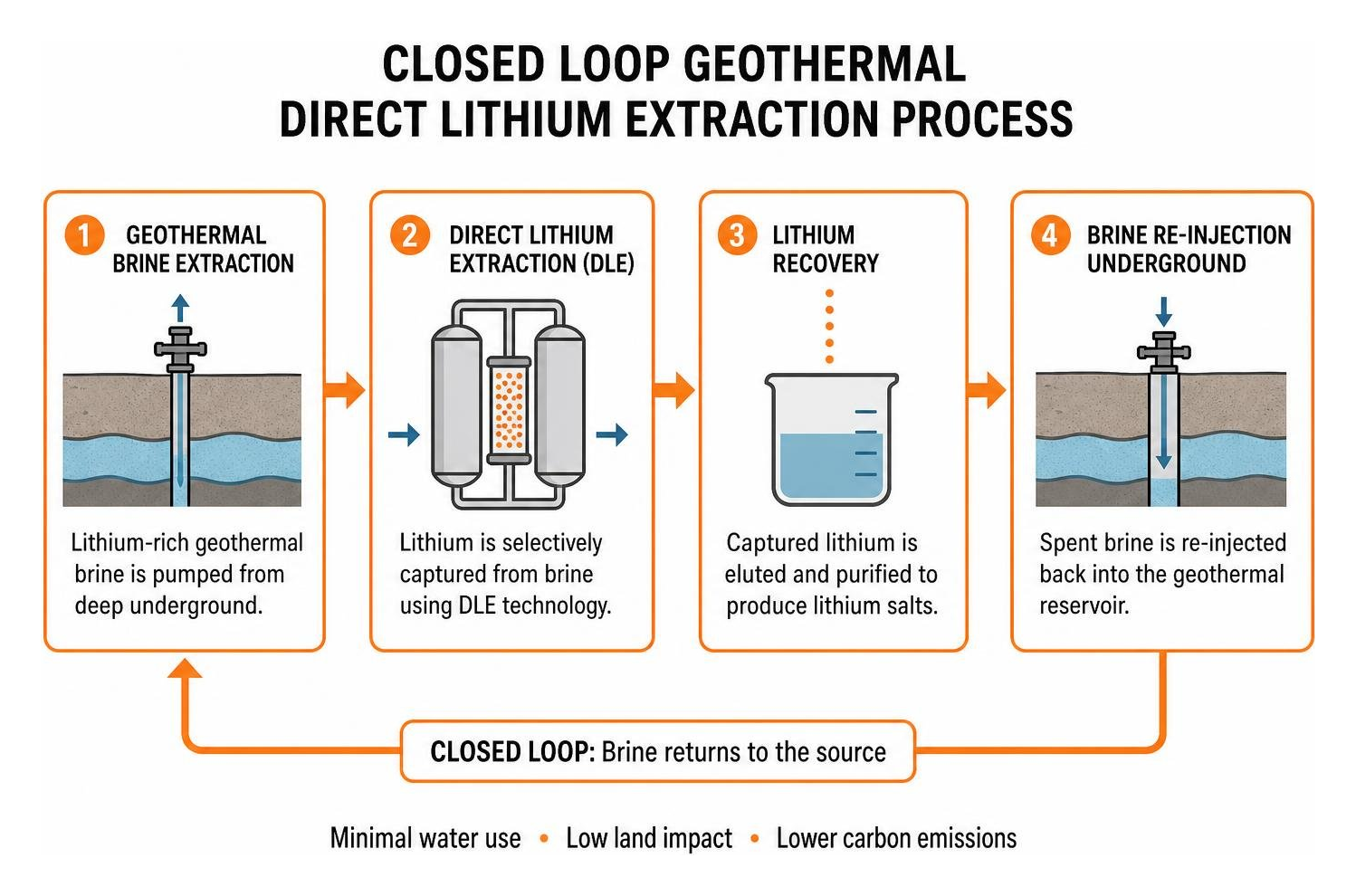
To establish sustainable domestic supply chains, modern extraction projects—such as geothermal lithium extraction initiatives in California's Salton Sea region—use closed-loop direct lithium extraction (DLE). These systems extract lithium salts directly from subterranean geothermal brines and re-inject the brine underground, dramatically cutting water use, land disturbance, and carbon emissions.
Cathode composition also directly influences supply chain ethics. Cobalt mining presents human rights and environmental challenges in certain global regions. This reality has driven manufacturers toward cobalt-free LiFePO₄ chemistries and reduced-cobalt NMC formulations.
At end of life, recycling facilities use hydrometallurgical processing to shred spent packs, isolate the black mass, and chemically recover over 95% of active lithium, nickel, cobalt, and copper. Recovered battery-grade materials re-enter raw material supply streams, while lightly degraded EV modules find second lives in stationary solar storage banks before final recycling.
Frequently Asked Questions About Lithium Batteries
Can lithium batteries be safely mixed with traditional lead-acid or AGM banks?
No. You should never wire lithium batteries in parallel or series with lead-acid or AGM batteries. Lithium and lead-acid chemistries have different open-circuit resting voltages (13.3V+ for LiFePO₄ vs. 12.6V–12.8V for fully charged AGM) and completely different internal resistance profiles.
Connecting them directly causes the higher-potential lithium battery to continuously discharge into the lead-acid battery, causing parasitic drain, unbalanced charging, premature degradation, and possible BMS fault tripping. Always replace an entire battery bank with matching chemistries and capacities.
Why do lithium batteries require dedicated charging profiles?
Lithium chemistries lack the tolerance for overvoltage and continuous high-voltage float charging found in lead-acid designs. Standard lead-acid chargers rely on multistage profiles that include aggressive absorption modes and high-voltage desulfation pulses (exceeding 15V) to break up lead-sulfate crystals on lead plates.
Applying these voltage spikes to a lithium pack will trigger the internal BMS overvoltage protection, disconnecting the battery from the charging circuit. A dedicated lithium charger uses an exact Constant Current / Constant Voltage (CC/CV) algorithm that stops charging once the cells reach full capacity, preserving the electrolyte and preventing cell drift.
What causes thermal runaway in lithium cells, and how is it prevented?
Thermal runaway is a cascading chain reaction triggered by internal short circuits, manufacturing defects, mechanical penetration, or extreme overcharging. When internal cell temperatures exceed critical thresholds, the protective Solid Electrolyte Interphase (SEI) layer decomposes exothermically. This decomposition breaks down the organic electrolyte and releases oxygen from metal-oxide cathodes, generating self-sustaining combustion and rapid pressure buildup.
Thermal runaway is prevented through multiple independent safety layers:
- Using intrinsically safe cathode chemistries with high thermal runaway thresholds, such as olivine-structured LiFePO₄ (~270°C).
- Employing smart BMS circuitry that monitors individual cell voltages and temperatures, disconnecting current within milliseconds during abnormal conditions.
- Using ceramic-coated separators that resist physical melting up to elevated temperatures.
- Formulating flame-retardant, non-flammable organic electrolytes designed to self-extinguish under mechanical puncture.
Conclusion
Lithium battery technology has fundamentally transformed modern mobile energy storage. By replacing heavy, maintenance-prone lead plates with lightweight, efficient lithium-ion intercalation matrices, modern packs deliver exceptional power density, rapid recharge capabilities, flat discharge voltage curves, and service lives extending past a decade. For touring motorcyclists and powersports enthusiasts demanding clean power for high-output audio systems, upgrading to lithium eliminates unnecessary chassis weight while providing the clean, stable voltage required for distortion-free sound.
Discover elite power reserves, high transient current delivery, and rugged reliability for your touring platform with the Lithium Battery by XS Power PWR-S5-30Q.