

Harley-Davidson Battery Chemistries: AGM, Lithium, and Flooded
Selecting the right harley battery requires matching physical case sizing (Group 30 for Touring, Group 20 for Softail/Dyna, Group 14 for Sportster) and meeting high cranking demands (300 to 400+ CCA for Big Twins). The two primary modern replacement technologies are sealed Absorbent Glass Mat (AGM) and Lithium Iron Phosphate (LiFePO4). While AGM provides heavy-duty vibration resistance and dependable cold-weather starting, lithium delivers massive weight savings (up to 17.6 lbs on Touring models), longer cycle life (7–9 years), and up to 85% usable capacity.
Traditional flooded lead-acid batteries were standard for decades, but their liquid electrolyte makes them vulnerable to vibration damage, acid leaks, and rapid internal plate degradation. In modern high-displacement motorcycles, flooded options simply cannot withstand the rigorous demands of daily riding.
Modern designs rely on AGM and LiFePO4 technologies. AGM batteries use fiberglass mats sandwiched between lead plates to absorb liquid acid completely, making them spill-proof, highly vibration-resistant, and capable of strong burst currents. Original equipment offerings like the H-D AGM Original Equipment Battery feature lock-bonded plates, stainless steel terminal bolts, and reinforced cases designed specifically for Milwaukee iron.
| Specification / Metric | Flooded Lead-Acid | Sealed AGM | LiFePO4 Lithium |
|---|---|---|---|
| Typical Lifespan | 1 – 2 Years | 3 – 5 Years | 7 – 9 Years |
| Weight (Touring Size) | ~22 – 24 lbs | ~21 – 23 lbs | ~3.5 – 5.5 lbs |
| Usable Capacity (DoD) | ~10% to 15% | ~10% to 20% | ~80% to 85% |
| Vibration Resistance | Poor | High | Exceptional |
| Self-Discharge Rate | High (monthly drain) | Low (1–3% monthly) | Very Low (<1% monthly) |
| Maintenance Needs | Water top-offs required | Sealed / Maintenance-free | Sealed / Maintenance-free |
AGM vs. Lithium: Upgrading Your Harley Battery Technology
Choosing between an Agm Battery and a modern Battery Lithium system comes down to weight targets, usable capacity, and long-term service life.
Lithium LiFePO4 cells are 50% to 70% lighter than equivalent lead-acid units. On heavy Touring platforms, upgrading drops up to 17.6 pounds of high-mounted chassis weight. Cruisers also see noticeable gains: Softail and Dyna setups shed roughly 12.2 pounds, while Sportster models lose around 8.8 pounds.
Beyond mass reduction, lithium technology changes how electrical energy is stored and delivered. A standard lead-acid battery only safely delivers around 10% to 20% of its total capacity before terminal voltage dips below operational thresholds. LiFePO4 chemistries utilize up to 85% of their total Amp-Hour rating while holding stable voltage above 13.0V.
Factory upgrades such as the official Lithium LiFe 8Ah Battery incorporate solid-state Battery Management Systems (BMS). This onboard micro-circuitry guards against over-voltage, thermal spikes, and destructive deep-discharge cycles while balancing cell banks internally during every charge cycle.
Cold Cranking Amps (CCA) and High-Compression V-Twins
Cold Cranking Amps (CCA) define the amperage a 12V battery can sustain at 0°F (-18°C) for 30 seconds without dropping below 7.2 volts. Big Twin pushrod engines require immense cranking torque to push massive dual pistons through compression strokes on cold mornings.
- Sportster / Street Models: 200 – 250 CCA minimum
- Softail / Dyna Cruisers: 300 – 350 CCA minimum
- Touring Baggers (Stock): 350 – 400 CCA minimum
- Touring with Audio Upgrades: 400+ CCA / 500+ Burst Amps recommended
While a standard Big Twin can fire on 300 CCA under ideal conditions, modern riders require 400+ CCA to overcome parasitic draw, extreme ambient temperatures, and aftermarket loads. Premium high-cranking units like the Agm Battery By Xs Power Psx30L provide the heavy discharge capability required to crank big engines and prevent audio systems from dropping out during hard bass hits.
Choosing the Right Harley Battery by Model and Power Demands
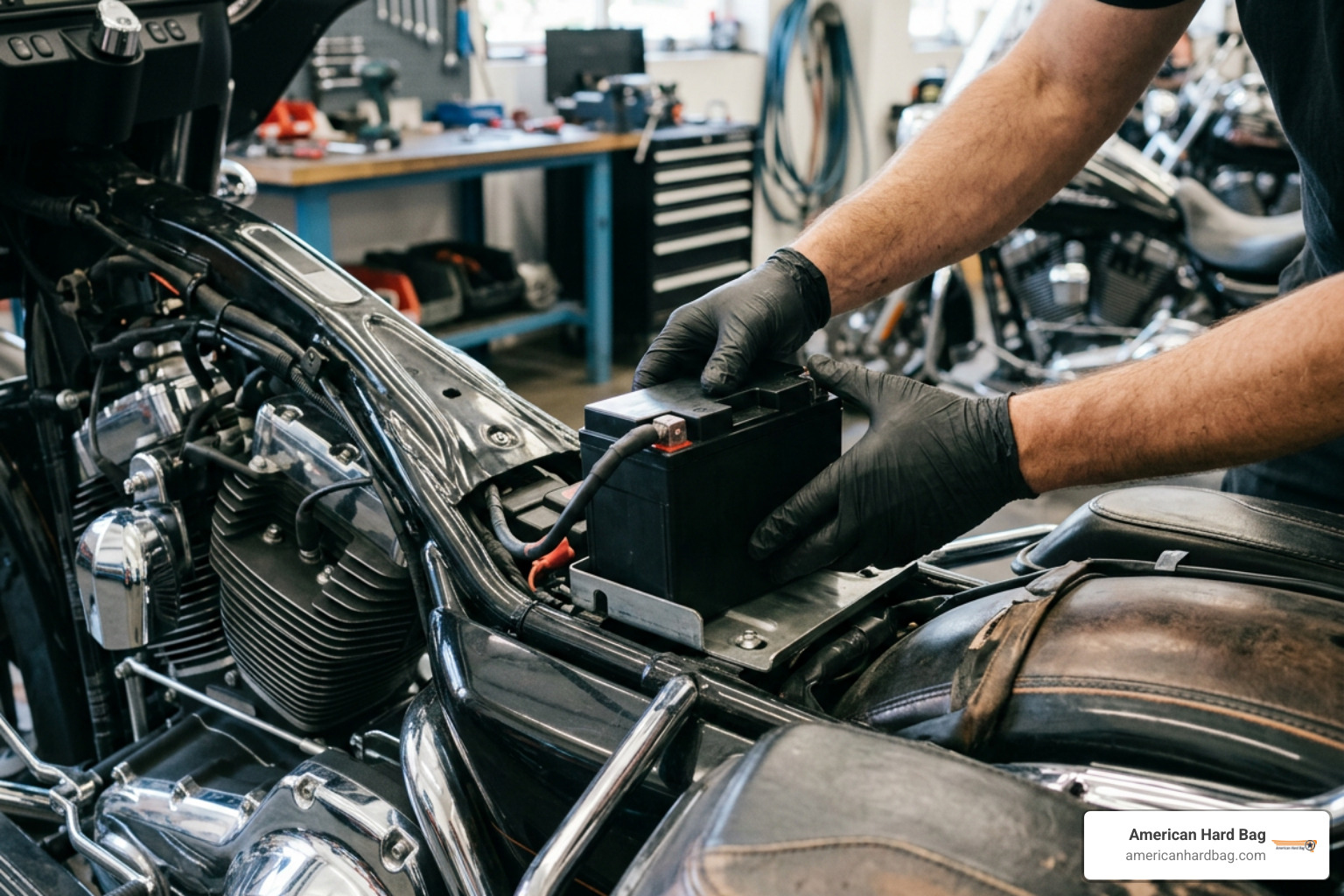
Selecting the right power cell requires checking terminal polarity, physical case group dimensions, and total onboard current demand. The complete catalog of Batteries Chargers provides model-matched options designed to withstand harsh road vibrations.
Fitment Guide for Sportster, Softail, and Touring Models
Harley frame families use distinct chassis trays and terminal post positions. Selecting the incorrect case standard can lead to clearance issues, shorted cables, or damaged seat pans:
- Touring Family (Road Glide, Street Glide, Electra Glide, Road King): Utilizes standard BCI Group 30 cases (e.g., YTX30L / ETX30L equivalents). Batteries must supply high cranking capacity and drop straight into the deep frame pocket below the seat. Ultra-high-power units like the Lithium Battery By Xs Power Rsv S5 30Q provide direct fitment while freeing up internal tray volume for audio wiring.
- Softail & Dyna Models: Typically take Group 20 cases (such as 20L-BS series). These bikes require compact footprints with high pulse outputs to manage heavy engine vibration and tight frame envelopes.
- Sportster (XL) & Revolution Max Platforms: Rely on Group 14 or lightweight specific formats that fit within side-mount covers or compact under-seat wells.
When swapping to high-performance aftermarket batteries, always confirm that the positive (+) and negative (-) terminals match factory harness runs to avoid stretching wiring harnesses.
Supporting High-Power Audio and Electronic Accessories
Modern Harleys are mobile computers. Keyless ignition antennas, integrated security systems, GPS modules, and digital dash clusters create continuous parasitic draws when parked. When you add high-output audio systems with multi-channel amplifiers, electrical demands skyrocket.
A factory stator creates alternating current that the voltage regulator converts into direct current, maintaining roughly 14.0V to 14.4V while cruising. However, when idling at stoplights with a multi-speaker audio system pumping, power demands can outpace stator output at low RPMs.
A high-discharge battery acts as an electrical reservoir. It stabilizes 12V bus voltage, prevents headlight flickering, protects amplifier power supplies from thermal shutdown, and ensures clear sound during demanding transient peaks.
Maintenance, Charging, and Jump-Starting Best Practices
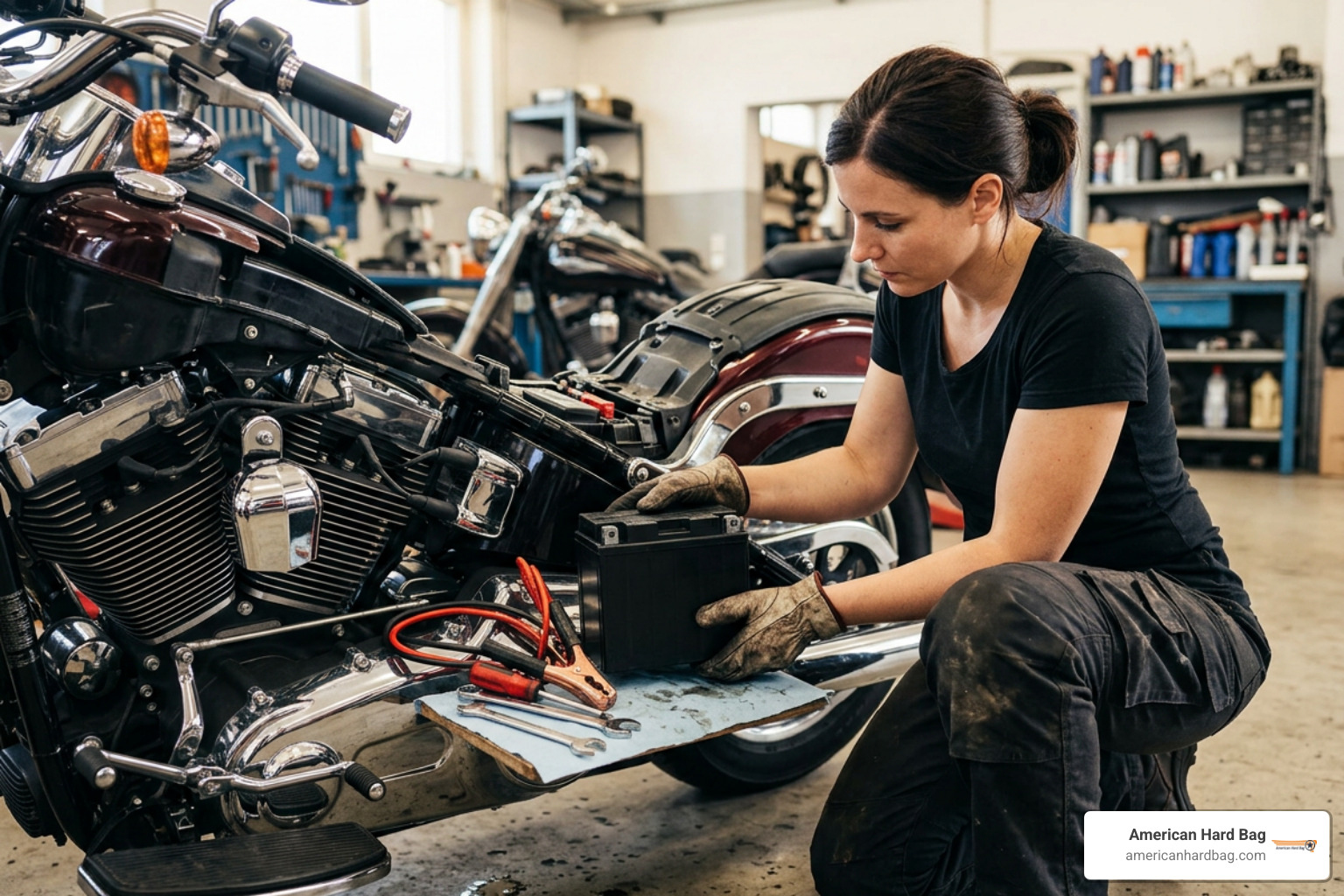
Routine care is essential for getting maximum life out of your battery. Harley owners need dedicated smart tenders matched to their specific chemistry to prevent sulfation in lead plates or cell imbalance in lithium packs. Explore our complete selection of Battery Charger solutions to find the right charging profile for your setup.
Maintenance Schedules to Extend Your Harley Battery Lifespan
While an AGM battery lasts between 3 to 5 years with regular care, a quality lithium unit can easily run 7 to 9 years. Lithium packs can hold their charge for up to 12 months in storage without a maintainer when disconnected from the bike's parasitic drains.
Follow these proven habits to maximize battery life:
- Maintain Float Voltages: Never let an AGM battery drop below 12.4V for extended periods. For standard lead chemistry, use the Agm Battery Charger Xs Power 12V 8A Intellicharger Hf1208 to run multi-stage absorption, float, and desulfation cycles.
- Charge Lithium Safely: Never connect a standard charger that has an automatic high-voltage desulfation mode to a LiFePO4 battery. Instead, use the Lithium Battery Charger Xs Power 12V 8A Intellicharger Li1208 to deliver the exact 14.4V constant-current/constant-voltage algorithm required by lithium cells.
- Service Terminal Posts: Clean corrosion from terminals twice a year using a brass wire brush, torque bolts to factory spec, and apply a thin layer of dielectric grease to keep moisture out.

Safe Jump-Starting and Emergency Recovery Procedures
If you turn the ignition switch and hear rapid clicking, your starter solenoid is engaging, but your battery lacks the amperage to turn the motor over.
When you need an emergency jump, avoid hooking up to a running car or truck—their high-output alternators can send voltage spikes through your Harley's sensitive ECM and audio equipment. Instead, use a self-contained portable pack such as the Zs Power 6 000Ma Jump Pack.
Follow these steps for a safe jump-start:
- Turn the motorcycle ignition completely off.
- Connect the red clamp to the positive (+) terminal post.
- Connect the black clamp to a clean chassis ground or negative (-) terminal.
- Power on the jump unit; for heavy cranking demands, a dedicated booster like the Battery Tender 1000 Amp Jump Starter provides the burst current needed for big motors.
- Turn the bike's ignition switch to RUN, allow the fuel pump to prime, and hit the starter button.
- Once the engine starts, disconnect the black negative clamp first, followed immediately by the red positive clamp. Ride for at least 20 to 30 minutes to replenish the charge.
Frequently Asked Questions About Harley Batteries
What are the main signs that a Harley battery is failing?
Common signs of a failing battery include a slow, sluggish crank when starting the engine, rapid clicking from the starter relay, dimming headlights and gauges when you hit the starter switch, and erratic security system or check-engine warnings caused by voltage dips. If an open-circuit multimeter test shows your battery sitting below 12.0V after a full charging cycle, the internal cells have likely degraded and need replacement.
Can I use a standard lead-acid trickle charger on a lithium Harley battery?
No. Standard lead-acid chargers often include automatic desulfation or "pulse" modes that send high-voltage spikes (sometimes exceeding 15.5V) to break up lead sulfate crystals. These voltage spikes can permanently damage the solid-state BMS on a lithium battery or cause it to shut down for safety. Always use a dedicated LiFePO4 smart charger configured for 14.4V CC/CV charging profiles.
How much weight do I save by switching from AGM to lithium?
Switching to lithium saves approximately 50% to 70% of total battery weight. On Harley Touring models (Street Glide, Road Glide, Ultra), a lithium swap removes up to 17.6 pounds from under the seat. Softail models save roughly 12.2 pounds, while Sportster platforms drop around 8.8 pounds, helping lower your bike's center of gravity and improve low-speed handling.
Conclusion
Your battery does far more than just crank your motor over—it powers the vital electronics, security features, and audio equipment that define your riding experience. At American Hard Bag, we engineer premium plug-and-play audio systems and electrical upgrades built specifically for Harley-Davidson Touring motorcycles.
Upgrading your electrical backbone with the ultra-light, high-output Lithium Battery By Xs Power Pwr S5 30Q delivers effortless Big Twin starts and provides clean, steady power to your amplifier at any volume. Invest in the right battery technology today to keep every ride starting strong and sounding incredible.