

What Are DSP Units and Why Do They Matter for Audio?
DSP units are digital signal processors that take an audio signal, adjust it with software-controlled math, and send a cleaner, better-balanced signal to your amplifier and speakers. In a motorcycle or vehicle audio system, they give you precise control over sound that basic bass and treble settings cannot provide.
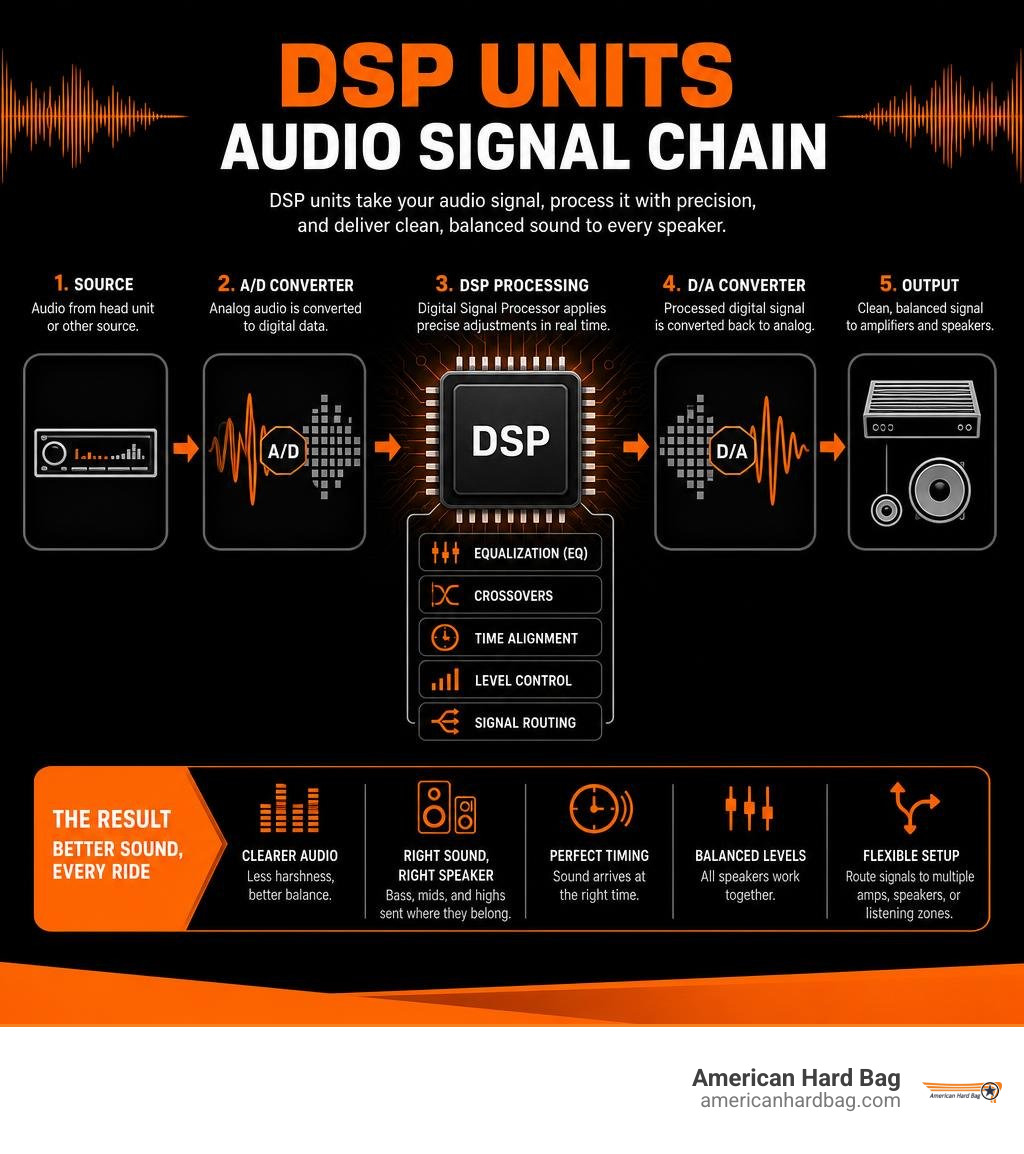
In simple terms, a DSP unit can help manage:
- Equalization (EQ): Reduces harsh peaks and improves tonal balance.
- Crossovers: Sends bass, mids, and highs only to speakers designed to play them.
- Time alignment: Delays closer speakers so sound reaches the rider or driver at the right time.
- Level control: Balances the output of each speaker channel.
- Signal routing: Directs one source to multiple amps, speakers, or listening zones.
A DSP works on sound after it becomes digital data. If the source is analog, an analog-to-digital converter captures the signal as digital samples. The processor makes its adjustments in real time, then a digital-to-analog converter can prepare the result for amplifiers and speakers. This process makes DSP units useful far beyond audio, including phones, communications systems, vehicles, and professional AV installations.
For riders, the value is practical: motorcycles face road noise, wind, uneven speaker placement, and limited mounting space. A well-chosen DSP can make an audio upgrade sound more focused and controlled without requiring you to replace every component at once.
At American Hard Bag, we build durable motorcycle accessories for riders who expect more from their equipment. Our experience with motorcycle audio upgrades helps us understand where DSP units fit into a reliable, high-output system, starting with a clean signal before it reaches the speakers.
What is a Digital Signal Processor (DSP) and How Does It Work?
A Digital signal processor is a specialized microprocessor fabricated on a integrated circuit chip specifically engineered to perform continuous, real-time mathematical operations on digitized real-world signals. Unlike general-purpose CPUs that manage unpredictable background apps and operating system tasks, a DSP focuses on streaming math calculations with deterministic, near-zero latency.
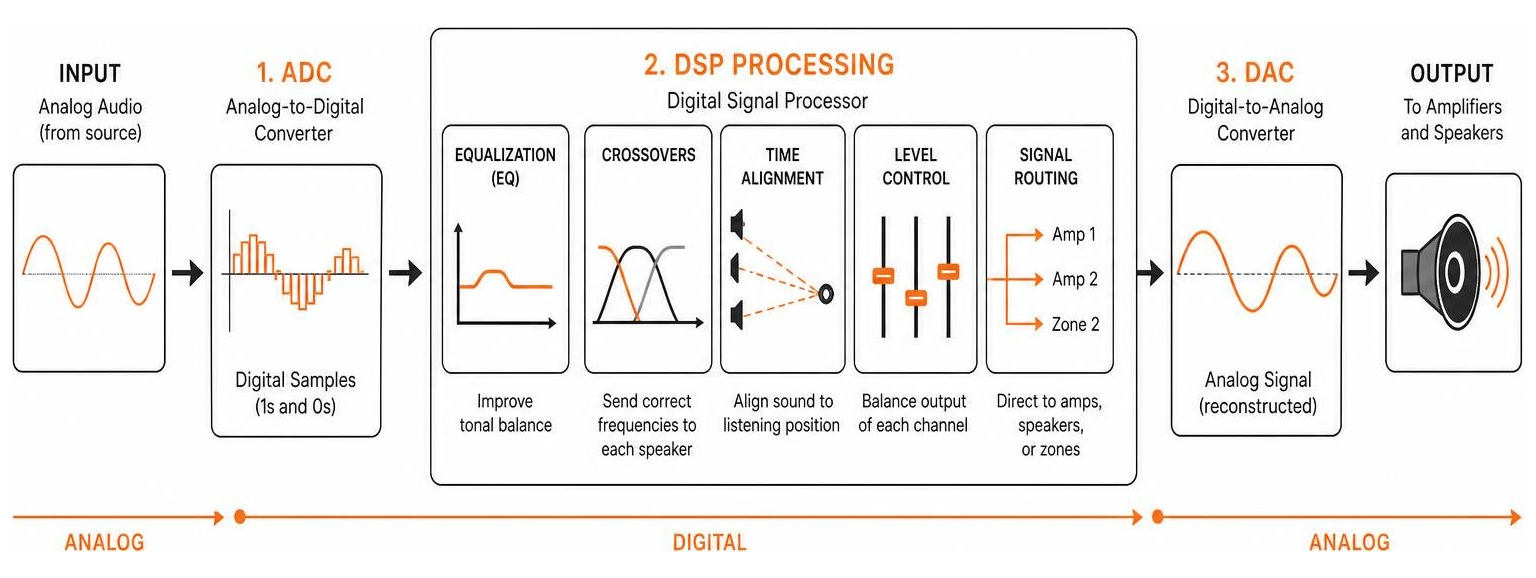
When processing real-world audio, continuous physical sound waves cannot be directly calculated by digital silicon. The physical signal must undergo conversion:
- Analog-to-Digital Conversion (ADC): An Analog-to-Digital Converter measures the continuous analog voltage waveform thousands of times per second (such as 48 kHz or 96 kHz sampling rates) and translates those measurements into a digital stream of binary numbers (1s and 0s) at 16-bit, 24-bit, or 32-bit resolutions.
- Digital Signal Processing: The core compute engine of the DSP receives the stream of binary numbers and applies mathematical algorithms—such as addition, subtraction, multiplication, and matrix manipulation—to alter frequency amplitudes, phase angles, and timing.
- Digital-to-Analog Conversion (DAC): Once transformed, a Digital-to-Analog Converter reconstructs the manipulated binary numbers back into a continuous physical analog voltage signal that can feed downstream amplifiers and drive high-output speaker cones.
Core Architectural Features and MAC Operations
The reason dedicated DSP units outpace standard microprocessors in signal processing boils down to internal architecture. Standard general-purpose CPUs traditionally used a Von Neumann architecture, where program instructions and data share the exact same bus and memory space. When executing mathematical routines on continuous data streams, this creates a severe memory bottleneck.
In contrast, DSP architectures utilize a Harvard architecture (or Modified von Neumann architecture), featuring completely separate memory buses and physical address spaces for program memory and data memory. This allows the processor to fetch an instruction and read or write data values simultaneously in a single clock cycle.
At the center of every DSP compute engine is the Multiply-Accumulate (MAC) pipeline. Real-time digital signal processing—such as digital filtering, audio matrixing, and spectral analysis—relies almost entirely on repeating polynomial formulas of the form $Y = (A \times B) + C$.
Historical processors, like Texas Instruments' landmark TMS32010 introduced in 1983, required 390 nanoseconds to execute a single 16-bit multiply-add instruction. Modern multi-core processors, such as TI's C6000 series running at 1.2 GHz, achieve up to 8,000 MIPS (Millions of Instructions Per Second) with MAC execution times under 3 nanoseconds.
Additional hardware innovations built directly into DSP units include:
- Zero-Overhead Looping: Dedicated hardware loop counters execute repeat code loops without consuming extra CPU cycles to evaluate branch conditions.
- Modulo and Bit-Reversed Addressing: Hardware-level memory pointers automatically loop around circular buffers without software bounds checks, while bit-reversed addressing accelerates Fast Fourier Transform (FFT) array indexing.
- Saturation Arithmetic: Prevents harsh digital clipping wraparound (where exceeding maximum positive values causes sudden wrapping to negative infinity) by clamping values to the maximum register ceiling during math overflow.
Fixed-Point vs Floating-Point Hardware in DSP Units
When choosing or evaluating DSP units, one fundamental distinction lies in how the processor's hardware handles mathematical numbers: fixed-point arithmetic versus floating-point arithmetic.
- Fixed-Point DSPs: Store integers or fractions using a fixed number of bits (typically 16-bit or 24-bit signed integers). Because integer logic circuits require far fewer hardware transistors, fixed-point DSP chips are lower cost, consume less electrical power, and execute basic instruction cycles faster. However, fixed-point programming requires careful scaling to prevent register overflow or quantization noise degradation when processing dynamic audio peaks.
- Floating-Point DSPs: Store data using a mantissa and an exponent format (commonly 32-bit or 64-bit IEEE 754 standard). This provides an immense dynamic range (often exceeding 1,500 dB), eliminating concerns over internal arithmetic register overflow. Processors such as Analog Devices' SHARC series (ranging from 198 MFLOPS up to 2,400 MFLOPS) allow software engineers to implement complex linear phase audio filters with maximum dynamic precision.
For most embedded consumer audio applications, high-resolution 24-bit fixed-point processing provides plenty of dynamic range (144 dB theoretical) while maintaining optimal hardware thermal limits and high power efficiency.
Key Modules and Functions Built Into DSP Units
Modern digital signal processors are structured using modular code structures and hardware blocks. Developers and software libraries, such as the lsp-dsp-units C++ library, organize audio algorithm pipelines into discrete processing modules that route and modify digital audio streams in real time.
Audio Equalization, Crossovers, and Dynamic Control
Within an audio signal chain, a DSP unit deploys specific modules to ensure speakers operate safely and accurately:
- Parametric Equalization (PEQ): Standard bass and treble controls make broad, clumsy adjustments across huge frequency ranges. DSP parametric equalizers allow precise control over individual center frequencies, boost/cut gain (dB), and Bandwidth/Q-factor (how wide or narrow the filter curve is). This allows tuners to eliminate resonant acoustic peaks caused by vehicle fairings or glass reflection without stripping away neighboring musical details.
- Active Crossovers (HPF / LPF): High-Pass Filters (HPF) and Low-Pass Filters (LPF) dictate exact frequency limits for dedicated speaker drivers. By applying high-slope digital crossover curves (such as 12, 24, or 48 dB/octave Linkwitz-Riley or Butterworth filters), a tweeter is protected from destructive low-bass excursion while a subwoofer receives only sub-bass energy.
- Phase Alignment and Inversion: Physical speaker placement and wiring polarity can cause acoustic cancellation where sound waves collide and erase each other. DSP units can invert phase by 180 degrees or adjust continuous phase angles in micro-degree increments across specific crossover boundaries.
- Dynamic Compressors and Limiters: These safety modules monitor real-world output levels. If a sudden voltage spike or extreme volume adjustment occurs, dynamic limiters instantly cap the digital signal peak below distortion thresholds, protecting speaker voice coils from thermal overload or mechanical bottoming.
FFT Spectrum Analysis and Acoustic Echo Cancellation
In high-end commercial audio, pro AV installations, and smart electronics, DSP units do far more than shape basic EQ curves. They perform advanced time-frequency transformation using software libraries like the Espressif DSP Library.
- Fast Fourier Transform (FFT): Converts time-domain digital audio samples into continuous frequency-domain spectral data. This enables real-time visual RTA (Real-Time Analyzer) spectrum displays, automated room correction, and spectral noise reduction.
- Acoustic Echo Cancellation (AEC): Crucial for teleconferencing and hands-free vehicle voice communication. AEC uses adaptive FIR filters to compare incoming speaker sound against microphone feeds, mathematically subtracting the acoustic speaker bleed in real time so the caller hears a clear voice without hearing their own voice echo back.
- Feedback Suppression and Auto-Mixing: Monitors live microphone channels for narrow acoustic feedback loops and automatically drops surgical notch filters onto feedback frequencies before audible howling occurs. Automated mic mixers dynamically manage gain levels across dozens of active conference mics.
Real-World Applications Across Electronics and Audio
Because digital signal processing hardware spans price points ranging from simple $1.50 microchips to $2,000 commercial matrix hardware, DSP units are embedded across almost every modern electronic sector:
- Consumer Electronics & Communications: Mobile phones use DSP algorithms for speech encoding, background wind noise reduction, and voice compression. Digital media players rely on DSPs for decoding compressed MP3, AAC, or high-resolution lossless audio formats.
- Pro AV & Telecommunications: Commercial conference spaces and broadcasting centers employ 8x8 or 16x16 balanced matrix digital audio processors (such as network-enabled Dante units). These manage multi-zone audio distribution, auto-mix ceiling microphone arrays, and handle automatic gain compensation across vast commercial buildings.
- Automotive & Motorcycle Sound Systems: Modern road vehicles use integrated audio dsp setups to overcome difficult vehicle cabin acoustics, reflective windshield glass, absorbent seats, and factory radio equalization bottlenecks.
How Audio DSP Units Improve Vehicle and Motorcycle Sound
Vehicles present some of the most challenging acoustic environments in the world. Speakers are forced into low door panels, far footwells, or tight motorcycle fairings, creating radical physical distance differences between the speakers and the rider's ears. Furthermore, open-road wind noise and engine rumble destroy quiet musical dynamics.
Integrating a dedicated DSP unit into a motorcycle audio upgrade or vehicle system solves these physical environment flaws through three primary tuning mechanisms:
- Precision Time Alignment: Because sound travels through air at approximately 1,125 feet per second (or roughly 1 millisecond per foot), sound from a fairing speaker 2 feet away hits your ears much faster than sound from a saddlebag speaker 5 feet away. A DSP adds microsecond delays to the closest speakers, forcing sound waves from every driver to arrive at your ears at the exact same millisecond. This creates a balanced soundstage centered right in front of you.
- De-Equalization of Factory Head Units: Modern original equipment manufacturer (OEM) factory stereos bake heavy, un-adjustable bass roll-offs and weird frequency spikes into their factory signals to keep cheap stock speakers from blowing. A DSP unit with high-level speaker inputs captures this corrupted factory signal, cleans it up, flattens the frequency curve, and restores full dynamic bandwidth before sending it out to aftermarket amplifiers and high output speakers.
- Environmental Acoustic EQ Correction: Motorcycles face extreme wind, pipe noise, and body vibration. A calibrated DSP allows us to apply precise parametric EQ curves, cutting harsh high-frequency ringing caused by plastic fairing cavities while boosting the exact mid-bass frequencies needed to cut clean music through highway wind noise at 70 mph.
Standalone Processors vs Integrated DSP Amplifiers
When installing a DSP into a vehicle sound system, you will choose between two hardware form factors: standalone DSP units and integrated DSP amplifiers.
| Feature / Consideration | Standalone DSP Processor | Integrated DSP Amplifier |
|---|---|---|
| Primary Function | Pure audio signal processing and matrix routing | Signal processing combined with multi-channel power amplification |
| Amplification | None (Requires external outboard power amplifiers) | Built-in multi-channel power amplifier output stages |
| Installation Footprint | Requires extra mounting space and additional RCA interconnect cabling | Compact single-chassis footprint, reducing wiring complexity |
| System Flexibility | Maximum (Allows mixing high-power mono, 2-channel, and 4-channel amps) | Fixed power output per channel based on internal amplifier specs |
| Best Used For | Large, multi-amplifier custom audio builds with extreme power demands | Tight mounting locations (such as Harley fairings) needing plug-and-play simplicity |
For motorcycle applications where space inside the fairing or fairing cavity is extremely limited, high-power DSP amplifiers provide clean matrix processing and raw power output inside a single, weather-resistant chassis.
Frequently Asked Questions About DSP Units
How does a DSP processor differ from a standard general-purpose CPU?
While both are integrated silicon microprocessors, a standard CPU is designed for general flexibility, managing multi-tasking operating systems, software apps, mouse inputs, and user interfaces. A CPU relies on large caches and virtual memory, which introduces variable execution timing and processing latency.
A DSP is hard-wired specifically for continuous, deterministic mathematical processing on continuous data streams. Using specialized instruction sets, hardware MAC pipelines, zero-overhead looping, and dual-bus Harvard memory architectures, DSP units process audio samples continuously with near-zero latency and high power efficiency.
What role do Multiply-Accumulate (MAC) operations play in DSP performance?
Multiply-Accumulate (MAC) operations compute the product of two numbers and add that result to an accumulating register in a single clock cycle ($Y = (A \times B) + C$).
Because virtually all digital signal filtering (FIR and IIR filters), matrix mixing, time delays, and Fourier transforms are built on repeating polynomial equations, a processor's ability to execute single-cycle MAC operations dictates how many audio channels and filter stages it can process in real time without audio dropout or distortion.
What is time alignment and why is it important in audio tuning?
Time alignment (or signal delay) is a DSP feature that digitally delays the audio output sent to speakers that are physically closer to the listener.
Because speakers in a vehicle or motorcycle are placed at varying physical distances from the rider, unaligned sound waves hit the ear at staggered millisecond intervals, causing phase cancellation, muddy imaging, and localized instrument pulling. By applying microsecond delays to closer speakers, all acoustic sound fronts arrive at the listener's ears simultaneously, creating a clear soundstage.
Conclusion
Whether managing complex conference room microphoning, smoothing out digital media playback, or driving crystal-clear music through open-highway wind noise, DSP units serve as the ultimate system brain for modern signal chain management. By combining high-speed A/D conversion, specialized Harvard memory architecture, single-cycle MAC processing, and modular software filters, a DSP turns raw audio signals into controlled sound.
For Harley-Davidson riders and motorcycle enthusiasts, adding dedicated digital signal processing is the most transformative upgrade you can make to your bike's audio system. Rather than simply cranking up raw power into improperly filtered speakers, a properly calibrated setup gives you total command over time alignment, active crossovers, and parametric equalization.
If you are ready to elevate your motorcycle's sound system with American-engineered, plug-and-play upgrades built specifically to handle open-road demands, check out our high-output solutions like the Velocity 8 DSP Amplifier and explore our full line of motorcycle audio accessories at American Hard Bag today!