

Why High Output Speakers Are the Key to Hearing Your Music on the Highway
If you want to hear your favorite music clearly over the roar of your engine, upgrading to high output speakers is the single best choice you can make.
Here is a quick breakdown of what makes these speakers different from standard audio gear:
- High Sensitivity: They convert amplifier power into actual sound very efficiently (usually 93dB or higher at 1 watt/1 meter).
- Extreme Power Handling: They handle massive wattage (often 150W to 300W RMS) without burning out or blowing.
- Maximum SPL: They reach extreme volume levels (110dB to 120dB+) to easily cut through heavy wind and highway noise.
For most motorcycle owners, factory audio systems are a major disappointment. Once you hit 60 mph, the wind and engine noise completely drown out your music, leaving you with nothing but distortion when you try to turn it up.
At American Hard Bag, we are a US-based manufacturer of premium motorcycle accessories and audio upgrades built for riders who demand the best. Over the years, we have helped thousands of riders escape weak factory sound by designing and installing rugged high output speakers that cut through highway noise.
Demystifying High Output Speakers: Sensitivity, Power, and SPL
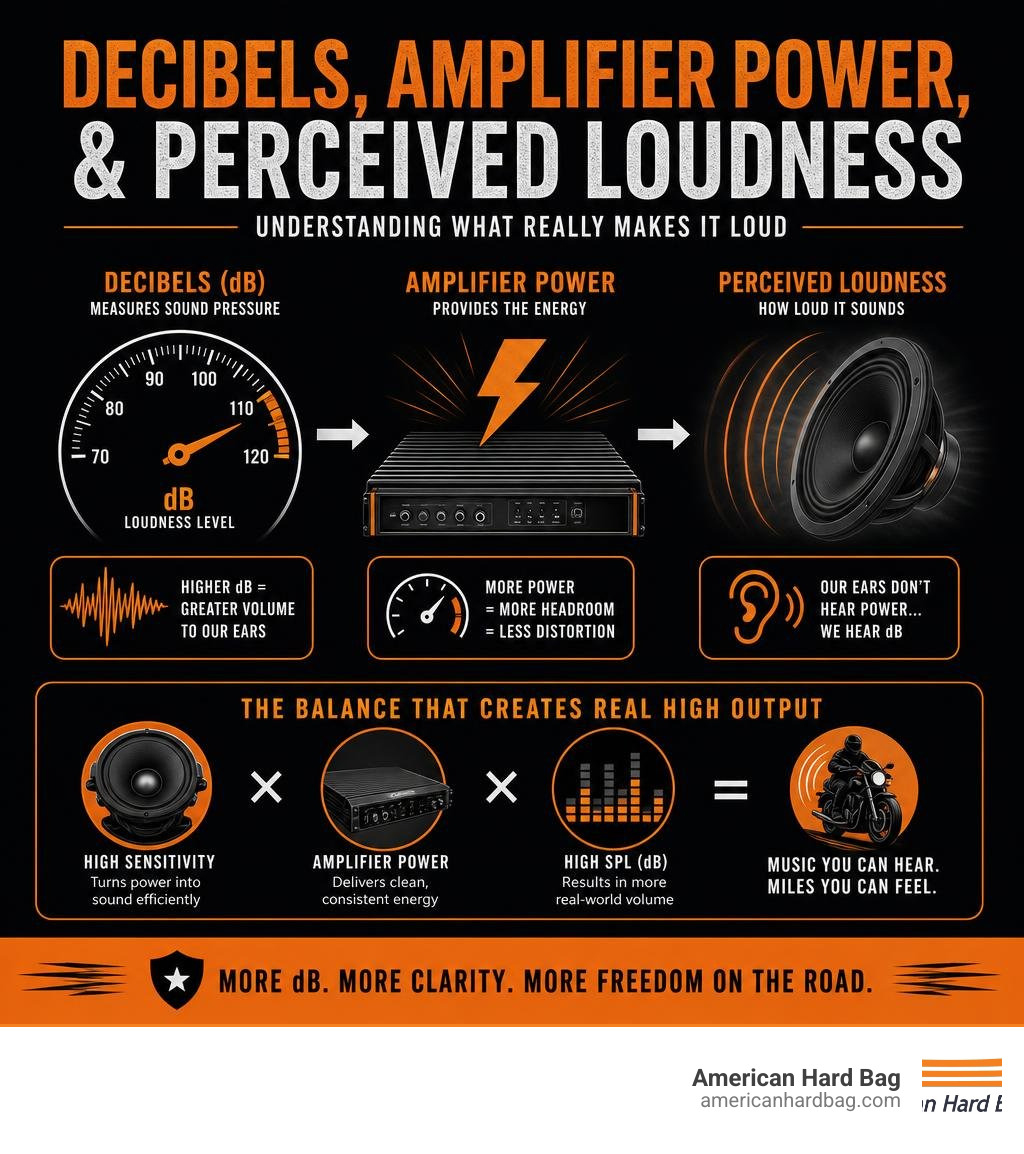
When you are looking for the absolute loudest sound possible, you cannot just look at the wattage listed on a speaker box. True high-output performance is a delicate dance between three critical specs: Sensitivity, Power Handling, and Sound Pressure Level (SPL).
- Sensitivity is measured in decibels (dB) at 1 watt of power from 1 meter away. Think of sensitivity as a speaker's fuel economy. A highly sensitive speaker (e.g., 95dB to 103dB) can create massive volume with very little amplifier power.
- Power Handling (measured in Watts RMS) tells us how much continuous electrical energy a speaker's voice coil can take before it melts. While cheap speakers might claim "1000W Peak" (which is usually a marketing fantasy), true high-performance drivers like the Sundown Audio NeoPro 8" handle a continuous 320W RMS.
- Sound Pressure Level (SPL) is the actual acoustic volume measured in the real world. It is the ultimate metric of how loud your system gets.
To understand how these specs work together, we have to look at Hoffman’s Iron Law. This fundamental rule of speaker design states that you can only choose two of the following three parameters:
- Low-frequency extension (deep bass)
- High efficiency (sensitivity)
- Small cabinet size
If you want a small speaker that fits inside a motorcycle fairing or a compact car door and you want it to be incredibly efficient, you have to trade off deep sub-bass. This is why professional PA style drivers and high-output motorcycle speakers focus heavily on midrange and high-frequency efficiency to cut through ambient noise.
The table below illustrates how speaker sensitivity changes the amount of amplifier power you need to reach target volume levels:
| Sensitivity Rating (1W/1m) | Power Needed for 100dB SPL | Power Needed for 105dB SPL | Power Needed for 110dB SPL |
|---|---|---|---|
| 85 dB (Low Efficiency) | 32 Watts | 100 Watts | 316 Watts |
| 90 dB (Average Efficiency) | 10 Watts | 32 Watts | 100 Watts |
| 95 dB (High Efficiency) | 3 Watts | 10 Watts | 32 Watts |
| 100 dB (Extreme Efficiency) | 1 Watt | 3 Watts | 10 Watts |
As you can see, choosing a speaker with high sensitivity completely changes your power requirements. A speaker with 95dB sensitivity only requires 32 watts to hit a blaring 110dB SPL, whereas a low-efficiency 85dB speaker requires a massive 316 watts to reach that same volume!
Core Technologies Behind High Output Speakers
To achieve these extreme volume levels without burning up, manufacturers use several specialized acoustic technologies:
- Compression Drivers & Horn Loading: Instead of using a standard dome tweeter, high-output systems often use compression drivers firing into a physical horn flare. The horn controls the sound's dispersion and mechanically amplifies the acoustic output, allowing high frequencies to cut through wind like a hot knife through butter.
- Square Cone Designs: Some midrange drivers, like the KICKER Street Series 7" and 9" square midranges, use a square cone shape. This provides more surface area than a traditional round cone of the same width, allowing them to displace more air and generate extreme loudness.
- Neodymium Magnets: Neodymium is a rare-earth material that is incredibly light yet produces a magnetic field significantly stronger than traditional heavy ferrite magnets. This allows us to build speakers with massive motor force and control without making the speaker too heavy for a motorcycle fairing or car door.
- Field Coil Motors: Primarily found in ultra-high-end home audiophile setups, field coil motors replace fixed magnets with an electromagnet powered by an external DC supply, giving builders absolute control over the motor's strength and efficiency.
For a great example of professional-grade horn loading and compression technology, you can look at stadium installations like the PD6322/43 | JBL Professional | English , which uses massive horn-loaded mid-high sections to project crystal-clear vocals over thousands of screaming sports fans.
Amplifier Matching and System Architecture
Even the best high output speakers will sound flat and lifeless if they are paired with the wrong amplifier. To build a system that can scream on the highway without blowing up, you must understand impedance matching and system architecture.

Impedance Matching: 2 Ohm vs. 4 Ohm vs. 8 Ohm vs. 16 Ohm
Impedance (measured in Ohms) is the electrical resistance a speaker presents to your amplifier.
- Solid-State Amplifiers: Most modern car and motorcycle amplifiers are solid-state Class D designs. As the impedance drops (from 4 ohms down to 2 ohms), the amplifier can push more current, resulting in higher wattage and louder volume. However, running at 2 ohms makes the amplifier run hotter and work harder.
- Tube Amplifiers: High-end home audio tube amplifiers work very differently. They use output transformers to transfer power to the speaker. Tube amps perform best and are most efficient when matched with high-impedance speakers (typically 8 ohms or 16 ohms). Pushing a tube amp with a low 4-ohm load can actually reduce its low-frequency bandwidth by up to an octave.
To dive deeper into choosing the right amp for your bike, check out our guide on How to Choose the Right Amplifier for Your Harleys Sound System.
Offloading the Low End: Subwoofers and Distributed Bass Arrays
Because high-efficiency speakers trade off deep bass to achieve extreme midrange volume, a complete high-output system requires dedicated low-frequency support.
In home theater and audiophile rooms, designers often use a Distributed Bass Array (DBA). This setup uses multiple subwoofers placed strategically around the room, crossed over at around 60Hz. This handles the deep bass independently, allowing the main speakers to focus entirely on clean, high-output mids and highs.
In high-end home audio, systems like the horn-loaded YOTTA pair massive, ultra-efficient point-source speakers with heavy-duty subwoofers to displace liters of air, achieving a concert-like experience in the home.
If you are planning an audio overhaul, check out our breakdown of The Top 3 Audio Upgrades Every Harley Owner Should Consider to see how to balance your mids, highs, and bass.
Application Guide: Finding the Right Gear for Every Venue
High-output audio is not a one-size-fits-all world. Different environments demand completely different speaker designs:
- Home Audio: Home audiophiles looking for "palpable" presence often pair highly sensitive horn speakers (96dB to 105dB efficiency) with low-wattage tube amplifiers. Alternatively, modern active home speakers like Fluance's powered bookshelf and tower models use integrated, perfectly matched Class D amplifiers to deliver impressive full-range dynamics down to 30Hz without needing bulky external receivers.
- Commercial Installations: Large venues, fitness studios, and restaurants require consistent coverage and rugged reliability. Commercial systems, like the Sonance Professional Series High Output line, utilize 1.4-inch aluminum dome compression drivers and 70V/100V transformers to deliver a rated maximum SPL of up to 114dB (120dB peak) across massive, open spaces.
- Car Audio SPL Competitions: Car audio competitors use specialized, heavy-duty PA-style drivers to achieve extreme sound pressure levels. Components like the KICKER Street Series 9" Square Midrange (handling 300W RMS / 600W Peak) or the Sundown Audio NeoPro Series are built specifically to handle massive amplifier power and project clean, loud midrange vocals over heavy subwoofer bass. You can explore these competition-grade options on the High Output PA Style Speakers - Pro Audio Center collection.
- Pro Audio PA (Public Address): Outdoor stadiums and concert venues require massive, single-source point arrays to project sound over long distances. Extreme examples like the J1-94 Jericho Horn use patented Synergy Horn technology to combine 15 individual drivers (including six 18-inch woofers) into a single point source, outputting an unbelievable 148 dB of continuous SPL.
Choosing High Output Speakers for Motorcycles and Outdoor Environments
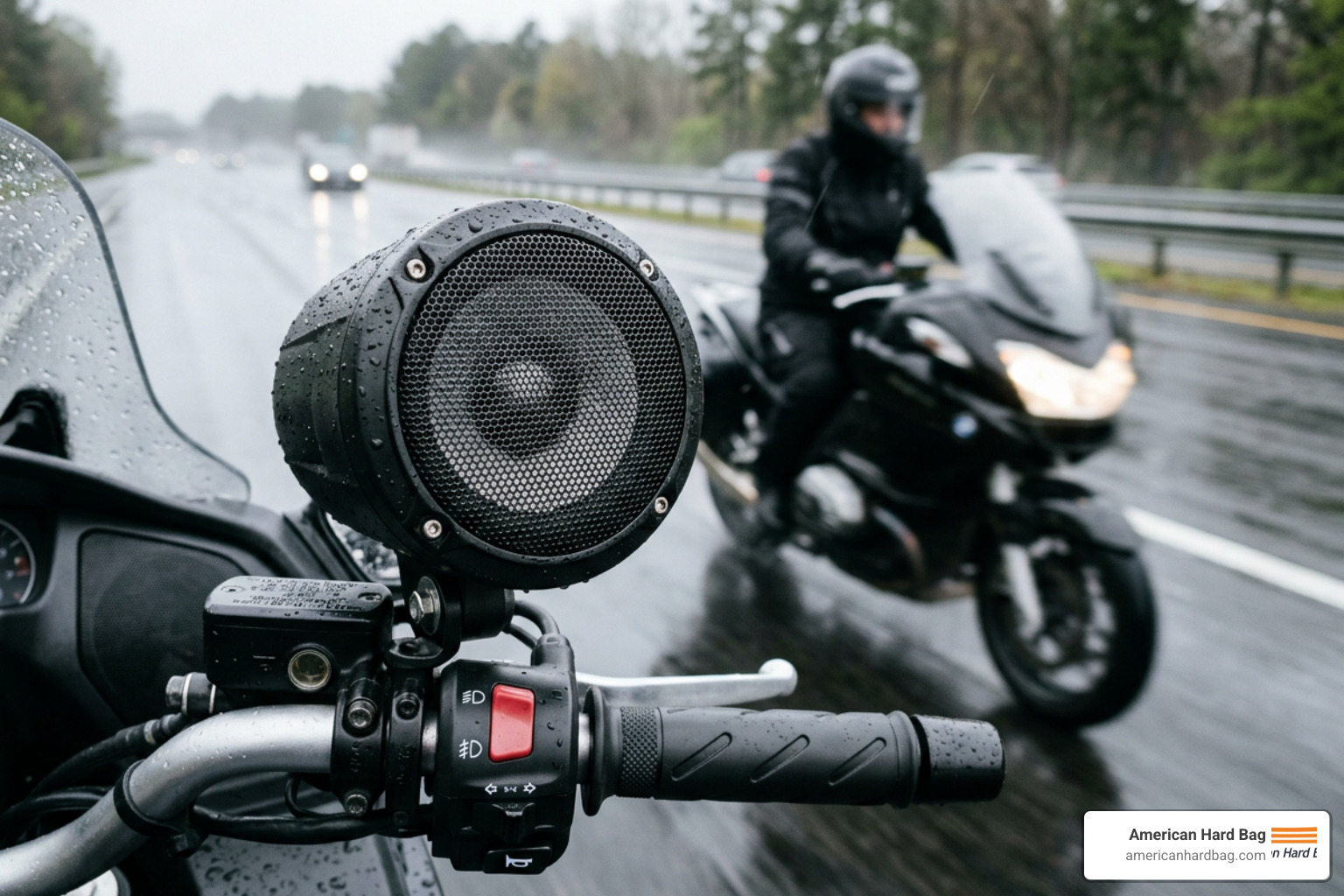
When you are riding down the highway at 70 mph, you are dealing with a brutal environment for audio gear. Not only do your speakers have to battle intense wind and engine noise, but they must also survive direct sunlight, heavy rain, dust, and constant road vibrations.
To survive on a motorcycle, high output speakers must have:
- IPX5 Waterproof Rating: This ensures the speaker can handle direct jets of water (like riding through a rainstorm or washing your bike) without shorting out.
- Vibration Resistance: Standard home or car speakers will quickly rattle themselves to pieces on a motorcycle. Outdoor and motorcycle-specific speakers use glass-fiber reinforced ABS frames and treated surrounds to withstand constant engine shake.
- Lightweight Neodymium Motors: Adding heavy ferrite speakers to your fairing can negatively affect your bike's handling. Neodymium magnets keep the weight down while delivering massive motor strength.
If you are looking for the absolute loudest options for your ride, check out our guide on the Loudest Motorcycle Speakers or browse our curated selection of high-performance Speakers for a Harley Davidson.
Frequently Asked Questions about High Output Audio
What is the difference between 2-ohm and 4-ohm speakers on a motorcycle?
The primary difference comes down to current draw, amplifier stability, and overall volume output.
A 2-ohm speaker has less electrical resistance than a 4-ohm speaker. This means that when connected to a compatible amplifier, a 2-ohm speaker will draw more current, allowing the amplifier to output more wattage and make the speaker play louder.
However, you must make sure your amplifier is rated as "2-ohm stable." Standard factory Harley-Davidson head units and amplifiers are typically designed for 4-ohm loads. Connecting a 2-ohm speaker to a stock system can cause it to overheat, distort, or shut down entirely.
For a deeper dive into choosing the right impedance for your fairing or bags, read our article on the Harley Audio Speaker.
Why do high-efficiency speakers often have less bass?
This goes back to Hoffman's Iron Law. In a fixed cabinet size (like a motorcycle fairing or a small car door), you have a physical trade-off between efficiency and bass extension.
To make a speaker highly efficient (95dB+ sensitivity), the cone must be incredibly lightweight and the suspension must be stiff so it can react instantly to the amplifier's signal. However, reproducing deep, low-frequency bass requires a heavy cone, a very loose suspension, and a massive cabinet to move large volumes of air.
If you try to force a small speaker to play deep bass, its efficiency drops dramatically. High-output speakers focus on maximizing midrange and high-frequency efficiency so they can play incredibly loud on the highway, leaving the deep bass to dedicated, larger subwoofers.
We explain more about these physical design trade-offs in our article on 5 Reasons Why American Hard Bag Speakers Outperform the Competition.
How does wind noise affect the perceived output of outdoor speakers?
At highway speeds, wind noise acts as a "masking effect" over your audio system. Wind noise is primarily made up of low and mid-frequency rumble. This rumble physically masks (drowns out) those same frequencies in your music, which is why your audio sounds thin or tinny when you ride fast.
To overcome this, outdoor and motorcycle audio systems must rely on high-frequency projection and strong upper-midrange output. Horn-loaded compression drivers are highly effective here because they direct the high frequencies straight at the rider, preserving clarity and vocals even at 70+ mph.
To learn how to tune your system to beat the wind, check out The Ultimate Guide to Upgrading Your Harley-Davidsons Audio System.
Conclusion
Building a high-output audio system that sounds crystal clear at highway speeds requires the right balance of sensitivity, power handling, and rugged durability. Whether you are upgrading your home theater, a commercial venue, or your favorite touring bike, understanding these acoustic principles ensures you get maximum volume without sacrificing sound quality.
At American Hard Bag, we specialize in designing and engineering premium, plug-and-play audio upgrades specifically for Harley-Davidson Touring bikes. Based in Rocklin, California, we build rugged, high-power systems designed to handle the open road.
Ready to transform your riding experience with a professional, high-output sound system? Explore our complete line of plug-and-play kits at American Hard Bag and let us help you ride louder!